Among the many pilgrimages that punctuate the spiritual life of the Lourdes shrine, the pilgrimage of Travellers occupies a unique place, deeply marked by faith and fervour. Every year, thousands of families from the Gypsy, Gypsy, Roma and Yenish communities gather at the foot of the Virgin Mary, bringing with them their culture, their music, their way of praying and their great trust in Providence. Over the decades, this pilgrimage has become an essential part of their spiritual and community life.
The origins of the pilgrimage
The pilgrimage of Travellers to Lourdes began in the 1950s, at a time when itinerant communities were often marginalised and misunderstood. The sanctuary of Lourdes, a place of universal welcome, quickly opened its doors to these pilgrims with their particular way of life. Here they found a place where their simple, living faith could be fully expressed, in communion with the Church as a whole.
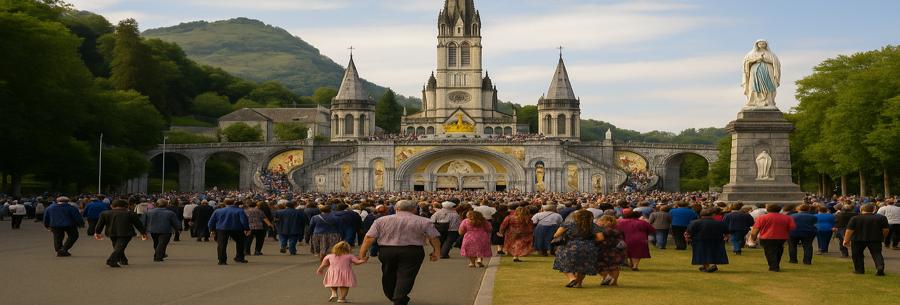
Over time, this annual gathering became structured and took on a national, then international, dimension. Today, it brings together pilgrims from all over France, but also from other European countries, who converge on Lourdes with their caravans, their extended families and the immense joy of finding themselves under the gaze of Mary.
A living, incarnated faith
The faith of Travellers is characterised by great spontaneity, a deep attachment to Marian prayer and total trust in Providence. At Lourdes, these dimensions are vividly manifested.
The pilgrimage is punctuated by highlights:
The Eucharistic procession and the torch-lit Marian procession, in which families participate in large numbers, singing and praying with fervour.
Open-air Masses, celebrated in several languages, where the faithful express their faith through powerful songs, dances and testimonies.
Baptisms and confirmations celebrated during the pilgrimage, which are often particularly moving moments.
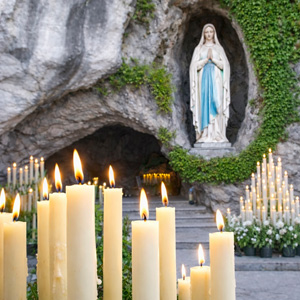
The passage to the grotto at Massabielle remains the heart of the pilgrimage: families come to place their intentions there, pray to the Virgin, ask for healings and entrust their journey.
A community and family dimension
For Travellers, the pilgrimage is not just an individual spiritual time. It is also a community and family event. At Lourdes, families meet up in their hundreds, renewing ties between clans and generations, and sharing moments of celebration and conviviality.
The gathering sometimes takes on the appearance of a giant camp, where caravans park together, giving Lourdes a unique atmosphere during these special days. The fraternity and solidarity are palpable: meals are shared, songs echo late into the evening, and the joy of being together mingles with religious fervour.
A Church that welcomes and accompanies
The Traveller pilgrimage is also an opportunity for the Church to demonstrate its universal welcome. The shrine chaplains, as well as many priests and deacons from the communities themselves, accompany the pilgrims in their faith journey.
This high point is also a way of recognising the spiritual richness of the Travellers, their fidelity to prayer, their attachment to the Virgin Mary and their ability to bear witness to Christian hope despite the difficulties of their often precarious lifestyle.
Lourdes, a land of encounters and fraternity
Beyond their own community, the pilgrimage for Travellers is also an opportunity to meet other pilgrims from all over the world. Lourdes becomes a place where social and cultural barriers are broken down, where everyone is welcomed as a brother or sister. This experience of universal brotherhood perfectly illustrates the message of Lourdes: a place of welcome for all, without distinction.
Conclusion
The pilgrimage of Travellers to Lourdes is one of the most beautiful testimonies to the diversity and universality of the Church. In their songs, their prayers and their joyful way of living the faith, the Travellers remind all Christians of the importance of a faith that is incarnate, simple and trusting. Every year, by coming to Lourdes to put themselves in the school of Mary, they give back to the Church a taste for fraternity and the joy of the Gospel.