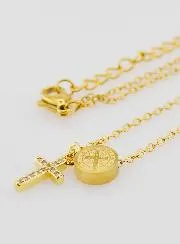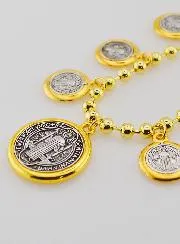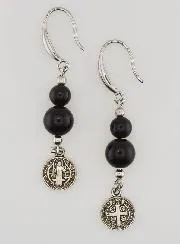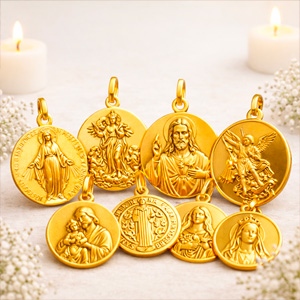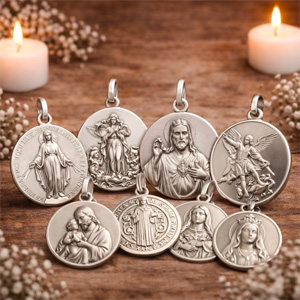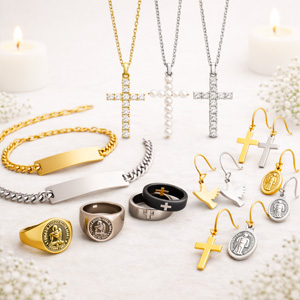
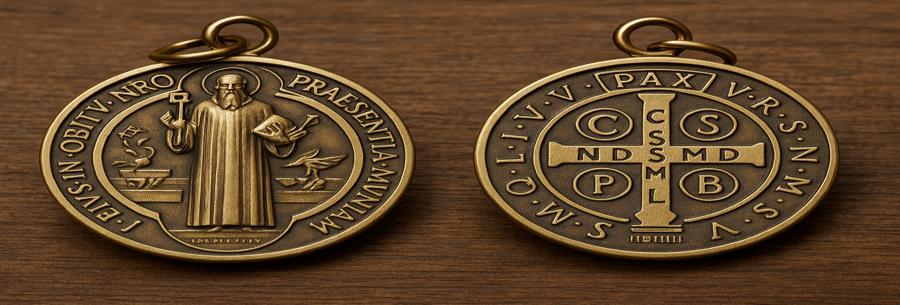
The medal of Saint Benedict is one of the most powerful and meaningful sacramentals in the Catholic tradition. At once a sign of faith, spiritual protection and personal commitment against evil, it has been worn and venerated for centuries by Christians all over the world. But what exactly does it represent? What is its origin? What do the letters engraved on its two sides mean? And how should it be used to receive its spiritual fruits? This text explores in depth the history, symbolism and practice associated with this medal unlike any other.
Origin of the Saint Benedict medal
The use of a medal associated with Saint Benedict of Nursia (480-547), founder of the Benedictine Order, goes back to an ancient tradition, but its current form became clearer during the 17th century.
In 1647, near the Benedictine abbey of Metten in Bavaria, some young people were accused of witchcraft. At their trial, they mentioned the use of a medal that they said was ineffective for evil rituals. Intrigued, the monks searched the abbey and discovered ancient frescoes depicting Saint Benedict holding a cross and mysterious inscriptions. These letters corresponded to the initials of a Latin prayer for protection. It was then understood that this was an ancient protective sacramental, based on the invocation of the saint and the power of the cross of Christ.
The medal was therefore restored, authenticated and distributed by the Benedictines, with the approval of the Church. In 1742, Pope Benedict XIV gave his official blessing to its use, and the medal of Saint Benedict became one of the most widespread sacramentals in the Catholic Church.
Description of the medal: a profound symbolic richness
The medal of Saint Benedict is loaded with signs, letters and images that express a veritable condensed exorcism, a permanent prayer for protection and fidelity to Christ, inspired by Benedictine spirituality.
The front of the medal
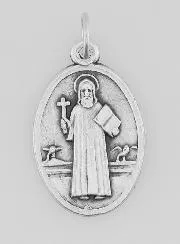
Saint Benedict is shown front-on, often depicted in monastic garb, holding:
In his right hand, a high cross, the symbol of faith victorious over evil.
In his left hand, a book, representing the Rule of Saint Benedict, the basis of Benedictine life.
At his feet: on the left a broken cup, and on the right a raven. These two elements refer to miraculous episodes in his life:
The raven carrying away a poisoned loaf of bread intended to kill him.
The cup broken by the sign of the cross even though it contained poisoned wine.
Around the saint, the Latin inscription:
Eius in obitu nostro praesentia muniamur
"May his presence protect us at the hour of our death"
A prayer of trust in Saint Benedict's intercession at the supreme moment.
The reverse of the medal
This is where the famous initials are found, which make up a veritable exorcism prayer:
In the centre:
A cross bearing the letters:
C.S.S.M.L.: Crux Sacra Sit Mihi Lux
(May the Holy Cross be my light)
N.D.S.M.D. : Non Draco Sit Mihi Dux
(May the devil not be my guide)
Around the cross, in the circle:
V.R.S. : Vade Retro Satana
(Behind Satan)
N.S.M.V. : Numquam Suade Mihi Vana
(Never suggest your vanities to me)
S.M.Q.L. : Sunt Mala Quae Libas
(What you offer me is evil)
I.V.B. : Ipse Venena Bibas
(Drink your own poison)
Finally, on the periphery of the medal, the letters:
PAX (Peace) or sometimes IHS (Name of Jesus), depending on the version.
These powerful formulas constitute a prayer of renunciation of the devil and temptations, in faith in the cross of Christ and under the protection of Saint Benedict.
Why is the medal of Saint Benedict a spiritual protection?
The medal has no magical powers. It is a visible sign of an invisible reality, like all sacramentals. Its power comes from several spiritual elements:
The believer's faith: it is faith placed in Jesus Christ and in the intercession of the saints that acts.
The Church's blessing: the medal must be blessed according to a specific ritual (with an exorcism prayer) to transmit all its graces.
Union with the cross of Christ: all the inscriptions revolve around the cross, the centre of victory over evil.
The protection of Saint Benedict: his name is invoked as an intercessor against attacks by the Evil One.
It is therefore used against:
Demonic influences
Serious temptations
Spiritual dangers (blasphemy, impure thoughts, despair...)
Occult curses and spells
Unexplained illnesses or disorders
Oppressive or spiritually charged places
How to use the Saint Benedict medal?
To benefit from the protection and graces attached to the medal, here are the recommended practices:
1. Have it blessed by a priest
The blessing of this medal follows a particular ritual, often longer than a simple blessing of an object. It contains a prayer of exorcism and a special invocation to Saint Benedict. It should not be blessed lightly.
2. Wear it with faith
It can be worn around the neck, slipped into the pocket, hung in the car, carried in the bag, or placed under the pillow. It should be a constant reminder of the covenant with Christ, not just a decorative object.
3. Use it in prayer
You can recite the associated prayers, meditate on the inscriptions, invoke Saint Benedict in times of trial or temptation. It is also used in prayers of deliverance, as a complement to the sacraments.
4. Place it in places to be sanctified
It is common to fix one on the front doors of a house, to place one in a garden, or in places where you feel spiritual tension. It acts as a spiritual shield and an invitation to peace.
A path to inner peace
The Saint Benedict medal is an instrument of peace, light and spiritual combat. It does not replace prayer, confession or the Eucharist, but helps to strengthen faith and place oneself under God's protection, through the intercession of a great saint.
It is the sign of a commitment to live according to the Gospel, to reject evil in all its forms, and to walk each day in the light of Christ. Saint Benedict, through this medal, watches over souls seeking truth and spiritual freedom.
"May the Holy Cross be my light,
and may the devil never be my guide."
Amen.