Our Lady of Mount Carmel is one of the oldest and richest titles of the Virgin Mary, deeply rooted in biblical tradition and Christian spirituality. Mount Carmel is a mountain range in the Holy Land, in the north of Israel, overlooking the Mediterranean Sea. It is famous in the Old Testament as the place of the prophet Elijah, a man of fire and fidelity, who confronted the prophets of Baal to bring the people back to the worship of the one God (1 Kings 18). It was in this spirit of spiritual combat, fervent prayer and secluded living that Carmel became a place of pilgrimage and contemplation.
The birth of the Order of Carmel
In the 13th century, Christian hermits, inspired by the figure of Elijah and their devotion to the Virgin Mary, settled on Mount Carmel to lead a life of prayer, solitude and penance. It is to them that we owe the birth of the Order of Carmel, whose spirituality rests on two pillars: the imitation of the Virgin Mary and the quest for union with God in the silence of the heart.
Mary is honoured there as the "Queen and Beauty of Carmel". She is the model of the interior life, docility to the Holy Spirit and pure contemplation. The Carmelite hermits soon consecrated their chapels to her, and the entire order placed itself under her special protection. The feast of Our Lady of Mount Carmel, fixed for 16 July, recalls the recognition of this spiritual motherhood, and celebrates her role in the lives of all those who seek to follow Christ in a path of fidelity, humility and prayer.
The Carmel scapular: a sign of grace
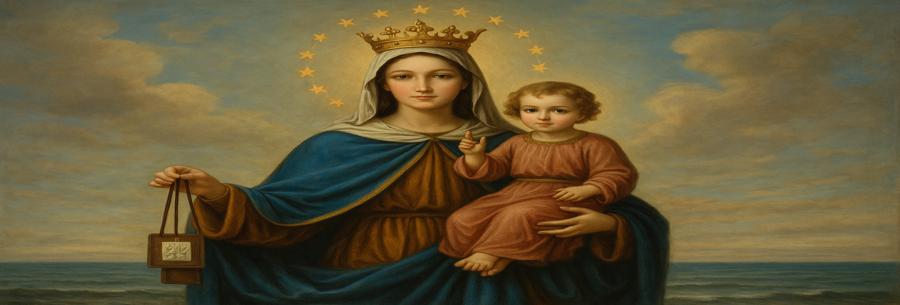
One of the best-known elements of devotion to Our Lady of Mount Carmel is the brown scapular. It originated in a Marian apparition to the Carmelite saint Simon Stock, in England, in 1251. The Virgin appeared to him holding a scapular - a piece of cloth worn over the chest and back - and said:
"This is the sign of my covenant with you and yours. Whoever dies clothed in this scapular will not suffer eternal flames."
This scapular has become a powerful symbol of spiritual protection, commitment to Mary and the promise of salvation. It is not a magical talisman, but a visible sign of an inner covenant: whoever wears it commits to live as a child of God, to practise prayer, chastity according to their state in life, and to honour the Virgin Mary.
Popular piety has widely spread this devotion, and successive popes have encouraged the faithful to wear the scapular with faith, trust and fidelity.
Mary, Mother and guide of contemplative souls
Our Lady of Mount Carmel is venerated throughout the world as the patroness of contemplatives and all those who wish to unite themselves with God in interior prayer. She is the Mother of Carmelites and Carmelites, but also of all lay people united to their spirituality. Great mystical figures such as Saint Teresa of Avila, Saint John of the Cross, Saint Teresa of Lisieux and Saint Elizabeth of the Trinity lived in the light of Carmel, at the school of Mary.
In this tradition, Mary is not just a moral model or a distant figure: she is a maternal Presence, gentle and strong, who guides souls to the heights of divine union. She teaches faithful hearts to stand in silence, to listen to the Word, to suffer in secret and to love without return.
A feast of light in the heart of summer
Celebrated every 16 July, the feast of Our Lady of Mount Carmel is a special occasion for Christians to renew their trust in Mary. In certain regions, particularly in Spain, Italy and Latin America, processions, novenas and blessings of the sea are organised, so closely is her figure associated with protection and peace.
She is invoked by sailors, fishermen, travellers, but also by all those going through inner storms. Her protective mantle symbolises the tenderness of God, who never tires of drawing His children to Himself. Her feast day is a reminder that, in a noisy, hectic world, it is still possible to retreat to the "grotto of the heart" to rediscover the silence of God, with Mary as our guide.