The foundation: Saint Peter, the first pope
According to Catholic tradition, the history of the popes begins with Saint Peter, one of Christ's twelve apostles. Jesus entrusted him with the mission of "feeding his sheep" (John 21:15-17) and declared: "You are Peter, and on this rock I will build my Church" (Matthew 16:18). Peter thus became the first bishop of Rome and the visible head of the Church. He died a martyr around 64 AD in Rome, crucified upside down on Vatican Hill. His tomb lies beneath St Peter's Basilica.
The popes of the first centuries (1st - 4th century): from martyrs to defenders of the faith
After Peter, the first popes such as Linus, Clement I, Sixtus I and Pius I (died around 155) continued his work against a backdrop of persecution. Many died as martyrs for their faith. They ensured the faithful transmission of the Gospel and the unity of the Church in the face of the first heresies.
Among them, Saint Clement I (pope from 88 to 97), author of an important letter to the Church of Corinth, embodied an authority already recognised by Rome. Saint Victor I (circa 189-199) was the first African pope and attempted to unify the date of Easter.
With the Emperor Constantine and the Edict of Milan (313), Christianity became a tolerated, and then favoured, religion. Pope Sylvester I (314-335) was then at the heart of a historic turning point, although he himself did not take part in the Council of Nicaea (325), which defined the divinity of Christ in the face of Arianism.
The Age of the Great Doctors and the Fall of Rome (5th - 8th centuries)
Pope Leo I, known as Leo the Great (440-461), strongly marked this period. He affirmed the primacy of the Bishop of Rome over the other Churches, defended the Catholic faith against heresies, and met Attila to dissuade him from attacking Rome.
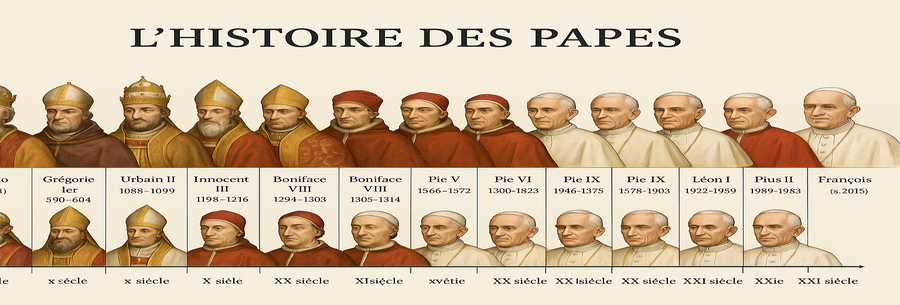
Pope Gregory I, known as Gregory the Great (590-604), was another spiritual giant. A former prefect of Rome who became a monk, he reformed the liturgy (Gregorian chant), organised missions (notably in England with Saint Augustine of Canterbury), and made himself the "servant of the servants of God".
In a West in the midst of political decay, popes also became figures of stability. They were sometimes in conflict with the Byzantine Empire, especially around monothelitism, until the papacy emancipated itself from imperial influence.
The Middle Ages and the assertion of papal power (9th - 13th centuries)
The Carolingian era saw a growing alliance between the papacy and the Frankish kings. In 800, Pope Leo III crowned Charlemagne emperor, establishing the Holy Roman Germanic Empire.
But the 10th century, often referred to as the "Iron Age", saw popes subject to the influence of powerful Roman families. The Gregorian reform, led by Pope Gregory VII (1073-1085), reaffirmed the independence of the Church and the celibacy of priests. He fiercely opposed Emperor Henry IV in the Investiture Quarrel.
Pope Urban II (1088-1099) preached the First Crusade at the Council of Clermont in 1095. Subsequent popes played a central role in medieval Christendom, sometimes more spiritual (Innocent III, 1198-1216, who convened the Fourth Lateran Council), sometimes very political (Boniface VIII, 1294-1303).
The crisis of the Church: Avignon and the Great Schism (14th - 15th centuries)
From 1309 to 1377, the popes resided in Avignon, France, under the influence of the French kings. This was the "Babylonian captivity" of the papacy. Gregory XI's return to Rome in 1377 did not end the crisis, as the election of two, then three rival popes caused a schism that divided Christendom.
The Council of Constance (1414-1418) put an end to the schism by electing Martin V as the only legitimate pope.
Renaissance and reforms (15th - 16th centuries)
Renaissance popes such as Nicholas V, Julius II and Leo X were often great patrons of the arts, supporting the arts and the construction of St Peter's Basilica. But they were also criticised for their worldly lifestyles.
Luther published his 95 theses in 1517. Pope Leo X condemned the Protestant Reformation, but too late. The Council of Trent (1545-1563), under Paul III, Julius III and Pius IV, thoroughly reformed the Church: training of priests, liturgy, catechism, etc.
Saint Pius V (1566-1572) rigorously applied these reforms and instituted the feast of Our Lady of the Rosary after the victory of Lepanto (1571).
The Church in modern times (17th-19th centuries)
In an increasingly secular world, the popes had to assert their spiritual authority while losing their temporal power. Pius VI and Pius VII were confronted with the French Revolution and Napoleon. The latter even had the Pope imprisoned.
In 1870, the First Vatican Council (under Pius IX) defined the dogma of papal infallibility. That same year, Rome was annexed to the Kingdom of Italy, and the Pope lost the Papal States.
Leon XIII (1878-1903) was a great intellectual and wrote the encyclical Rerum Novarum, founding the Church's social doctrine.
The 20th century: crises, councils and opening up to the world
Pius XI and Pius XII were confronted with totalitarianism. Pius XII (1939-1958), Pope during the Second World War, remains a controversial figure for his apparent silence on the Shoah, although studies highlight his discreet actions.
John XXIII (1958-1963) convened the Second Vatican Council (1962-1965), a major turning point: reform of the liturgy, openness to ecumenical dialogue, emphasis on the Church as the "people of God".
Paul VI, John Paul I (33 days as pontiff) and above all John Paul II (1978-2005) continued this work. John Paul II, the first non-Italian pope for centuries, left his mark on history through his fight against communism, his extensive travels and his profound spirituality.
The 21st century: continuity and contemporary challenges
Benedict XVI (2005-2013), a German theologian, renounced the pontificate in 2013, an event unseen since the Middle Ages. Francis, elected in 2013, became the first Jesuit pope, the first in Latin America and chose the name of the "poor man of Assisi".
His pontificate was marked by a desire to reform the Curia, attention to the poor and the environment (encyclical Laudato si'), and efforts towards synodality, i.e. a Church more attuned to the people of God.
The history of the popes is a living fresco, two thousand years long, mixing spiritual greatness, human conflicts, reforms and fidelity. Each pope, with his strengths and limitations, is the bearer of the mission entrusted to Peter: to guard the unity of the faith and lead the Church to Christ. Beyond the controversies, the papacy remains a central pillar of the Catholic Church, the guarantor of its memory, its faith and its hope in history.