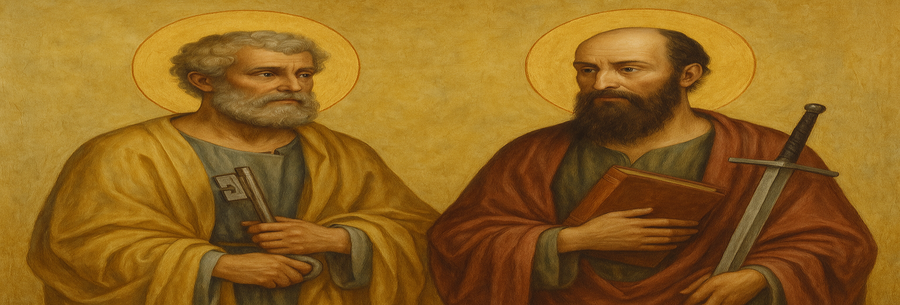
St Peter and St Paul are two major figures in Christianity, considered to be the pillars of the nascent Church. Their lives, mission and martyrdom have profoundly marked Christian history and continue to inspire believers down the centuries.
St Peter, the rock of the Church
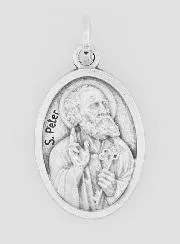
Born as Simon, St Peter was a simple fisherman from Galilee when he met Jesus. Jesus chose him as one of his first disciples and gave him the name Peter, which means "rock", saying to him: "You are Peter, and on this rock I will build my Church" (Matthew 16:18). Peter witnessed the great moments of Christ's life: the Transfiguration, the Last Supper, Jesus' arrest, and also his resurrection. Although he denied Jesus three times out of fear during the Passion, he received his Master's forgiveness and became one of the main witnesses to the resurrection.
After Pentecost, Peter became the head of the Christian community in Jerusalem. He proclaimed the Gospel powerfully, performed healings and faced persecution. He is also credited with evangelising various regions, including Antioch and Rome. It was in the latter city that he was arrested and sentenced to death under Emperor Nero. Out of humility, Peter asked to be crucified upside down, not deeming himself worthy to die like Christ.
Saint Paul, the apostle to the nations
Paul, for his part, was called Saul before his conversion. He was a very zealous Pharisee, known for persecuting the early Christians. But one day, on the road to Damascus, he had a vision of the risen Christ that turned his life upside down. From persecutor he became an apostle. Paul then changed his name and embarked on a tireless mission of evangelisation throughout the Roman Empire.
St Paul is often nicknamed "the apostle to the Gentiles", because he took the Good News beyond the Jewish people, addressing Greeks, Romans and all those who did not yet know the God of Jesus Christ. He founded many Christian communities and kept up a regular correspondence with them, many of whose letters became New Testament epistles. A man of great intelligence and ardent faith, he passionately defended the idea that faith in Christ was enough to be saved, without the need to follow all the Jewish prescriptions.
Like Peter, Paul ended his life in Rome, where he was imprisoned several times before being beheaded, again under the reign of Nero. His martyrdom, like Peter's, sealed his witness and his fidelity to Christ to the end.
Two complementary missions
Peter and Paul did not always agree, particularly on the place of pagans in the Church, but their differences enriched the Christian message. Peter represents stability, continuity and institution, while Paul embodies movement, openness and the spreading of the message. Together, they symbolise the unity of the Church, founded on both apostolic tradition and missionary drive.
This is why the Church celebrates them together on 29 June, the day of their joint martyrdom in Rome. Their relics are kept in two major basilicas: St Peter's in the Vatican and St Paul's Outside the Walls. They are venerated not only as saints, but also as founders of the Christian faith.
Their lives and their example remind us that the path to God is sometimes made up of weaknesses, inner struggles, profound conversions and courageous fidelity. Peter and Paul, so different in their journeys, were each able to respond to Christ's call with generosity, daring and humility.