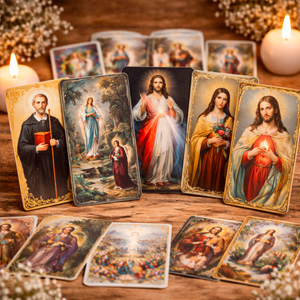
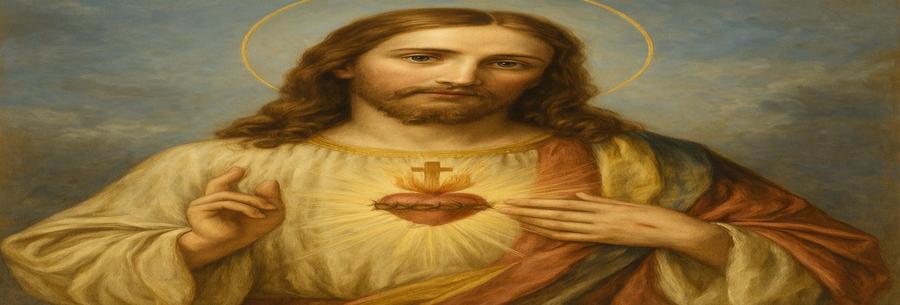
Devotion to the Sacred Heart of Jesus is one of the richest and most fruitful spiritual currents in the history of the Catholic Church. It has its roots in Revelation itself, finds its development over the centuries in mystical texts, the visions of saints and the prayer of the Church, and today blossoms into a living spirituality centred on the merciful love of Christ. This devotion is not simply a popular tradition: it is a response to the burning call of the Heart of Jesus, which wants to reach every human being and transform them.
Biblical and theological foundations
From the Gospels onwards, Jesus' heart appears as the deepest place of his love. He weeps over Jerusalem, is moved with compassion for the crowds, welcomes sinners and forgives without measure. But it is above all at the moment of his Passion that this heart literally opens up, pierced by the spear of a Roman soldier: "One of the soldiers pierced his side with his spear, and immediately there came out blood and water" (John 19:34). This passage, full of symbolism, was meditated on by the Fathers of the Church as the sign of the opening of Christ's heart, from which the sacraments and the Church itself are born. Saint Augustine, Saint John Chrysostom and Saint Bernard evoke this heart as the source of life and love.
Medieval theology was enriched by this intuition. Saint Bonaventure and Saint Thomas Aquinas, among others, speak of the heart of Jesus as the centre of his being, the seat of his divine and human love. But devotion to the Sacred Heart as such would gradually take shape, driven by affective prayer and mystical contemplation.
The precursors: a slow maturation
As early as the eleventh and twelfth centuries, some mystics began to focus on the heart of Christ in their prayer. Saint Gertrude of Helfta (1256-1302), a German Benedictine nun, received visions in which Jesus showed her his heart as a sanctuary of love. She spoke of it with a new tenderness, as an intimate and burning refuge. Her sister Saint Mechtilde of Hackeborn also expressed this same sensitivity in her writings.
In the 17th century, at the height of the Baroque period marked by contrasts between rigorist Jansenism and affective spirituality, this devotion found a more structured expression with Saint John Eudes. This French priest (1601-1680) was the first to promote a liturgy in honour of the Heart of Jesus (and also the Heart of Mary), convinced that devotion to the inner feelings of Christ was a source of conversion and union with God. He composed offices, wrote a spiritual treatise and celebrated the first liturgical feast of the Sacred Heart in 1672, well before it was officially recognised by Rome.
The apparitions to Saint Marguerite-Marie Alacoque
The decisive event that gave this devotion its definitive form took place at Paray-le-Monial, in Burgundy, where a Visitation nun, Marguerite-Marie Alacoque (1647-1690), received several apparitions of Christ between 1673 and 1675. Jesus showed her his Heart inflamed with love for humanity, but also wounded by the ingratitude and indifference of men, particularly those consecrated to him.
Among the messages entrusted to him, several requests have left a profound mark on Catholic spirituality:
Personal and community consecration to the Sacred Heart.
The establishment of a specific liturgical feast on the Friday after the octave of Corpus Christi (today the 3rd Friday after Pentecost).
The practice of the first nine Fridays of the month with confession, Mass and Communion in reparation.
The Holy Hour on Thursday evenings, in union with Christ's agony in Gethsemane.
Marguerite-Marie, supported by her confessor Saint Claude La Colombière, made these revelations known despite resistance. She died in oblivion, but her writings and popular fervour led to the growth of this devotion.
Recognition by the Church and worldwide dissemination
In 1765, Pope Clement XIII authorised the liturgical celebration of the Sacred Heart in France. A century later, Pope Pius IX extended it to the whole Church. It was Leo XIII who marked a turning point, solemnly consecrating the human race to the Sacred Heart in 1899, following the request of the Blessed Jesuit R.P. Ramière and the Italian mystic Mary of the Divine Heart.
Over the course of the 19th and 20th centuries, devotion spread throughout the world. Churches, shrines, parishes and religious orders placed themselves under this patronage. The Sacred Heart became a spiritual emblem, but also a political one in certain contexts (as in France after the Commune, with the construction of the Sacré-Cœur de Montmartre). Apostolic movements, such as the Apostleship of Prayer, worked to spread it in families, schools and missions.
A message for our time
Devotion to the Sacred Heart remains highly topical today. It is not simply an ancient or sentimental piety. It is a reminder that God has a heart, a heart wounded by our indifference but always open to welcome us. It is an invitation to mercy, to reparation, to trust. It proposes a spirituality centred on the love of Jesus Christ, who became vulnerable in order to save us.
Pope Francis, in line with his predecessors, continues to highlight this source of mercy that is the Heart of Christ. In a wounded, fractured world, saturated with noise and fear, the Sacred Heart reminds us that the centre of the Christian faith is not an idea, but a loving person. And this person is waiting for us, with an open heart.