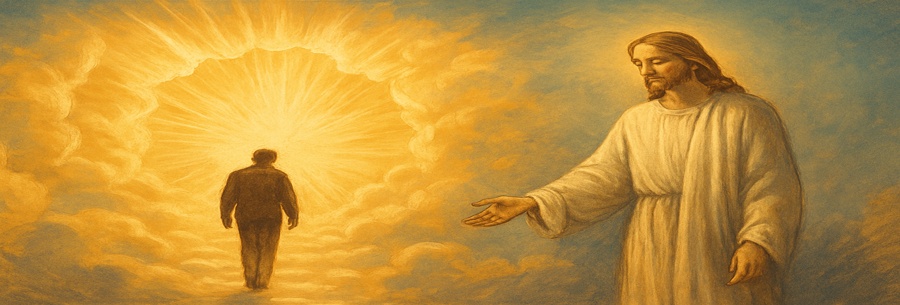
A universal and profound question
The question of what happens after death cuts across all cultures, all eras, all souls. What becomes of us? Where do we go? Is it the end of everything or the beginning of something else? For the Christian faith, death is not an end point, but a passage, a mysterious threshold beyond which a new life begins.
But this Christian hope is not vague or uncertain. It is based on the Word of God, on Christ's resurrection, and on the promise of a love that never fades.
Death, the consequence of sin, but not the end
According to the Bible, death entered the world through sin. It was not in God's original plan. Man was created for life, for eternal communion with his Creator. But the rupture introduced by sin also introduced suffering, separation and physical death. Yet even this death cannot prevent God from fulfilling his loving plan.
The Christian faith affirms that Jesus Christ conquered death through his resurrection. He is "the first fruits of those who have died" (1 Corinthians 15:20). In Him, death is transformed: it is no longer a wall, but a door.
The soul does not die
A human being, according to Christian tradition, is body and soul. At death, the body returns to dust, but the soul remains. It enters a special phase, awaiting the final resurrection. This is what is called "life after death" in its spiritual sense.
At this point, the soul stands before God. This face-to-face is called the "particular judgment". It is not a tribunal in the human way, but a meeting of truth and light. There, each person sees his or her life in the light of love. It is not God who condemns: it is man himself who accepts or rejects God's love.
Heaven, purgatory, hell: what do Christians say?
The Church teaches three possible outcomes after death:
Heaven: this is perfect communion with God. Those who die in a state of grace, purified, in friendship with God, enter into eternal joy. It is not a place, but a state of complete union with infinite Love.
Purgatory: for those who die in a state of grace but still imperfect, wounded by sin, there is a time of purification. It is a fire of love, preparing for the vision of God. It is a sign of divine mercy.
Hell: it is the total and definitive refusal of love. God does not condemn anyone to Hell. But man can freely refuse God to the very end. Hell is this eternal no to love, this absolute rejection.
These realities should not frighten, but awaken our conscience and invite us to live in the light today.
The final resurrection: a glorious body
The Church also teaches that salvation does not concern the soul alone, but the whole being, including the body. At the end of time, when Christ returns in glory, all the dead will rise. Each will receive a glorious, transfigured body, in the image of Jesus' resurrected body.
This final resurrection will mark the fullness of the Kingdom, when God will be "all in all" (1 Corinthians 15:28), and every tear will be wiped away.
Living now as resurrected people
Believing in life after death is not running away from the present: it is living with hope. It means knowing that our suffering, our struggles and our bereavements are not in vain. It means living each day in the light of eternity.
Love given, faith choices made, acts of charity, forgiveness offered have a value that transcends time. By living according to the Gospel, we prepare our hearts for this decisive encounter with Christ.
Prayer: Lord, teach me to live with eternity in mind
Lord Jesus,
You died and rose again for me.
You have conquered death, and You go before me into the light.
I do not know what awaits me beyond the veil,
but I know that You will be there.
Help me to live each day
as a step towards You.
To love without waiting,
to forgive unconditionally,
to seek the truth,
to open myself to Thy mercy.
When the hour of my death comes,
may I not be afraid,
but filled with confidence,
like a child coming home.
Prepare my heart to meet You.
And give me the grace to hope
for those I love who are gone.
For in You, death is conquered,
and life is eternal.
Amen.