The Feast of the Holy Trinity, also known as the Solemnity of the Most Holy Trinity, is a major celebration in the Christian liturgical calendar. It honours the central mystery of the Christian faith: the unity of one God in three distinct persons - the Father, the Son and the Holy Spirit. This feast, which occurs on the Sunday following Pentecost, closes the cycle of Eastertide and opens the period of Ordinary Time in the Catholic liturgical year.
Historical origins of the feast
Unlike other Christian feasts such as Christmas or Easter, the Holy Trinity does not commemorate a specific event in the life of Jesus or in salvation history. Rather, it is a doctrinal feast, intended to celebrate and deepen a fundamental theological mystery.
Trinitarian devotion is present from the very beginnings of Christianity, as witnessed by the baptismal formulae ("in the name of the Father, the Son and the Holy Spirit") in the Gospels (cf. Matthew 28:19). However, the liturgical feast itself appeared later, from the 8th century onwards in certain regions of Europe, notably France and Spain.
It was Pope John XXII who, in the 14th century, officially instituted this feast for the entire Latin Church. His aim was to underline the orthodox faith in the face of certain heresies, and to encourage a unified veneration of the Trinitarian mystery.
The mystery of the Trinity: theological explanation
The dogma of the Holy Trinity teaches that:
There is one God in three distinct but consubstantial and co-eternal persons:
The Father, source of all things, creator of heaven and earth.
The Son, eternally begotten by the Father, incarnate in Jesus Christ, redeemer of the world.
The Holy Spirit, proceeding from the Father (and the Son according to Western theology), animator of the Church and sanctifier.
This mystery is beyond human reason, but it is at the heart of the Christian faith. It is not a question of believing in three gods (that would be polytheism), but in one God in three modes of relationship. Saint Augustine, in his work De Trinitate, compares this relationship to human thought: memory, intelligence and will - three different faculties but inseparable in the unity of the mind.
Liturgy and celebration
Trinity Sunday is marked by a liturgy focused on the glory of God in his Trinitarian mystery. The readings focus on:
God as Creator and Almighty (reading from the Old Testament),
The revelation of Jesus as Son of God (reading from the New Testament),
The active presence of the Spirit in the Church (often in the Gospel or Acts).
The Glory be to God, the Alleluia, and the Creed take on particular importance, as they openly proclaim the Trinitarian faith. Many liturgical hymns, such as the Sanctus or the Te Deum, resound with praise for the Trinity.
In some traditions, the Creed is recited or sung with solemnity, recalling the Church's faith in this mystery. The faithful may also be blessed "in the name of the Father, the Son and the Holy Spirit" with emphasis.
Symbols and representations of the Trinity
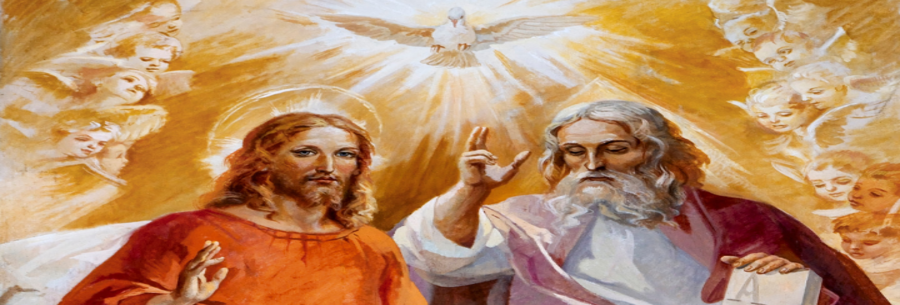
Christian art has often attempted to represent this mystery using symbols:
The equilateral triangle: representing the equality of the three persons.
The shamrock (notably used by Saint Patrick to explain the Trinity in Ireland).
Three intertwined circles or three faces in one body.
Famous Trinitarian icons, such as Rublev's icon of the Trinity (15th century), which depicts three angels around a table.
These representations are not intended to explain the mystery, but to aid contemplation.
Spiritual importance of the Holy Trinity
The Trinity is not just an abstract theological concept, but a living reality at the heart of Christian life:
Christians are baptised in the name of the Trinity.
He often prays through Trinitarian formulas (e.g. "Glory be to the Father, the Son, and the Holy Spirit...").
The Eucharist itself is an action of Christ within the Church animated by the Spirit, towards the Father.
The Trinity is also a model of unity in diversity, a communion of love. As such, it inspires community life, fraternity and charity among men.
Conclusion
The feast of the Holy Trinity is an invitation to contemplate the very heart of God. It reminds us that God is not solitude, but a relationship of eternal love between the Father, the Son and the Spirit. To celebrate the Trinity is therefore to celebrate pure love, perfect communion, and the call addressed to every Christian to participate in it.