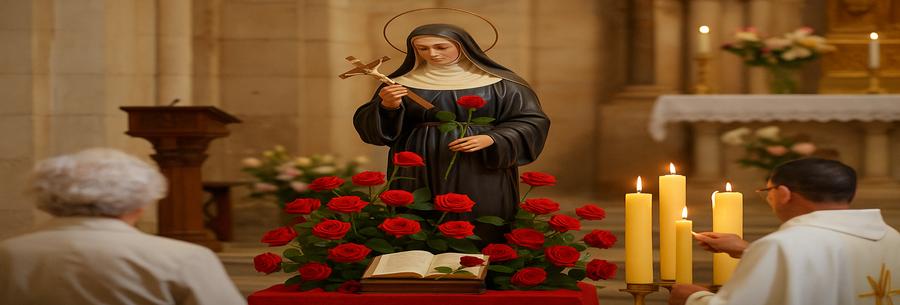
Every year on 22 May, millions of faithful around the world gather to celebrate the feast of Saint Rita of Cascia, one of Catholicism's most beloved saints. Known as the patron saint of hopeless causes and impossible cases, Saint Rita has a profound effect on those who are experiencing hardship, pain or hopeless situations. Her feast is much more than a simple liturgical commemoration: it's a time of hope, recollection, intense prayer and testimonies of faith.
A date set on the day of her death
The feast of Saint Rita is celebrated on 22 May, the anniversary of her death in 1457, in Cascia, Umbria (Italy). This choice is in keeping with the Christian tradition that sees the death of a saint as his or her "birth in heaven", i.e. the moment when he or she enters the glory of God. This day is therefore experienced as a rendezvous between the saint and those who invoke her, a passage between earth and heaven, a strong spiritual bond that is renewed year after year.
Celebrations all over the world
The feast of Saint Rita is not limited to Cascia, although this city becomes a central place of pilgrimage on this occasion. Throngs of pilgrims flock to her shrine to attend masses, venerate her relics, pray and entrust their intentions. On 22 May, a grand procession passes through the streets of Cascia, with blessed roses carried by the faithful, a symbol of the saint's miracles and tenderness.
All over the world, churches, chapels, parishes and communities organise novenas, special Masses and times of prayer in honour of Saint Rita. In France, Italy, Spain, Brazil, the Philippines and French-speaking Africa, this day brings together believers and families in a common surge of faith.
Rites specific to the feast: blessing of roses and candles
One of the most emblematic rites of the feast of Saint Rita is the blessing of roses. This tradition commemorates the miracle of the rose that occurred shortly before her death: in the middle of winter, when nature was asleep, a rose bloomed in her childhood garden, fulfilling her last wish. Since then, the rose has become the sign par excellence of the saint's intercession. On 22 May, the faithful bring roses to church to be blessed. They then keep them at home as a symbol of protection, hope and answered prayer.
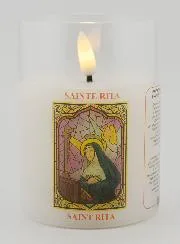
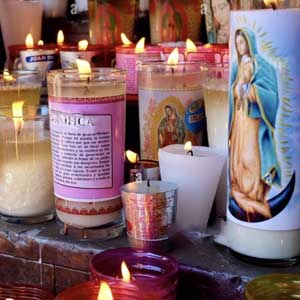
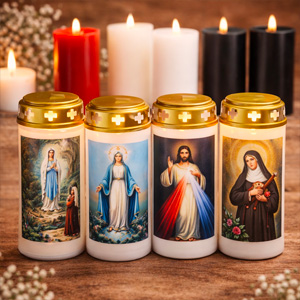
The candles blessed on this occasion also carry a strong symbolism. They recall the light of faith that Saint Rita was able to keep in the darkness of trial, and are often lit during the year at difficult times to rekindle hope.
The preparatory novena: a spiritual journey
The nine days preceding the feast are devoted to a novena, a form of prayer repeated every day to prepare oneself inwardly for the feast. The novena to Saint Rita is often very popular, as it allows the faithful to express their deepest distress, their requests for healing, peace, reconciliation or consolation. Each day, a meditation is proposed, centred on an aspect of Saint Rita's life: patience, faith, charity, forgiveness, union with the Cross... This spiritual journey is a way of uniting oneself more intimately with the saint and entrusting the most difficult intentions to her with confidence.
A high point of popular faith
What profoundly marks the feast of Saint Rita is its roots in popular faith. She touches people from all walks of life, including non-practising people or people far removed from the Church, who find in her an accessible, human, compassionate saint. In hospitals, prisons, retirement homes and hostels, prayers are raised to Saint Rita on this special day. She becomes a light in the night, a listening ear, a silent ally.
A feast turned towards hope
To celebrate Saint Rita is to celebrate hope in the darkest of human situations. It's a reminder that God can still act when all seems lost. It's about affirming that faith, lived in simplicity and perseverance, can transform trials into paths of grace. This day of 22 May then becomes a great spiritual breath for so many tired, wounded, desperate people... who find in Saint Rita a spiritual mother, a sister in the faith, a friend from Heaven.
The feast of Saint Rita transcends cultural and religious boundaries. It touches the human heart at its most vulnerable: the need to be heard, consoled, guided. Every 22 May, thousands of candles are lit, churches are filled, and hearts are opened to a saint who knew all about human suffering. This day is a reminder that, even in the dead ends, God's love can still blossom - like a rose in winter.