
The baptism of Jesus is a fundamental event in the New Testament, marking the beginning of his public ministry. This deeply symbolic and spiritual act is of great importance for the Christian faith, as it manifests Jesus' humility and his willingness to identify himself fully with humanity. Let's explore the circumstances of this baptism: when it took place, the specific location, and its theological significance.
When was Jesus baptised?
Jesus' baptism probably took place early in his adult life, at the age of about 30. This estimate is based on the Gospel according to Luke (3:23), which indicates that Jesus was about thirty years old when he began his ministry. Although the Gospels do not provide a precise date, the historical and religious context gives us some clues.
At that time, the preaching of John the Baptist, a charismatic prophet, attracted large crowds. John called for repentance and proposed baptism for the forgiveness of sins. His message resonated in a context where many Jews were eagerly awaiting the arrival of the Messiah and seeking to purify themselves in preparation for the Kingdom of God. It was in this context that Jesus presented himself to John, marking a turning point in his life and in the history of salvation.
The event also fits into the context of the Jewish calendar and the religious practices of the time. Although the Gospels do not mention a precise date, some scholars suggest that this moment may have taken place shortly before Passover, a period of renewal and spiritual expectation for the Jews.
Where was Jesus baptised?
Jesus was baptised in the Jordan River, an emblematic river for the Jewish people. The Jordan has a strong biblical and symbolic significance, as it represents both the physical border of the Promised Land and a place of purification. In the Old Testament, the Jordan was crossed by Joshua and the Israelites as they entered Canaan, marking the beginning of a new era for God's people.
The Gospels place this event precisely in the region where John the Baptist ministered. According to the Gospel of John (1:28), it took place in Bethany-beyond-the-Jourdain, a locality east of the river, today identified as Al-Maghtas, in Jordan. This site, recognised by UNESCO as a world heritage site, is considered by many Christians to be the exact location of Jesus' baptism.
However, some accounts and traditions also mention different sites in Israel, near Jericho, where the Jordan flows peacefully. Whatever the case, it is the river itself that is of spiritual significance, as it symbolises purification, transformation and new life.
Why is the baptism of Jesus important?
The baptism of Jesus cannot be understood without considering its theological significance. Although Jesus was sinless, he submitted to a rite intended for those seeking to repent of their sins. This gesture of humility demonstrates that he fully identified with humanity and chose to share our experiences, struggles and sufferings.
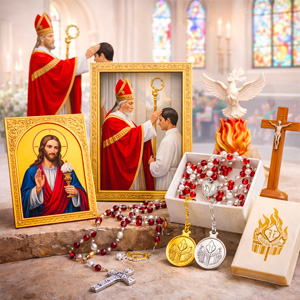
The moment of baptism is also marked by a unique divine manifestation. The Synoptic Gospels (Matthew 3:13-17, Mark 1:9-11, and Luke 3:21-22) report that after being baptised, Jesus came up out of the water and the heavens opened. The Holy Spirit descended upon him in the form of a dove, and a voice from heaven declared, "This is my beloved Son, in whom I am well pleased." This scene is a direct testimony to the Trinity - God the Father, the Son and the Holy Spirit - and a public declaration of Jesus' divine identity.
The baptism also marks the beginning of Jesus' mission. After this event, he begins his public ministry, preaching the Gospel, healing the sick and announcing the coming of the Kingdom of God. Baptism is therefore an inauguration, a moment when Jesus receives the divine anointing and is sent to carry out his redemptive work.
The baptism of Jesus in the Christian faith
For Christians, the baptism of Jesus is rich in teachings and spiritual implications. It reminds us of the importance of humility, obedience to God's will and purification. Christian baptism, practised today in many traditions, has its origins in this event. It symbolises a death to sin and a resurrection to new life in Christ.
Finally, this episode emphasises that Jesus did not begin his ministry with displays of power or grandeur, but with an act of humility, in the simple waters of the Jordan. This example inspires believers to follow his path of service, simplicity and faith.
In conclusion, the baptism of Jesus, although it took place some two thousand years ago, remains an event vibrant with meaning and symbolism for Christians the world over. At Bethany-beyond-the-Jourdain, in the waters of the Jordan, Jesus performed a gesture that continues to resonate in the hearts of believers as a reminder of his love, his humility and his saving mission.