
St John, one of the twelve apostles of Jesus Christ, plays a fundamental role in Christian tradition, both through his closeness to Christ and through his inspired writings. Known as the "Apostle of Love", he is a key witness to the major events of the New Testament and a central figure in Christian theology. His role extends far beyond his own time, profoundly influencing Christian spirituality and faith down the centuries.
The role of privileged witness to Jesus Christ
St John occupies a unique place among the apostles because of his spiritual intimacy with Jesus. He is often presented in the Gospel as "the disciple whom Jesus loved". This expression reflects not only the personal closeness between the two men, but also John's special role as a witness to the most important moments in Jesus' life.
Witness to miracles and teachings: John accompanies Jesus from the very beginning of his ministry. He witnesses miracles such as the wedding feast at Cana, where Jesus turns water into wine, and is present at many of the speeches where Jesus reveals his divine mission.
Presence at key events:
The Transfiguration: Along with Peter and James, John is one of the three apostles chosen to see Jesus transfigured on the mountain, an event that reveals Christ's divine glory.
The Last Supper: At the last supper, John sits very close to Jesus. Here he symbolises the intimate communion between Christ and his disciples.
The Passion: Unlike the other apostles who flee, John remains faithful. He is present at the foot of the Cross with Mary. It was at this point that Jesus entrusted him with his mother, Mary, saying, "Behold your mother" (John 19:27). John accepts this mission and becomes a protector of the Virgin Mary.
First witness to the Resurrection: After the crucifixion, John is among the first to discover the empty tomb. He is described as believing immediately in the Resurrection, even before he fully understood the Scriptures.
The role of writer and theologian
St John is traditionally regarded as the author of several major New Testament texts, which played a decisive role in the development of Christian theology.
The Gospel according to John
John writes a deeply spiritual and theological Gospel, different from the three synoptic Gospels (Matthew, Mark and Luke). His Gospel emphasises the divinity of Jesus and universal themes such as light, life and love. Among the roles of this Gospel:
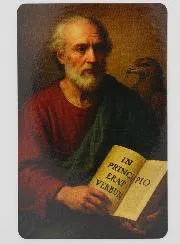
It reveals Jesus as the Son of God and the Incarnate Word ("In the beginning was the Word, and the Word was with God, and the Word was God" - John 1:1).
It emphasises Jesus' role as Saviour and Light of the world, offering eternal life to those who believe.
He presents essential teachings on love, as in Jesus' command, "Love one another as I have loved you" (John 13:34).
The Epistles of John
In his letters, John plays a pastoral role, offering advice and encouragement to the early Christian communities. He stresses crucial themes:
Brotherly love: He reminds us that love is the mark of true disciples of Christ.
Vigilance against false teachings: He warns against heresies that question the divinity of Jesus.
God is love: John proclaims that love is the very essence of God and that living in God means loving others.
The Apocalypse
The Apocalypse, or Book of Revelation, attributed to John, plays a prophetic role in the Bible. This symbolic and mystical text offers a vision of the future, but also a message of hope and faith for persecuted Christians. It reminds us that God will triumph over evil and that faith in Christ brings eternal life.
The role of pastor and spiritual guide
After the death and resurrection of Jesus, John assumed a leadership role in the early Church. According to tradition, he moved to Ephesus, where he guided the first Christian communities. He also played a role in passing on Jesus' teachings to new generations of believers.
Protector of the Virgin Mary: Faithful to the mission entrusted to him by Jesus, John watched over Mary until her death or Assumption, according to tradition.
A model of fidelity: Unlike most of the other apostles, John is said not to have suffered martyrdom. He is regarded as an example of perseverance and dedication to the faith.
4. The role of symbol in Christian tradition
St John is venerated as a model of faithful, loving and contemplative discipleship. He embodies several essential aspects of the Christian life:
Love: He is called the "Apostle of love" for his insistence on this theme in his writings.
Fidelity: Present with Jesus to the end, he is the model of the disciple who remains faithful despite trials.
Mystical contemplation:
His Gospel and visions in the Apocalypse bear witness to his ability to penetrate the divine mysteries.
His traditional symbol is the eagle, representing the height and depth of his theological thoughts.
Conclusion
St John's role goes beyond that of a mere witness or writer. He is a pillar of the Christian faith, a spiritual guide and a model of fidelity and love. Through his writings, he offers believers profound teachings on the nature of God and the importance of love in the Christian life. Throughout the centuries, his message continues to enlighten and inspire Christians the world over, making him a key figure in the Christian tradition.