St Patrick's Day, celebrated on 17 March, is much more than just a festive event. It is a day that brings together faith, tradition, culture and national pride around many powerful symbols. Some have deep religious roots, others are part of Irish popular culture. Together, they weave a universe rich in meaning and history, celebrated today around the world.
The shamrock: symbol of the Trinity
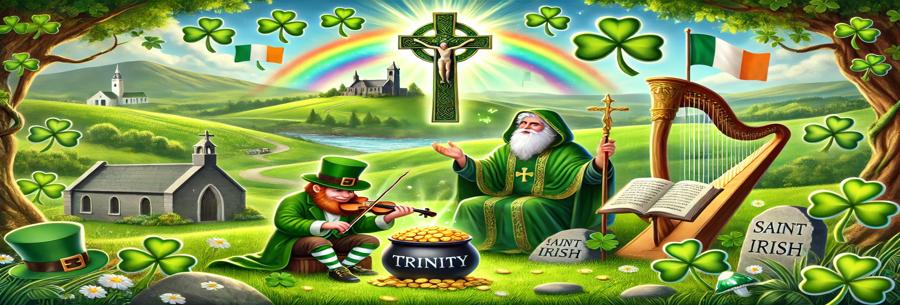
Among the most emblematic symbols of Saint Patrick's Day, the shamrock occupies a central place. It is directly associated with Saint Patrick himself. According to legend, the saint used this little three-leafed plant to explain the mystery of the Holy Trinity - the Father, the Son and the Holy Spirit - to the Irish pagans. Each leaf represented one of the three divine persons, united on the same stem: a simple symbol, but a powerful one.
Over time, the shamrock has become a national emblem of Ireland. Wearing it on St Patrick's Day is both a religious and cultural gesture. It embodies the Christian faith, but also the attachment to Irish identity.
Green: the colour of Ireland and hope
Another unmissable element of St Patrick's Day: green. Streets are decked out in this colour, clothes are dyed green, and even monuments around the world light up in this shade during the celebration. But why green?
First and foremost, green represents the Irish landscape, nicknamed the "Emerald Isle" because of its lush vegetation. It also symbolises renewal, spring and hope. Politically, it became the colour of Irish nationalism in the 19th century. And religiously, it evokes the shamrock, of course, but also life and fertility.
A funny tradition: those who don't wear green on St Patrick's Day can get pinched! This symbolic gesture is a reminder of the importance of being visually associated with the celebration.
The Celtic harp: the voice of ancient Ireland
Less well known than the shamrock, the harp is nevertheless an official symbol of Ireland. It can be found on coins, official documents and even on bottles of Guinness beer. The Celtic harp is associated with traditional Irish music and the country's medieval history.
During St Patrick's Day, we often hear pieces played on the harp, reviving the ancestral spirit of Ireland. This instrument embodies the cultural richness, poetry and depth of the Irish soul.
Snakes: a symbol of eradicating paganism
One of the miracles attributed to Saint Patrick is that he drove all the snakes out of Ireland. Although no species of snake ever really populated the island (according to biologists), this story has strong symbolic significance. The snakes are said to represent ancient pagan beliefs, and their disappearance would be a sign of the victory of Christianity.
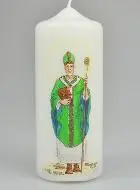
In religious iconography, for example, Saint Patrick is sometimes seen holding a cross or a staff, fending off snakes. This image has survived the centuries as an allegory of spiritual purification.
The Celtic cross: between Christian faith and pagan heritage
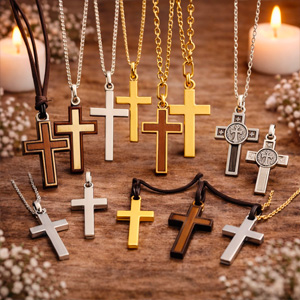
The Celtic cross is another symbol often found during St Patrick's Day celebrations. It is distinguished by its ring surrounding the centre of the cross, a fusion of the Christian cross and the solar circle of Celtic traditions.
It evokes the meeting of two worlds: nascent Christianity and ancient beliefs. Many stone Celtic crosses, carved in the Middle Ages, can still be seen in the Irish countryside. They are a reminder of Saint Patrick's missionary work and the country's religious history.
The Leprechaun: a leprechaun at the heart of popular traditions
Leaving the religious realm to venture into Irish folklore, one character returns every year to be at the heart of the celebrations: the leprechaun. This mischievous little leprechaun, often dressed in green and wearing a high hat, comes from Celtic mythology. He is renowned for his prankster nature and for preciously guarding a cauldron full of gold at the foot of a rainbow.
Although not directly linked to Saint Patrick's Day, the leprechaun has become an integral part of the celebration. He brings a touch of magic, humour and mystery to the parades and decorations.
Beer and parades: modern symbols of conviviality
St Patrick's Day has also become a popular festival marked by gatherings, parades and a joyous atmosphere. Beer, particularly Guinness, is often at the centre of celebrations, both in Ireland and abroad. This contemporary symbol of celebration underlines the conviviality and community unity around the Irish identity.
In some cities, even the rivers are dyed green for the occasion, as in Chicago. These spectacular gestures show the extent to which St Patrick's Day has become a global event, while retaining its deep roots.
Conclusion: a festival at the crossroads
The symbols of St Patrick's Day weave a bridge between religious history, popular beliefs and modern culture. From the shamrock to the leprechaun, from the harp to the Celtic cross, each tells a piece of the Irish soul. So celebrating St Patrick's Day is about much more than dressing in green: it's about honouring a rich and living spiritual, cultural and identity heritage.