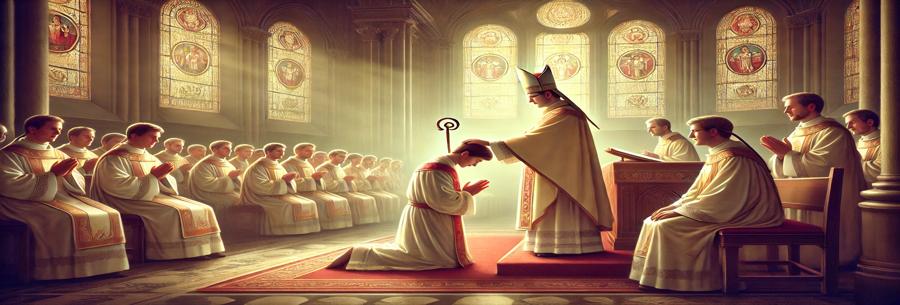
The sacrament of ordination, also known as the sacrament of Holy Orders, is one of the seven sacraments of the Catholic Church. This sacrament confers on certain faithful a particular mission in the Church: that of serving the people of God through preaching, the celebration of the sacraments, and pastoral leadership. Ordination consecrates men called by God to become deacons, priests or bishops, according to three distinct degrees of the sacrament. This sacrament is a response to the call of Christ, who invites his disciples to follow him in total and selfless service.
1. The biblical origins of ordination
a) Prefigurations in the Old Testament
In the Old Testament, God chooses people to serve as priests, prophets, or kings. The Levitical priests had a specific role in worship and offering sacrifices:
Aaron and his descendants (Exodus 28): They are consecrated to serve in the sanctuary.
Melchisedek (Genesis 14:18): Priest and king, he offers bread and wine, prefiguring Christ.
b) Institution by Jesus Christ
Jesus is the supreme priest, mediator between God and humanity. At the Last Supper, he institutes the Eucharist and entrusts his apostles with the mission of continuing his work:
"Do this in memory of me." (Luke 22:19)
Jesus also gives them the authority to forgive sins:
"Receive the Holy Spirit. Whose sins you forgive, they are forgiven them." (John 20:22-23)
c) Apostolic practice
After Pentecost, the apostles ordained deacons to assist them in their mission:
"They laid their hands on them." (Acts 6:6)
2. The spiritual significance of ordination
a) A configuration to Christ
Ordination configures the minister to Jesus Christ, the Good Shepherd. The priest acts in the person of Christ, particularly in the sacraments.
b) A call to service
This sacrament is a commitment to serve the Christian community, bringing the Word of God, the sacraments, and pastoral accompaniment.
c) A participation in the priesthood of Christ
Ordained persons share in a special way in the threefold ministry of Christ:
Prophetic: Proclaiming the Gospel.
Sacerdotal: Sanctifying through the sacraments.
Regal: Guiding the people of God.
3. The three degrees of the sacrament of Holy Orders
a) The diaconate
Deacons are ordained to serve in the Church, especially among the poor and the sick. They also assist priests and bishops in liturgical celebrations.
They may preach, baptise, and celebrate marriages.
The diaconate may be transitional (before becoming a priest) or permanent.
b) The presbyterate
Priests are consecrated to celebrate the sacraments, preach the Gospel, and guide a parish community.
They particularly celebrate the Eucharist, Reconciliation, and the Anointing of the Sick.
They are collaborators with the bishop and receive a pastoral mission.
c) The episcopate
Bishops receive the fullness of the sacrament of Holy Orders. They are the successors of the apostles and responsible for teaching, sanctification, and pastoral government in their dioceses.
They ordain deacons and priests.
Each bishop is a member of the episcopal college, in communion with the pope.
4. The symbols of ordination
a) Laying on of hands
This gesture, practised since the apostles, symbolises the transmission of the Holy Spirit and apostolic authority.
b) The conservatory prayer
The prayer recited by the bishop invokes the Holy Spirit to consecrate the ordinand to his ministry.
c) Liturgical vestments
The stole: Sign of priestly service.
The chasuble: Symbolises love and total self-giving to Christ.
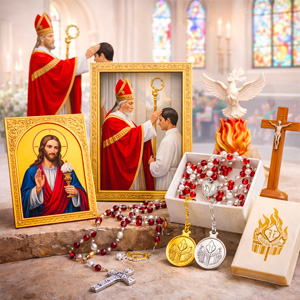
The mitre and pastoral staff: For bishops, they represent their role as spiritual guides.
d) The anointing of hands
The hands of the priest or bishop are anointed with holy chrism, a sign of their consecration to sanctify the faithful.
5. The rite of ordination
a) The calling of the ordinand
The bishop calls the candidate by name, thus confirming that the Church recognises his call.
b) The commitment
The ordinand promises obedience to the bishop and his successors.
c) The litany of saints
The assembly invokes the saints to accompany the candidate in his ministry.
d) The laying on of hands and the prayer of ordination
The bishop lays his hands on the head of the ordinand and pronounces the consecratory prayer, thus conferring the sacrament.
6. The spiritual fruits of the sacrament of ordination
a) A special grace
Ordination confers a special grace to carry out the functions of the ordained ministry with love and fidelity.
b) An indelible character
Like baptism and confirmation, ordination imprints a permanent spiritual character on the soul.
c) A participation in salvation
Through their ministry, the ordained become instruments of divine grace to lead the faithful to holiness.
7. The challenges and beauty of the ordained life
a) A life of giving
Ordained ministers are called to live in total availability to God and to others.
b) A vocation of sanctification
They must seek to live in accord with the demands of the Gospel, as models for the faithful.
c) A profound joy
Despite the challenges, ordained ministry is a source of joy, because it is rooted in the service of Christ and his Church.
8. Conclusion: A ministry for the Church and the world
The sacrament of ordination is a precious gift for the Church. It enables deacons, priests, and bishops to fulfil their mission with the grace and strength of the Holy Spirit. By responding to God's call, ordained ministers become living witnesses to Christ's love, guiding the faithful on their spiritual journey and bringing the light of the Gospel to the whole world. This sacrament, rooted in the apostolic tradition, continues to be a powerful sign of God's presence and action in the Church today.