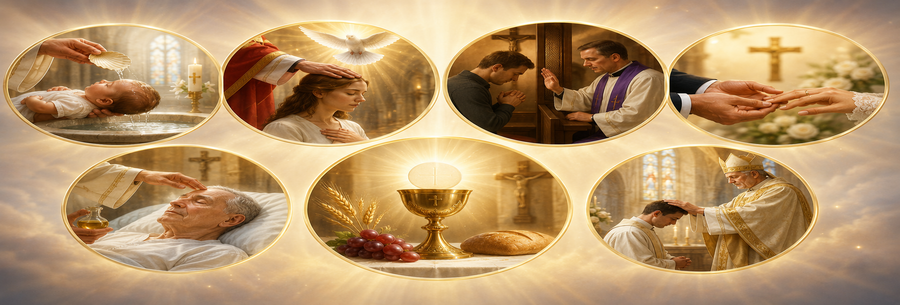
The Catholic sacraments are visible signs instituted by Jesus Christ to communicate divine grace to the faithful. They are at the heart of the Christian life and accompany believers throughout their lives, marking important stages in their spiritual journey. Each sacrament has a particular meaning and a specific function in the life of the Church. Here is an in-depth exploration of the seven Catholic sacraments and their role in the lives of the faithful
.1. The sacraments of Christian initiation
These sacraments introduce believers to the Christian life and unite them to the community of the Church.
a) Baptism
Signification : The first sacrament of Christian initiation, baptism purifies from original sin and brings one into the community of the Church.
Symbol: Water is the central element of baptism, symbolising purification and new life in Christ.
Institution: Jesus himself was baptised in the Jordan by John the Baptist (Matthew 3:13-17) and commanded his disciples to baptise in his name (Matthew 28:19).
Effect: Baptism confers sanctifying grace, makes the person a child of God, and opens the door to the other sacraments.
b) Confirmation
Signification: Confirmation reinforces the graces received at baptism and confers the gift of the Holy Spirit to live as a witness to Christ.
Symbol: Holy oil (chrism) is used for anointing, marking the believer as a disciple of Jesus.
Institution: At Pentecost, the apostles received the Holy Spirit and began their mission (Acts 2:1-4).
Effect: Confirmation gives the strength to bear witness to one's faith and to fully assume one's Christian life.
c) The Eucharist
Significance: The heart and summit of the Christian life, the Eucharist is the sacrament in which Christ makes himself present under the species of bread and wine.
Symbol: The bread and wine, having become the Body and Blood of Christ, recall Jesus' last meal with his disciples.
Institution: Jesus instituted this sacrament at the Last Supper: "Take and eat, this is my body" (Matthew 26:26-28).
Effect: The Eucharist nourishes the soul, strengthens unity with Christ and with the Church, and renews spiritual strength.
2. Sacraments of Healing
These sacraments bring reconciliation and comfort to the faithful in their spiritual and physical journey.
a) Reconciliation (or Confession)
Significance:Reconciliation offers forgiveness for sins committed after baptism and restores communion with God and the Church.
Symbol: The words of absolution pronounced by the priest: "I forgive you all your sins, in the name of the Father, the Son and the Holy Spirit."
Institution: Jesus gave the apostles the power to forgive sins: "Receive the Holy Spirit. Whose sins you forgive, they are forgiven them" (John 20:22-23).
Effect: This sacrament heals the soul, restores inner peace and renews the relationship with God.
b) The Anointing of the Sick
Significance: This sacrament is for those who are seriously ill or at the end of life. It brings comfort, peace, and sometimes physical healing.
Symbol: The consecrated oil used for anointing, symbolising strength and healing.
Institution: Jesus healed the sick and entrusted this mission to his disciples (Mark 6:13).
Effect: Anointing the sick gives strength in times of trial, forgives sins and prepares for eternal life.
3. Sacraments at the service of mission
These sacraments are oriented towards serving others and strengthening the Christian community.
a) Marriage
Significance: Marriage is the sacred union of a man and a woman, a reflection of the covenant between Christ and the Church.
Symbol: The exchange of consents and covenants, a sign of mutual commitment.
Institution: Jesus affirmed the sanctity of marriage: "What God has joined together, let no man put asunder" (Matthew 19:6).
Effect: Marriage gives the grace to live married love with fidelity, generosity and openness to life.
b) Order
Signification: This sacrament confers on men called by God the power and mission to exercise the priestly ministry.
Symbol: The laying on of hands by the bishop, accompanied by a prayer consecrating the new priest.
Institution: Jesus entrusted this mission to his apostles at the Last Supper: "Do this in memory of me" (Luke 22:19).
Effect: The sacrament of Holy Orders gives grace to serve the community and dispense the sacraments.
4. The importance of the sacraments in the Christian life
a) An encounter with God
The sacraments are privileged moments when the believer encounters Christ in a tangible way, receiving his grace and blessing.
b) A path of spiritual growth
The sacraments accompany believers throughout their lives, helping them to grow in faith and to respond to their Christian vocation.
c) A link with the community
The sacraments strengthen the unity of the Church, the community of the faithful, who share the same mysteries of faith.
5. Conclusion : A treasure of grace
The seven Catholic sacraments are treasures offered by God to His Church to sanctify the faithful, guide them on their spiritual journey, and unite them to Him. Each sacrament is an expression of God's infinite love and an invitation to live the Christian life to the full, in faith, hope and charity. Through these visible signs of grace, the Church continues to pass on the spiritual heritage left by Christ to his disciples.