Discover the meaning of the Feast of Christ the King and reflect on the Gospel reading about the Last Judgement: to love, serve and recognise Jesus in the most vulnerable.
Christ the King of the Universe: recognising Jesus in the least among us
The feast of Christ the King of the Universe reveals to us a kingship that is profoundly different from all human kingships. Jesus reigns neither by force, nor by fear, nor by wealth. He reigns through love, self-sacrifice, mercy and service.
In the Gospel according to Saint Matthew, Jesus presents himself as the Son of Man coming in his glory. All the nations are gathered before him, and he takes the image of a shepherd who separates the sheep from the goats. Yet the criterion for this judgement is neither success, nor influence, nor reputation. It lies in very simple acts: giving food, giving drink, welcoming, clothing, visiting and caring for others.
Jesus then utters a statement that sheds light on the whole of Christian life: whenever we do good to one of the least of his brothers and sisters, it is to him that we do it.
Christ the King thus teaches us that true greatness is not found in domination, but in concrete acts of charity. His Kingdom begins whenever a person chooses to love.
A King who draws near to the most vulnerable
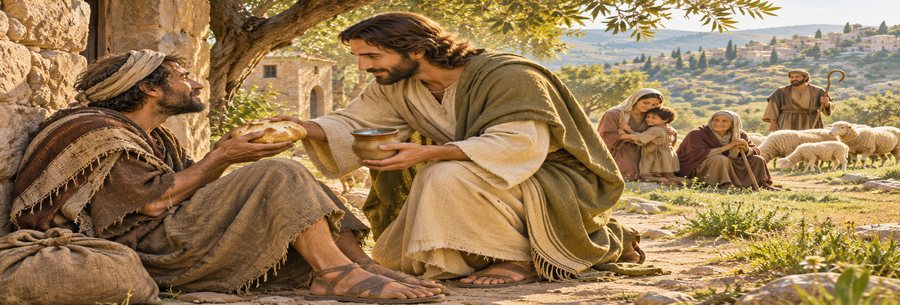
In the Bible, the king was often the one who was supposed to protect the people, ensure justice was upheld and defend the weakest. Jesus fulfils this mission in an unexpected way: he identifies himself with those who are hungry, thirsty, strangers, sick, isolated or imprisoned.
He does not merely say that he loves the poor and the vulnerable. He declares that he is present within them.
These words profoundly change the way we see things. We sometimes seek God in extraordinary events, in visible signs or in great spiritual experiences. Yet Jesus invites us to recognise him in a person who is suffering, in someone who needs a listening ear, in an isolated neighbour, in a family going through hardship, or in a person in need of a gesture of support.
Encountering a vulnerable person can sometimes unsettle us. We may feel powerless, pressed for time or unable to meet every need. Jesus does not ask us to solve everything. He asks us not to look away. A simple gesture, a word of respect, a little time set aside or a faithful prayer can already become an encounter with Christ.
Charity: the language of the Kingdom of God
The Gospel does not present charity as a general concept. Jesus lists concrete acts: feeding, giving drink, welcoming, clothing and visiting.
The Christian faith is lived out in the most ordinary circumstances. It is not reduced to words alone, even though prayer and the proclamation of the Gospel are essential. It becomes visible when love is expressed through actions.
Giving food may mean helping someone in need, but it can also mean generously sharing what we have. Giving drink may mean offering a comforting presence to someone who is deeply weary. Welcoming the stranger may mean making room for those who feel excluded. Visiting the sick may take the form of a phone call, a message, a quiet visit or a prayer offered faithfully.
No act is too small in God’s eyes when it is done with love. A gesture that seems modest can become a ray of light in the day of someone who is discouraged.
Christ’s Kingdom grows in this way: not through noise, but through repeated acts of kindness, often hidden yet precious.
The judgement of love
The Gospel of Christ the King can be striking because it speaks of judgement. But this judgement is not a threat intended to frighten us. It reveals the truth of our lives. Jesus shows us that love is the deepest measure of our existence.
At the end of our lives, what remains is not what we have possessed, nor the appearances we have maintained. What remains is the love given, the forgiveness offered, the peace sought, the suffering accompanied and the good accomplished with humility.
The righteous in the Gospel are astonished. They do not recall having seen Christ in the people they helped. Their charity had become second nature. They did not act to receive a reward or to be recognised. They simply loved.
This attitude is a beautiful invitation to us. Doing good without calculation, serving without expecting thanks, caring for others without seeking admiration: this is what draws our hearts closer to that of Christ.
We must not live in fear of being judged, but in the desire to let God’s love transform our choices. Mercy is the path to the Kingdom.
Jesus, Shepherd and King of Peace
The readings for this feast also present God as a caring shepherd. He seeks out the lost sheep, brings back the one that has strayed, tends to the wounded one and restores strength to the sick one.
This image is particularly comforting. Christ the King is not a distant sovereign. He knows our wounds, our weariness, our hesitations and our weaknesses. He does not turn away from those who fall. He comes to lift them up.
When we feel lost, we can turn to him. When we carry a pain we cannot put into words, he listens to us. When we need to find a path to peace again, he walks before us.
Christ also asks us to be like him. Like him, we are called to seek out those who feel forgotten, to care for the wounded, and to foster peace around us.
Jesus’ kingship is a kingship of service. He is King because he loves to the very end.
How can we serve Christ in our daily lives?
We do not need to do anything extraordinary to respond to this Gospel. Christ allows us to encounter him in many simple situations.
We can serve him by paying attention to someone who is alone. We can serve him by sharing a meal, a piece of clothing or a little of our time. We can serve him by praying for someone who is ill or by asking after their well-being. We can serve him by refusing to speak ill of others, by choosing words that uplift, and by showing patience within our family.
We can also serve him by humbly accepting our own frailties. There are times when we ourselves lack strength, peace or hope. At such times, accepting help can also become a way of recognising that God is at work through others.
Christian charity does not begin far from us. It begins in our home, in our neighbourhood, at our workplace, in our parish and in the people whom God places in our path.
Christian meditation
Let us take a few moments to ask ourselves: who is ‘the least’ that the Lord is placing in my path today? Perhaps it is someone who suffers in silence. Perhaps it is someone I find difficult to understand. Perhaps it is someone who is isolated, ill or discouraged.
Let us ask Christ to give us a more attentive gaze. We cannot meet all the world’s needs, but we can choose not to close our hearts.
Christ the King does not ask us to be perfect. He asks us to love with who we are and with what we have. He makes simple acts grow when they are done in faith.
Prayer to Christ the King of the Universe
Lord Jesus,
you are the King of love and peace.
Teach me to recognise you
in those who are hungry, who are suffering,
who are lonely or forgotten.
Give me an attentive and generous heart,
capable of welcoming, comforting and serving.
When I pass by someone in need,
open my eyes so that I do not look away.
Make my life a sign of your Kingdom,
a Kingdom of justice, mercy and brotherhood.
Reign in my heart,
so that I may choose love every day.
Amen.
FAQ – Understanding the Feast of Christ the King
What does ‘Christ the King of the Universe’ mean?
Christ is King because he reigns through love, truth, justice and peace. His kingship is not based on domination, but on service and self-sacrifice.
Why does Jesus identify with the least among us?
Jesus wants to teach us that every person possesses immense dignity. He is present in a special way amongst those who suffer, who are poor, sick, lonely or marginalised.
What is the main message of the Gospel account of the Last Judgement?
The Gospel reminds us that concrete love for others is essential. Feeding, welcoming, visiting and helping others become ways of serving Jesus himself.
Can we serve Jesus through simple acts?
Yes. Listening attentively, paying a visit, offering a word of comfort, providing material help or praying for someone going through a difficult time are all acts that can become true acts of charity.
How can we help the Kingdom of God to grow?
The Kingdom of God grows every time we choose justice, forgiveness, peace, solidarity and love for the most vulnerable.
The liturgical reading is Matthew 25:31–46, for the Solemnity of Christ the King.