Meditation on Jesus in the Temple: understanding his call to make our hearts a house of prayer, peace and encounter with God.
The House of God: Rediscovering the Meaning of Prayer with Jesus
In the Gospel according to Saint Luke, Jesus enters the Temple in Jerusalem and drives out the money-changers. His words are powerful: the house of God must be a house of prayer, not a place that has strayed from its mission.
This passage may come as a surprise. Jesus, whom we know to be gentle, patient and merciful, shows himself to be firm here. Yet his firmness is not violence. It reveals his jealous love for God and for his people. Jesus wishes to restore the Temple to its true vocation: to be a place where everyone can encounter the Lord, pray, listen to his Word and find peace.
The Gospel, therefore, does not merely speak to us of an ancient place. It challenges us to examine our own hearts. What place do we give to God? Is our inner life still a space of silence, truth and prayer? Or is it cluttered with anxieties, worries, wounds and everything that distances us from what really matters?
The Temple: a house open to encounter with God
For the people of Israel, the Temple was the holy place par excellence. People came there to pray, to present offerings, to celebrate the great feasts and to remember the Covenant between God and his people.
Jesus does not reject the Temple. On the contrary, he recalls its greatness. He wants this place to remain true to its mission: to enable everyone to turn towards God.
Through his actions, Jesus particularly defends the least among us. When the house of God becomes a place of profit, exclusion or confusion, the most vulnerable risk no longer finding their place there. Yet God wishes to welcome everyone: the poor, the stranger, the sinner, the wounded, those who are searching, those who doubt and those who pray in silence.
Prayer is not reserved for a select few. It is a door open to all. You do not need to be perfect to enter a church or speak to God. All that is needed is a heart that longs to return to him.
Jesus comes to purify whatever stands in the way of this encounter. He reminds us that God cannot be reduced to an outward ritual, a personal interest or a religious façade. He desires a genuine relationship.
Making our hearts a house of prayer
In the Christian faith, our hearts are also called to become a house of God. This does not mean that we must be flawless. We all carry weaknesses, distractions, fears and, at times, deep wounds. But Jesus can come into our lives to restore order, shed light on what is obscure and reopen a path to peace within us.
Like the Temple, we need to be regularly purified.
Perhaps our hearts are weighed down by a worry we cannot seem to let go of. Perhaps a grudge is taking up too much space. Perhaps we live in a constant state of restlessness, without taking the time to breathe, to give thanks or to pray. Perhaps, too, we have allowed sadness to make us believe that God is far away.
Jesus does not come to condemn us. He comes to set us free from everything that prevents us from living life to the full. He wants to drive out of our hearts not people, but what imprisons us: anger, selfishness, despair, fear of the future and withdrawal into ourselves.
Allowing Jesus into our lives means accepting that he restores our inner freedom.
A simple and sincere prayer
Making one’s life a house of prayer does not necessarily require long hours of contemplation. Prayer can begin very simply.
It can be a word spoken in the morning: ‘Lord, be with me.’ It can be a thank you for a moment of joy. It can be the offering up of a difficulty: ‘I entrust to you what weighs heavily on me. ’ It can be a plea for forgiveness or an intention offered up for a loved one.
Prayer then becomes a way of living in God’s presence. It helps us not to bear our responsibilities, our wounds and our questions alone. It teaches us to receive each day as a gift.
It is also important to find moments of silence. In a life often filled with noise, messages and worries, silence can seem difficult. Yet it is not empty. It allows our hearts to settle and open up to the Lord’s presence.
Sometimes even a few minutes are enough. Reading a sentence from the Gospel, sitting in a church, gazing at a lit candle, slowly reciting the Lord’s Prayer: these simple gestures can become precious moments of encounter with God.
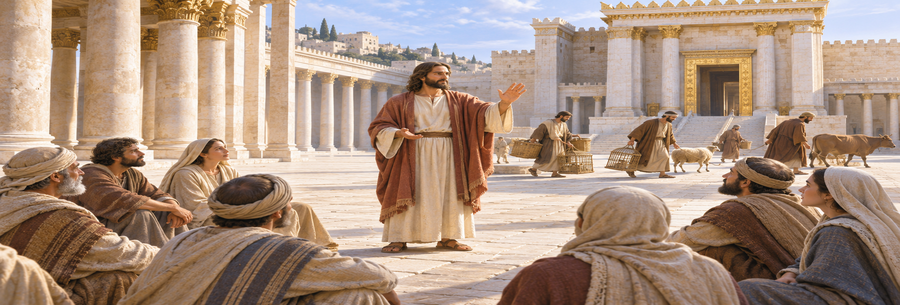
Jesus teaches in the Temple
After recalling the Temple’s purpose, Jesus teaches there. The people listen to him attentively. This detail is important: Jesus does not merely point out what needs to change. He speaks words that enlighten, nourish and uplift.
The Word of God is not a cold set of rules. It is a light for our choices. It helps us to discern what leads to peace, love and justice. It also shows us what needs to be transformed in the way we live.
Listening to the Gospel means allowing Jesus to teach us. Sometimes his word comforts us. Sometimes it challenges us. But it never leaves us alone. It reminds us that our lives are precious and that God desires our happiness.
We can make reading the Gospel a simple habit. A few lines read slowly, a word held in our hearts, a question put to the Lord: ‘What do you want to tell me today? ’ Little by little, this faithfulness transforms the way we look at events and at others.
Faith must not become an empty habit
The Gospel also warns us against a faith that is merely outward. It is possible to perform religious acts, to know certain prayers or to take part in celebrations, whilst keeping one’s heart closed to love.
Jesus expects a living faith from us. A faith that is expressed through charity, justice, forgiveness and care for the most vulnerable.
True prayer brings us closer to God, but it also brings us closer to others. It makes us more patient, more attentive and better able to serve. If we pray sincerely, we learn to look upon those around us with greater compassion.
It is not a matter of judging others, nor of becoming discouraged by our own limitations. It is a matter of asking the Lord to renew our hearts every day. God does not seek outward perfection. He seeks openness, truth and a desire to grow in love.
Christian meditation
Let us take a moment to look at our heart as if it were a house. What do we find there? Peace or restlessness? Trust or fear? Gratitude or bitterness? Room for God, or only worries that go round and round in our minds?
Christ wants to dwell in this house. He does not ask us to make it perfect before He comes. He longs to enter right now, with gentleness and truth, to restore prayer and peace there.
We can hand over to Him whatever is cluttering our hearts. We can say to Him: ‘Lord, come and purify whatever is keeping me from You. Teach me to make my life a house of prayer.”
Prayer inspired by the Gospel
Lord Jesus,
come into my heart as you entered the Temple.
Drive out of me whatever distances me from your peace:
fear, anger, restlessness and discouragement.
Teach me to seek you with simplicity
and to make my life a house of prayer.
Grant me a taste for silence,
a love for your Word
and a heart open to those who need me.
May my faith be alive, humble and faithful,
and may my every action
bear witness to your love.
Amen.
FAQ – Understanding Jesus in the Temple
Why does Jesus drive the merchants out of the Temple?
Jesus reminds us that the Temple is a place consecrated to prayer and encounter with God. He refuses to allow this place to be misused for profit or for practices that prevent people from praying freely.
Is Jesus angry in this Gospel passage?
Jesus shows firmness because he is defending the holiness of God’s house and everyone’s right to encounter the Lord there. His firmness is driven by love and the desire to restore the truth.
What does it mean to make one’s heart a house of prayer?
It means giving God a real place in one’s life, through prayer, silence, listening to the Gospel, forgiveness and acts of charity.
How can we rediscover a love of prayer?
You can start with just a few minutes each day, with a simple word, an intention entrusted to God, reading a short passage from the Gospel, or slowly reciting a familiar prayer.
What is the link between prayer and charity?
Authentic prayer transforms the way we view others. It helps us to become more patient, more just, more attentive to those who are vulnerable, and more willing to serve.
The liturgical reference is Luke 19:45–48.