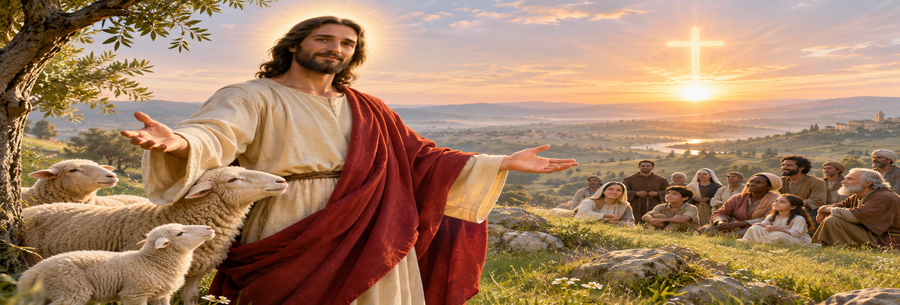
Discover the meaning behind the feast of Christ the King of the Universe: a kingship of peace, service, justice and mercy that illuminates the Christian life.
Christ the King of the Universe: a reign of peace, justice and love
On this Sunday, the Church celebrates the Solemnity of Our Lord Jesus Christ, King of the Universe. This great feast brings the liturgical year to a close, just before the start of Advent. This year, it takes precedence over the memorial of Saint Cecilia.
The title ‘Christ the King’ may come as a surprise. It might bring to mind a power of domination, a distant sovereign or earthly glory. Yet the Gospel reveals to us a kingship that is entirely different: Jesus reigns by serving, by forgiving, by lifting up the wounded and by giving his life out of love.
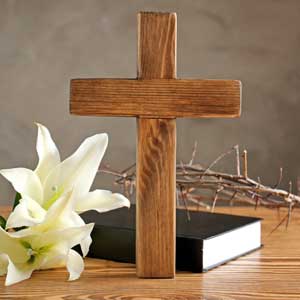
Christ is not a king like the powerful of this world. His throne is the Cross, his crown is that of self-sacrificing love, his law is charity, and his kingdom grows wherever peace, justice and mercy take root.
A solemnity that brings the liturgical year to a close
The liturgical year does not simply follow the rhythm of the civil calendar. It enables Christians to relive the great mysteries of the faith: the anticipation of Advent, the birth of Jesus at Christmas, his public ministry, his Passion, his Resurrection, Pentecost and the life of the Church.
The Solemnity of Christ the King of the Universe is, as it were, the crowning moment of this cycle. Having contemplated Christ at the various stages of his life, the Church proclaims that he is Lord of history, of creation and of all human life.
This feast does not mean that everything in the world is already perfect. Wars, injustices, illnesses, divisions and suffering show that the Kingdom of God has not yet been fully realised. But Christians profess that evil will not have the last word. The risen Christ is alive, and his love is already at work in the world.
To celebrate Christ the King is therefore to renew our hope. It means believing that humanity is not heading towards nothingness, but towards an encounter with God. It also means recognising that everyone is called to take part, from today onwards, in building this Kingdom through acts of kindness and truth.
Jesus, a king who does not dominate
In the Gospel, Jesus rejects the honours intended to make him an earthly king. He never imposes himself by force. He does not raise an army. He does not seek to crush his opponents or to secure political power.
His kingship is revealed in a different way. Jesus draws near to the poor, heals the sick, lifts up sinners, welcomes children, eats with those who are rejected and forgives those who abandon him.
In this way, he shows that to be a king according to God is to serve. The one who is the greatest draws near to the least. The one who possesses all authority kneels to wash the feet of his disciples. The one who is without sin bears the suffering of sinners.
The Cross is the most powerful sign of this kingship. In the eyes of the world, it appears to be a defeat. For Christians, however, it reveals the victory of love over hatred, of forgiveness over vengeance, and of life over death.
Christ reigns because he loves to the very end. His power is not one of coercion; it is the power of a love capable of touching and transforming hearts.
The Shepherd King who watches over his people
The first reading for this solemnity presents God as a shepherd who cares for his flock. He seeks out the lost sheep, brings back the one that has strayed, tends to the wounded one and strengthens the weak one.
This image helps us to understand Christ’s kingship. Jesus is not an unapproachable king, shut away in a palace. He is the Good Shepherd who knows his sheep and never abandons them.
Christ sees those who feel lost, discouraged or estranged from God. He does not forget those who suffer from loneliness, precarious circumstances, illness or bereavement. He never looks down on fragile hearts.
This feast is an invitation to allow ourselves to be met by Christ’s gaze. We do not need to hide our wounds to come to him. We can entrust to him our worries, our mistakes, our fears and our hopes.
The Good Shepherd does not come to condemn those who fall. He comes to lift them up. He also teaches us to look upon others with greater patience. If Christ cares for each and every one of us, we are called to become, in our own small way, signs of his compassion.
The judgement of love and service to the most vulnerable
The Gospel for the Solemnity of Christ the King, according to Saint Matthew, presents the Son of Man in his glory. The nations are gathered before him, and the judgement concerns very concrete acts: giving food, giving drink, welcoming the stranger, clothing the naked, visiting the sick and not forgetting those in prison.
This passage from the Gospel is demanding, but it is also enlightening. It teaches us that Christ is mysteriously present in the most vulnerable people. Loving one’s neighbour is not a secondary aspect of faith. It is one of the ways in which God’s love is revealed.
The Lord does not necessarily ask for extraordinary deeds. He asks us about our day-to-day willingness to help. Have we taken the time to listen to someone? Have we supported someone who is isolated? Have we shown patience within our family? Have we refrained from saying something hurtful? Have we given a little of our time, our attention or our resources?
Christ’s Kingdom grows through these gestures, which are sometimes invisible. A visit, a shared meal, an act of forgiveness, a word of comfort or a faithful presence can become profoundly royal acts, because they bear witness to the reign of love.
Christ the King and justice
Christ’s kingship is also a kingship of justice. But God’s justice is neither cold nor merciless. It is always imbued with mercy.
In a world where many feel wounded by injustice, the Gospel affirms that God sees everything that is lived out in secret. He sees the tears, the efforts, the sacrifices and the acts of kindness that receive no recognition.
This promise is a source of consolation. It reminds us that the good we do is never lost. Even when no one notices it, it is known to God.
Christ’s justice also calls us not to remain indifferent. We cannot proclaim Jesus as King if we accept contempt, exclusion, racism, violence or humiliation without reacting. To follow Christ is to seek to uphold the dignity of every person.
This mission often begins very close to home: in the way we speak, in our care for those who are alone, in our respect for people who are different, and in our choice not to fuel anger or division.
Welcoming Christ’s reign into our lives
Saying ‘Jesus is King’ does not mean adding a religious idea to our daily lives. It means choosing to give him a real place in our decisions, our relationships and our priorities.
Christ reigns in our lives when we choose truth over lies, forgiveness over resentment, sharing over selfishness, and peace over violence.
We cannot always change the major realities of the world. But we can ask God to transform our hearts. The Kingdom begins in a peaceful conscience, in a home where we learn to speak to one another with respect, in a family where we care for the most vulnerable, and in a community where everyone finds their place.
This solemnity invites us to ask ourselves a simple question: what place do I give to Christ in my life? Is he present only in my prayers, or does his Gospel also enlighten my words, my work, my choices and the way I love?
A feast looking towards the hope of Advent
The Feast of Christ the King already prepares us for Advent. Having proclaimed that Christ is Lord of the universe, the Church prepares to celebrate his humble and silent coming to Bethlehem.
This passage is very beautiful. The King of the universe does not come first in the splendour of a palace. He comes as a fragile child, welcomed by Mary and Joseph. He chooses the simplicity of a manger to reveal the greatness of God’s love.
Thus, Christ’s kingship leads us to humility. To welcome the King, we do not necessarily have to accomplish great things. We must open the door of our hearts to him, make room for prayer, seek reconciliation, serve and wait with confidence.
As Advent approaches, we can ask Christ to come and reign more fully in our lives. Not by imposing his will upon us, but by giving us peace, light and the strength to love.
Prayer to Christ the King of the Universe
Lord Jesus Christ,
King of the Universe and Good Shepherd of your people,
come and reign in our hearts through your peace and your mercy.
Teach us to recognise you
in the poor, the sick, those who are lonely
and all those who await an act of kindness.
Deliver us from pride, fear and indifference.
Make our families, our parishes and the places where we live
spaces of forgiveness, justice and brotherhood.
May your love guide our choices,
may your Cross strengthen our hope
and may your Kingdom of peace grow within us.
Amen.