Reflection on the Parable of the Talents: understanding the gifts received from God, overcoming fear and bearing fruit in the Christian faith.
The Parable of the Talents: Living Faithfully with the Gifts Received from God
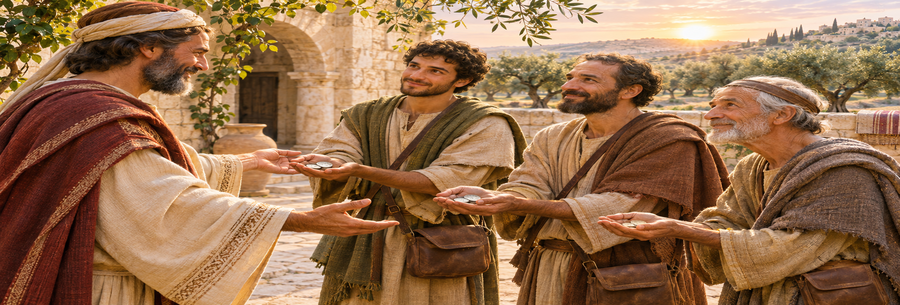
In the Gospel according to Saint Matthew, Jesus tells the story of a man who sets off on a journey and entrusts his possessions to three servants. To one he gives five talents, to another two, and to the last one only one, ‘to each according to his ability’. On his return, the master asks each of them what they have done with what had been entrusted to them.
Two servants made their talents grow. The third, out of fear, chose to bury his in the ground. This parable is often understood as a call to develop one’s qualities. Yet it goes much further: it speaks to us of God’s trust, of our freedom, of the fear that can paralyse the heart, and of the joy to which the Lord calls us.
A talent is not merely a visible or exceptional ability. It may be a simple quality, a willingness to help, a word of peace, patience, the ability to listen, the courage to try again, a humble faith or the desire to do good. God does not ask us all to be the same. He entrusts each of us with a share of his grace and invites us to let it bear fruit.
God entrusts his gifts with confidence
The master in the parable does not give the same sum to all the servants, but he entrusts each one with something precious. This difference is not an injustice: it shows that God knows each of us personally. He knows our strengths, our weaknesses, our history and the possible paths ahead of us.
We sometimes tend to compare ourselves with others. We look at others’ abilities, their successes, their self-assurance or their place in the world. Such comparisons can give rise to jealousy, discouragement or the feeling that we have not received enough. Yet, in the Gospel, God never asks a person to become someone else.
He asks us to respond faithfully to what has been entrusted to us.
For one person, their talent may lie in knowing how to comfort others. For another, it may be intelligence put to use in a worthwhile project. For a parent, it may be the patience shown to their children. For someone who is ill or going through a difficult time, it may be perseverance in trust, despite the hard days. For an elderly person, prayer offered faithfully can become an immense treasure for those around them.
No act performed with love is insignificant in God’s eyes.
To make something bear fruit does not mean to succeed according to the world’s standards
The first two servants make what they have received grow. They do not remain idle. They take the risk of taking action, of accepting responsibility and of placing their trust in God. The master does not simply praise them because they have achieved a good result; he recognises them as ‘good and faithful’ servants.
Faithfulness lies at the heart of this parable. It does not mean doing great things at any cost. It means living out, with sincerity and love, what God places in our daily lives.
Making a talent bear fruit can mean:
- looking after someone who is alone;
- carrying out one’s work honestly;
- passing on the faith to children;
- asking for forgiveness after saying something hurtful;
- supporting someone who is grieving;
- giving a little of one’s time to a charitable cause;
- remaining faithful to prayer even when we feel nothing;
- not allowing discouragement to extinguish our desire to do good.
The fruit of the Gospel is not measured solely by what is visible. A kind word can soothe great suffering. A discreet gesture of care can prevent someone from losing heart. A prayer offered in silence can bear fruit that we shall never know on this earth.
The Lord does not ask us to be admired. He asks us to love.
The danger of hiding one’s talent out of fear
The third servant does not lose the talent he has been given. He keeps it carefully, but he buries it. His problem is not that he received little; his problem is that he let fear decide for him.
He says: ‘I was afraid.’ This phrase resonates deeply with our human experience. We may be afraid of failing, afraid of being judged, afraid of not succeeding, afraid of taking on responsibility, afraid of forgiving, or afraid of trusting. So we hide what God has given us.
We may hide our talent by refusing to believe that we have anything to offer. We may hide it by allowing an old wound to govern our choices. We may hide it by repeating that what we do doesn’t matter. We can also hide it by waiting until we are perfect before we begin.
But God does not expect immediate perfection from us. He wants us to move forward with him. He prefers a humble and sincere step to a whole life spent locked in fear.
The Christian faith does not remove all fears at a stroke. It gives us the grace not to let them have the last word. It teaches us to entrust our worries to Christ and to do the good that is possible, today.
Enter into the joy of the Lord
The master’s reply to the first two servants is magnificent: ‘Enter into the joy of your master.’ The aim of faithfulness is not performance, nor material reward, nor the pursuit of personal worth. True fulfilment lies in communion with God.
When we nurture love, when we choose the truth, when we use our gifts to serve, we are already entering into this joy. It is not always a boisterous or easy joy. It can be peaceful, unassuming, and at times mingled with weariness. But it is profound, for it springs from the certainty of having lived according to the Gospel.
The parable also reminds us that God is generous. Those who humbly place themselves at the service of the good gradually discover that the Lord enlarges their hearts. The more we share, the more capable we become of loving. The more we give, the more light we receive to carry on.
God’s gift is not exhausted when it is shared: it multiplies.
A practical reflection for our lives
It is good to take a few moments to look at our lives with gratitude. What talents, visible or hidden, has God placed within us? What qualities can we put more at the service of others? What good deeds have we put off out of fear, weariness or a lack of confidence?
It is not a question of judging ourselves harshly. It is about responding to Christ’s call with sincerity.
Perhaps the first talent we need to put to good use is simply our time in prayer. Perhaps we need to ring someone we have left feeling lonely. Perhaps we need to take up again a worthwhile project that we abandoned too quickly. Perhaps we need to believe once more that our presence, our words and our actions can bring about something good.
The Lord does not ask us to change everything in an instant. He invites us not to bury what he has entrusted to us. Today, a small act of faith, charity or courage can become the beginning of a great journey.
Prayer inspired by the parable of the talents
Lord Jesus,
you know the gifts you have placed in my heart.
Teach me to receive them with gratitude
and not to hide them out of fear.
Give me the strength to put my qualities
at the service of those around me.
Help me to foster peace, kindness and hope
in my family, at work and in my interactions with others.
When I doubt myself, remind me that you trust me.
When I am tempted to give up, sustain me with your grace.
May my life bear the fruits of love
and may I one day share in your joy.
Amen.
FAQ – Understanding the Parable of the Talents
What do the talents represent in the Gospel?
The talents represent everything that God entrusts to each of us: life, faith, human qualities, time, opportunities to act and the capacity to love.
Does God give the same gifts to everyone?
No. The parable shows that everyone receives ‘according to their abilities’. God knows each person and does not ask them to live by comparing themselves to others.
What does it mean to make one’s talents bear fruit?
It means putting one’s gifts at the service of the common good, growing in love, fulfilling one’s duty faithfully, sharing, supporting others and living out one’s faith in daily life.
Why does the third servant hide his talent?
He acts out of fear. His attitude highlights the risk of allowing fear, discouragement or a lack of confidence to prevent the gifts we have received from bearing fruit.
What is the main message of the Parable of the Talents?
God trusts us and calls us to live out our faith actively. He does not ask for perfection, but for humble, practical and generous faithfulness.
The liturgical reference is Matthew 25:14–30, the Parable of the Talents.