How can you explain Christmas to children? Discover the Christian significance of the birth of Jesus, the story of the Nativity, the nativity scene, traditions and ideas for passing on the faith within the family.
How can we explain the true meaning of Christmas to children?
Christmas is undoubtedly one of the holidays children look forward to most. Illuminated Christmas trees, decorations, presents and family gatherings create an atmosphere of joy and wonder.
But behind all these traditions lies an event that forms the very heart of Christmas for Christians: the birth of Jesus Christ in Bethlehem.
In a society where Christmas is often associated with presents and festivities, it can sometimes be difficult to convey its religious significance to young children. Yet children are naturally receptive to stories, symbols and acts of love. They can discover the beauty of the Christian message of Christmas from a very early age.
Why was Jesus born? Who are Mary and Joseph? Why was the Baby Jesus laid in a manger? What do the shepherds, the angels and the Three Wise Men represent? Why do Christians still celebrate this event more than two thousand years later?
These are all questions that can help us start a meaningful conversation with children and pass on to them the foundations of the Christian faith.
Explaining Christmas to children means helping them realise that God loves us so much that he sent his Son, Jesus, to come and live amongst us.
1. Christmas is, above all, the anniversary of Jesus’ birth
To explain Christmas to a young child, it is best to start with a simple sentence:
‘At Christmas, Christians celebrate the birth of Jesus, the Son of God. He came to Earth to show us how much God loves us and to teach us to love one another.”
Children easily understand what a birthday is. They know it is a day of celebration during which we mark a person’s birth.
So we can explain to them that Christmas is the great festival during which Christians celebrate the birth of Jesus.
But this birth is special.
For Christians, Jesus is not just a child born a very long time ago. He is the Son of God, who came to share our human life in order to reveal to us his Father’s love and bring us salvation.
This is what the Church calls the mystery of the Incarnation: God became man in Jesus Christ.
Why do we celebrate Christmas on 25 December?
The Catholic Church traditionally celebrates the birth of Jesus on 25 December.
Over the course of the first centuries of Christianity, this date became the day on which the Nativity was celebrated in the Church of Rome.
However, the Bible does not specify the exact day of Jesus’ birth.
It is important to help children understand that what matters most is not knowing the precise historical date, but celebrating the event itself: the coming of the Saviour into our world.
Every year, Christmas invites us to remember this birth and to welcome Jesus into our hearts.
2. Telling the story of Jesus’ birth in simple words
The best way to introduce children to Christmas is to tell them the story of the Nativity.
This story is recounted in the Gospels, particularly those of Saint Matthew and Saint Luke.
It can be told as a vivid narrative, taking the time to introduce the characters and events.
The angel Gabriel brings great news to Mary
Over two thousand years ago, in a town called Nazareth, there lived a young woman named Mary.
Mary loved God and trusted Him deeply.
One day, God sent an angel called Gabriel to her.
The angel told her that she was to become the mother of an extraordinary child: Jesus, the Son of God.
Mary was surprised by this news, but she trustingly accepted the mission God had entrusted to her.
She replied that she was ready to do His will.
We can explain to children that Mary teaches us to trust in God, even when we do not understand everything.
Joseph looks after Mary
Mary was betrothed to Joseph, a righteous man faithful to God.
Joseph, too, received a message from God, who asked him to take Mary and the child she was carrying into his home.
He accepted this task with confidence.
Joseph thus became the protector of Mary and Jesus.
He shows us how important it is to look after one’s family, to be courageous and to remain faithful to one’s responsibilities.
The journey to Bethlehem
One day, Mary and Joseph had to travel to Bethlehem for a census.
The journey was difficult, as Mary was expecting her child any day now.
When they arrived in Bethlehem, they could find no room in the inn where they might have stayed.
It was in these very humble circumstances that Jesus came into the world.
Mary wrapped him in swaddling clothes and laid him in a manger.
To children, this scene may seem surprising.
Why wasn’t the Son of God born in a grand palace?
This question helps to explain one of the most important messages of Christmas: God chose to come amongst humankind in humility and simplicity.
In this way, he shows us that true greatness depends neither on money, nor on power, nor on riches.
3. Why was Jesus born in a manger?
The manger is one of the most important elements of the nativity scene.
It reminds us of the humble circumstances in which Jesus was born.
To explain this to children, we can say:
‘Jesus could have been born in a palace, surrounded by riches. But he was born in a very humble place, to show us that God’s love is meant for everyone, even the poorest of people. ”
This birth teaches us several essential values.
Humility
Jesus did not come into the world to display his power through wealth or honours.
He was born as a fragile child, in need of the love and protection of Mary and Joseph.
This humility teaches us not to judge others by their appearance or what they possess.
Simplicity
The birth of Jesus reminds us that the most important things are not necessarily the most expensive.
A family’s love, a gesture of tenderness, a comforting word or a moment shared can be of immense value.
God’s love for all
By choosing to come into the world in humble circumstances, Jesus reminds us that no one is forgotten by God.
The poor, the lonely, the sick and the most vulnerable hold a special place in his heart.
That is why Christmas is also a special time to teach children about generosity and solidarity.
4. The shepherds and the angels: understanding the joy of Christmas
In the Gospel according to Saint Luke, the first to receive the news of Jesus’ birth were shepherds.
These men were keeping watch over their flocks during the night.
Suddenly, an angel of the Lord appeared to them and announced some extraordinary news: a Saviour had just been born in Bethlehem.
The shepherds were frightened at first, but the angel reassured them.
He told them of great joy intended for all the people.
The shepherds then set off for Bethlehem and found Mary, Joseph and the Baby Jesus lying in a manger.
Why did God choose the shepherds?
The shepherds were simple people who lived by their labour.
The fact that they were among the first to be told of the Saviour’s birth has a profound significance.
It shows that the good news of Christmas is not reserved for important or powerful people.
It is meant for everyone.
We can explain to children that God loves every person, whatever their circumstances.
What do the Christmas angels represent?
Angels are God’s messengers.
In the Nativity story, they announce the birth of Jesus and give glory to God.
They remind us that Christmas is a festival of peace and joy.
The angels’ song speaks of God’s glory and the peace offered to humankind.
This peace begins in our hearts and can grow through our everyday actions.
5. Who are the Three Wise Men and why do they bring gifts to Jesus?
The Three Wise Men play an important role in Christmas traditions.
The Gospel according to Saint Matthew tells us that magi from the East followed a star to find the newborn King of the Jews.
Guided by this star, they came to Jesus and presented him with three gifts: gold, frankincense and myrrh.
Christian tradition has gradually come to depict them as three kings, named Caspar, Melchior and Balthazar.
It is worth noting that the Gospel gives neither their exact number nor their names.
What do their gifts signify?
Gold represents Jesus’ kingship.
Frankincense symbolises his divinity and the worship paid to him.
Myrrh symbolically foreshadows his human nature and his future Passion.
These gifts therefore have a spiritual significance.
They remind us that Jesus is recognised as the Saviour, who came for all peoples.
Why are the Three Wise Men celebrated on Epiphany?
In the Catholic tradition, the visit of the Magi is particularly celebrated on Epiphany, 6 January, or on the Sunday to which this feast is transferred in certain countries, notably in France.
This feast reminds us that Jesus came for all humanity.
Children can understand that the Magi undertook a long journey to meet Jesus, because they recognised him as an extraordinary king.
6. The Christmas nativity scene: a wonderful way to pass on the faith to children
The nativity scene is one of the best ways to tell the Christmas story.
Thanks to the figurines and various characters, children can visualise the events of the Nativity.
This tradition was particularly developed following the initiative of Saint Francis of Assisi, who organised a live re-enactment of the birth of Jesus in Greccio in 1223.
Explaining each figure in the nativity scene
The nativity scene allows us to introduce the characters of the Christmas story one by one.
The Baby Jesus is the central figure. He reminds us that God became man to save us.
The Virgin Mary is the mother of Jesus. She teaches us trust, gentleness and love.
Saint Joseph watches over Mary and Jesus. He represents faithfulness, courage and the protection of the family.
The shepherds remind us that Jesus came for everyone, especially the most humble.
The angels announce the birth of the Saviour and invite people to rejoice.
The Three Wise Men symbolise the peoples who come to recognise Jesus and pay him homage.
The animals, often depicted in traditional nativity scenes, help to evoke the simplicity of Christ’s birth.
Involving children in setting up the nativity scene
It is a good idea to let the children place the figures themselves.
Each figurine can provide an opportunity to recount part of the story.
The Baby Jesus can be placed in the manger on the evening of 24 December or on Christmas morning.
This symbolic gesture shows that all the preparations during Advent lead up to the birth of the Saviour.
The nativity scene thus becomes much more than just a decoration: it is a genuine tool for passing on the faith.
7. Why do we give presents at Christmas?
For children, Christmas is often associated with opening presents.
It is natural for them to look forward to this moment with great anticipation.
But it is important to explain to them that presents are not the true focus of the celebration.
The greatest Christmas present is Jesus
You can say to the children:
‘At Christmas, we give each other presents to show our love. But the greatest gift God has given us is Jesus, his Son.”
In the Christian faith, the birth of Jesus represents an immense gift from God to humanity.
The presents we exchange can remind us of this love.
They express the joy of sharing and bringing pleasure to those we love.
Learning to give as much as to receive
Christmas is a special opportunity to teach children about generosity.
We can suggest that they make a small gift themselves for a loved one.
A drawing, a card, a handmade decoration or a heartfelt letter can be very meaningful.
We can also encourage them to donate a toy to a child in need.
These gestures help them understand that happiness does not depend solely on what we receive.
The true joy of Christmas grows when we learn to give with love.
8. How can we explain the role of Father Christmas in a Christian family?
Father Christmas now plays an important role in popular traditions.
His character, associated with presents and children’s joy, is part of the Christmas imagination in many families.
But it is important to distinguish this festive tradition from the religious significance of the celebration.
Saint Nicholas, a Christian figure at the origin of certain traditions
Some of the traditions associated with Father Christmas have their roots in the figure of Saint Nicholas, Bishop of Myra, known for his generosity towards the poor and children.
Over the centuries, various folk customs have developed around this figure.
Father Christmas as we know him today is the result of several cultural influences.
How can we tell the difference between Jesus and Father Christmas?
There is no need to pit popular traditions against the Christian faith.
We can simply explain to children that Father Christmas is part of festive customs, whilst Jesus is at the heart of the religious celebration of Christmas.
Father Christmas evokes gifts and generosity.
The birth of Jesus reminds us of God’s love, peace, hope and salvation.
The most important thing is that children understand why Christians celebrate Christmas.
9. Why do we go to Christmas Mass?
For Catholic families, attending Christmas Mass is a particularly important occasion.
It is an opportunity to celebrate the birth of Jesus with the whole Christian community.
Churches are often decorated, nativity scenes are set up and Christmas carols accompany the celebrations.
Christmas Eve Mass
Traditionally, many parishes hold a Mass in the evening or at night on 24 December.
During this service, the Gospel recounts the birth of Jesus in Bethlehem.
The faithful sing of their joy and give thanks to God for the coming of the Saviour.
For children, this Mass can become a particularly memorable experience.
The light of the candles, the carols, the nativity scene and the festive atmosphere help them to understand that Christmas is an important event for the whole Church.
Explaining the meaning of the celebration
Before going to Mass, parents can explain simply:
“ ‘Tonight, we’re going to church to thank God for sending Jesus among us. We’re going to pray, sing and celebrate his birth with all Christians.’
This explanation helps children to participate more attentively.
10. Christmas: a festival of peace, forgiveness and love
The Christian message of Christmas is not limited to the remembrance of a past event.
It invites us to transform the way we live.
Jesus came to teach us about the love of God and our neighbour.
He calls us to be considerate of others, to forgive and to seek peace.
Teaching children to make peace
In a family, arguments between brothers and sisters are sometimes unavoidable.
Christmas can be an opportunity to explain that peace begins with small gestures.
Asking for forgiveness, admitting a mistake or making an effort to listen to the other person are all ways of following Jesus’ teaching.
Learning to think of those who are lonely
The Christmas period can be difficult for people who are isolated, ill or living in poverty.
It is important to make children aware of this reality using language appropriate to their age.
We can suggest they write a card for an elderly person, take part in a toy collection or pray for those who are suffering.
These gestures help them discover that Christian love must be expressed through concrete actions.
Understanding that Christmas is a celebration for everyone
The birth of Jesus reminds us that every person possesses dignity and deserves to be loved.
Children can learn that kindness, respect and solidarity are essential values of Christian life.
Christmas thus becomes an opportunity to convey a universal message of brotherhood to them.
11. How can we explain Christmas according to the children’s age?
It is important to adapt explanations to the children’s level of understanding.
Ages 3 to 5: discovering the birth of Jesus
At this age, children are particularly receptive to stories and pictures.
You can simply tell them that Jesus was born in Bethlehem, that Mary is his mum and that Joseph looks after him.
The nativity scene is an ideal aid.
It is best to use short sentences and simple gestures.
For example:
‘At Christmas, we celebrate the birth of Jesus. He came to show us how much God loves us. ”
Ages 6 to 9: understanding the characters and traditions
Children start to ask more questions.
They can learn about the story of the Annunciation, the journey to Bethlehem, the shepherds and the Three Wise Men.
We can also explain to them the significance of the presents, the nativity scene and the Christmas Mass.
This is a particularly good age to invite them to take part in the religious preparations for the festival.
Ages 10 to 12: exploring the Christian message in greater depth
Children can begin to reflect on deeper questions.
Why did God send his Son? Why was Jesus born into poverty? What does it mean to love one’s neighbour?
These discussions help to link the Christmas story to their everyday lives.
They encourage them to discover that the Christian faith is based not only on traditions, but also on a personal relationship with God.
With teenagers: rediscovering the meaning of Christmas
Teenagers may sometimes view Christmas primarily as a family celebration.
It is important to offer them reflections suited to their age.
The mystery of the Incarnation, the dignity of every person, solidarity and hope can all be topics for discussion.
They can also take part in charitable initiatives or parish celebrations.
The aim is to show them that the message of Christmas remains deeply relevant today.
12. Christian activities to help children discover Christmas
Crafts and family activities can become effective ways of passing on the faith.
Making a nativity scene
Children can make a small nativity scene using cardboard, wood, clay or recycled materials.
Whilst they are making it, parents can tell the story of each character.
Reading the Gospel account of the Nativity
The account of Jesus’ birth is found in the Gospel according to Saint Luke, chapter 2.
It can be read as a family on Christmas Eve.
For younger children, an illustrated Bible suitable for their age group can make it easier to understand.
Making a Christian Christmas card
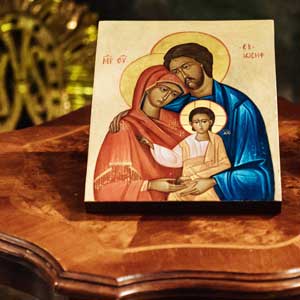
Children can draw the Holy Family, a star or a nativity scene.
They can then give their card to their grandparents or to someone who is lonely.
Learning a religious Christmas carol
Traditional carols help to convey the joy of the Nativity.
Songs such as ‘The Divine Child Is Born’, ‘Angels in Our Countryside’ or ‘Silent Night’ can be learnt and sung as a family.
Preparing a present for Jesus
Children can be encouraged to write down or draw a good deed they would like to do.
These little pledges can be placed near the nativity scene.
This activity helps them understand that the finest gift we can offer Jesus is a heart filled with love.
13. Questions children often ask about Christmas
Why is Jesus called the Son of God?
Christians believe that Jesus is the eternal Son of God, who became human to come amongst us.
He reveals God’s love to us and opens the way to salvation.
Why wasn’t Jesus born in a palace?
Jesus was born in humble circumstances.
His birth teaches us that true greatness lies in love, humility and simplicity.
Why is there a star above the nativity scene?
The star recalls the one which, in the Gospel according to Saint Matthew, guides the Magi to Jesus.
It also symbolises light and hope.
Why do angels sing at Christmas?
The angels announce the birth of the Saviour and give glory to God.
They invite us to rejoice at the coming of Jesus.
Why do we give presents?
Presents express love and generosity.
They also remind us that God gave us the greatest of all gifts by giving us his Son.
Why do we celebrate Christmas every year?
Every year, Christians celebrate the birth of Jesus to renew their faith and remember God’s love.
Is Christmas just a festival for children?
No. Christmas is a major Christian festival that involves people of all ages.
Children, parents, grandparents and the whole Christian community are invited to celebrate the birth of the Saviour.
14. A short Christmas prayer to say with the children
To help children experience Christmas through their faith, you can teach them a simple prayer.
It can be said in front of the nativity scene, before Christmas dinner or at bedtime.
Christmas prayer for children
Little Jesus,
On this Christmas Day, we celebrate your birth with joy.
Thank you for coming amongst us to show us God’s love.
Protect our family and everyone we love.
Help us to be kind, generous and considerate towards others.
Teach us to forgive and to share.
Watch over children who are sad, ill or alone.
May your light bring peace to our homes and to the world.
Stay close to us always, Lord Jesus.
Amen.
15. Making Christmas a memory of faith and love for the whole family
Childhood memories play an important part in building faith.
A child may remember for the rest of their life the nativity scene set up with their parents, the Christmas carols heard in church or the prayers said with their grandparents.
These simple moments can leave a deep impression.
They show that the Christian faith is not just knowledge to be learnt, but an experience to be lived.
Creating Christian family traditions
Every family can choose a few traditions that suit them.
These might include reading the Gospel before the Christmas meal, placing the Baby Jesus in the nativity scene, attending Mass or saying a prayer together.
The key is not to overload the schedule with activities.
It is better to focus on a few simple gestures, carried out with sincerity.
Passing on the faith by example
Children learn a great deal by observing adults.
When they see their parents praying, forgive, share or help someone in need, they discover in a tangible way what it means to live as a Christian.
Words are important, but example is just as important.
Preparing for Christmas then becomes an opportunity to bear witness to one’s faith in everyday life.
Conclusion: the greatest Christmas gift is the love of Jesus
Explaining the meaning of Christmas to children enables them to discover one of the greatest mysteries of the Christian faith: God became man in Jesus Christ to come and meet humanity.
Through the story of Mary and Joseph, the birth of Jesus in Bethlehem, the announcement to the shepherds and the visit of the Three Wise Men, children gradually discover the message of love and hope conveyed by the Nativity.
The nativity scene, carols, prayers and family traditions all serve to bring this story to life.
But beyond the explanations and activities, the most important thing is to help them understand that Christmas invites us to love more deeply.
Loving our family, forgiving, sharing, helping the most vulnerable and welcoming others with kindness are all ways of living out Jesus’ message.
Presents and decorations bring joy to the festivities, but they must not make us forget what lies at the very heart of it all.
For Christmas is not merely the remembrance of a child born over two thousand years ago: it is the celebration of God coming to dwell amongst us and offering us his love.
By passing on this truth to children with gentleness, simplicity and trust, families offer them a spiritual treasure that will stay with them throughout their lives.
And when children look at the Baby Jesus in the nativity scene, they will be able to understand that the most beautiful Christmas present is not to be found under the tree.
It is to be found in the manger at Bethlehem: it is Jesus, the Son of God, who came into the world out of love for each and every one of us.