How can you explain the season of Advent to children? Discover simple explanations, Christian traditions, prayers and activities to help them prepare for Christmas in the faith.
How can you explain the Advent season to children and prepare them for Christmas?
As Christmas approaches, children begin to count down the days with eager anticipation. The streets are lit up, Christmas trees are put up in homes, Advent calendars are opened every morning, and the festive preparations fill families with joy.
But amidst all this excitement, one crucial question needs to be asked: do our children really know why we look forward to Christmas?
For Christian families, the season of Advent is a wonderful opportunity to pass on the faith, to tell the story of Jesus’ birth and to teach the little ones that Christmas is so much more than just a celebration of presents.
Explaining Advent to children doesn’t require long catechism lessons. Often, all it takes is a few simple words, symbolic gestures and shared moments to help them discover the full beauty of this season.
The Advent wreath, the nativity scene, the candles, the prayers and small acts of generosity all become ways of preparing their hearts to welcome the Baby Jesus.
Advent is a four-week journey during which young and old alike learn to await Jesus with joy, trust and love.
1. What is Advent? A simple explanation for children
To explain Advent to a child, it is important to start with words they can understand.
You could say to them:
‘Advent is the time when Christians prepare to celebrate the birth of Jesus. For four weeks, we look forward to Christmas, but we also prepare our hearts to welcome Jesus with great love.”
The word ‘Advent’ comes from the Latin adventus, which means ‘coming’.
It reminds us that Jesus came into our world to show us how much God loves us.
Over two thousand years ago, in the small town of Bethlehem, Jesus was born into a humble family, to Mary and Joseph.
His birth is an extraordinary event for Christians, as they believe that Jesus is the Son of God who came amongst mankind.
Advent allows us to remember this birth and to prepare to celebrate it.
Why do we have to wait four weeks?
Children sometimes find it hard to understand why Christmas can’t happen straight away.
To explain the meaning of this waiting period to them, we can use a very simple example.
When a family is expecting a baby, they prepare the nursery, choose clothes and happily imagine the moment when they can finally welcome the baby home.
In the same way, during Advent, Christians prepare their hearts to welcome Jesus.
Each week brings us a little closer to Christmas.
This waiting teaches us patience, but also the joy of preparing for an important event.
It is also important to explain that Advent does not always last exactly twenty-eight days. It begins on the fourth Sunday before Christmas and ends before the celebrations of the Nativity.
In 2026, the first Sunday of Advent will be celebrated on 29 November.
2. Why do Christians prepare their hearts during Advent?
Children easily understand that you need to prepare a house before welcoming guests.
You tidy up, clean, decorate and try to make the place welcoming.
To explain the spiritual preparation of Advent, we can use this comparison.
‘ When we’re expecting someone we love very much, we prepare our home to make them happy. During Advent, we also prepare our hearts for Jesus.”
But how do we prepare our hearts?
Obviously, it’s not a question of decorating it with garlands!
Preparing one’s heart means trying to become kinder, more patient, more generous and more considerate of others.
This might mean helping your parents, sharing with your brothers and sisters, forgiving a friend, or taking a few minutes to pray.
Every good deed then becomes a small way of making room for Jesus in your life.
Explain that Jesus comes to bring light
Children are often fascinated by Christmas lights.
This is a lovely opportunity to explain to them that, in the Christian faith, Jesus is called the light of the world.
Light helps us to see when everything is dark.
In the same way, Jesus guides us towards love, truth, peace and forgiveness.
We can explain to children that every time they perform an act of kindness, they help to make this light grow around them.
So, Advent is not just a time when we wait for Christmas: it is also a time to learn how to make the world a little brighter.
3. The Advent wreath: four candles to help understand the anticipation of Christmas
The Advent wreath is one of the easiest symbols to explain to children.
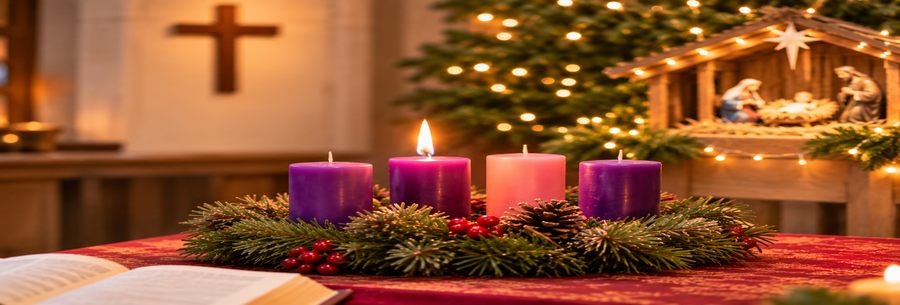
It is usually made up of fir branches, pine cones and four candles.
Its circular shape reminds us that God’s love has neither beginning nor end.
The evergreen branches symbolise life and hope.
As for the candles, they represent the light of Christ, which draws nearer as Christmas approaches.
How can we explain the four candles to children?
Every Sunday during Advent, a new candle is lit.
To help children understand their significance, each week can be linked to a Christian value.
The first candle: hope
We explain to the children that hope means trusting in God, even when things are difficult.
This week, we can suggest they pray for someone who is going through a difficult time.
The second candle: peace
Peace begins in our own hearts and within our families.
We can encourage the children to avoid arguments, to ask for forgiveness and to make a gesture of reconciliation.
The third candle: joy
The third Sunday of Advent is called GaudeteSunday, which means ‘Rejoice’.
This week, children can learn to thank God for the good things in their lives and to share their joy with others.
The fourth candle: love
The last candle reminds us that Christmas is approaching.
It invites children to reflect on God’s love, which gives us his Son, Jesus.
You could suggest they do a special good deed for someone they love.
These four values provide an educational way of presenting the candles. However, assigning them to each Sunday is not a universal liturgical rule.
A little family ritual around the wreath
Every Sunday, parents can gather the children around the Advent wreath.
After lighting the new candle, an adult can read a short passage from the Gospel or say a prayer.
The children can then share a special intention.
This ritual takes only a few minutes, but it can become a precious moment in family life.
It helps the youngest children understand that Advent is a time unlike any other, during which the whole family prepares together for Christmas.
The candles must, of course, be lit and supervised by an adult.
4. Tell the children the story of Mary and Joseph
To understand Advent, children need to learn about the people who prepared for and were part of the birth of Jesus.
The Virgin Mary and Saint Joseph play a central role in this story.
Mary, a young woman who trusts in God
You can begin by telling the story of the Annunciation.
One day, God sent the angel Gabriel to Mary, a young woman living in Nazareth.
The angel announced to her that she would become the mother of Jesus, the Son of God.
Mary is surprised by this announcement, but she confidently accepts the mission God has entrusted to her.
She replies:
‘I am the Lord’s servant; may it be done to me according to your word. ’ (Luke 1:38)
This story helps to explain to children that Mary is a model of faith and trust.
She teaches us to listen to God and to open our hearts to him.
Joseph, a good and protective man
Saint Joseph is also an important figure in the Christmas story.
He cares for Mary and watches over Jesus.
When God reveals his mission to him, Joseph agrees to become the protector of the Holy Family.
He teaches us faithfulness, courage and family love.
For children, Joseph can be presented as a man who looks after those entrusted to him and who trusts in God.
The journey to Bethlehem
Mary and Joseph must travel to Bethlehem for a census.
The journey is difficult, all the more so as Mary is expecting the birth of Jesus.
When they arrive, they cannot find a place in the inn where they might have stayed.
Jesus is therefore born in very humble circumstances, and Mary lays him in a manger.
This story helps to explain to children that Jesus was not born in a palace.
He was born in simplicity, showing us that God’s love depends neither on wealth nor on outward appearances.
5. The Christmas nativity scene: telling the story of Jesus’ birth with nativity figures
The nativity scene is a wonderful way to explain Advent to children.
Through the figures, they can gradually discover the story of the Nativity.
You can turn setting up the nativity scene into a real family catechesis activity.
Setting up the nativity scene gradually
At the start of Advent, you can set up the stable and a few animals.
The children can then place the shepherds and their sheep.
Mary and Joseph can be added as Christmas approaches.
The Baby Jesus will be placed in the manger on the night of 24th to 25th December.
The Three Wise Men can be added to the nativity scene on Epiphany.
Each stage becomes an opportunity to recount an episode from the story of Jesus.
Explaining the figures in the nativity scene
Mary is the mother of Jesus. She teaches us to love God and to trust in him.
Joseph protects Mary and Jesus. He shows us the importance of looking after our family.
The shepherds were among the first to receive thenews of the Saviour’s birth. They remind us that Jesus came for everyone, including the humblest of people.
The angels announce the good news of Christ’s birth.
The Three Wise Men come to pay homage to Jesus and offer him gifts. Their visit is particularly celebrated on Epiphany.
The Baby Jesus is the central figure in the nativity scene. His birth reminds us that God loves us so much that He came to share our human condition.
A lovely activity: preparing Jesus’s manger
A family tradition involves placing a small piece of straw in the manger each day when the child does a good deed.
This might involve helping to set the table, sharing a toy, comforting someone or showing patience.
By Christmas, the manger will be filled with straw and ready to welcome the Baby Jesus.
This activity helps children to understand in a practical way that their acts of love are part of their spiritual preparation.
6. The Christian Advent calendar: a different way to look forward to Christmas
For many children, the Advent calendar is associated with discovering a piece of chocolate or a little surprise each day.
It is entirely possible to keep this tradition whilst giving it a Christian dimension.
The calendar can become a journey of prayer, generosity and discovery of the faith.
24 little Christian tasks for children
Here are twenty-four ideas to suggest during the month of December:
Say a prayer for your family.
Help your parents without them asking.
Say something kind to a classmate.
Pray for children who are ill.
Read the story of the Annunciation.
Draw a picture for your grandparents.
Sharing a toy with your brother or sister.
Praying to the Virgin Mary.
Say thank you to God for three lovely things.
Make an effort not to argue.
Make a Christmas card for someone who is on their own.
Listen to a Christian Christmas carol.
Donate a toy in good condition to a charity.
Read a passage from the Gospel.
Help set up the nativity scene.
Pray for world peace.
Pay someone a sincere compliment.
Forgive someone.
Thank someone who helps us.
Do a small act of kindness.
Pray for people who are homeless.
Prepare a decoration for the nativity scene.
Thank Mary and Joseph for taking Jesus in.
Take a moment of quiet reflection before the nativity scene to celebrate the birth of the Saviour.
These little tasks help children realise that preparing for Christmas is not just about presents.
They teach them that the joy of Christmas grows when we learn to love and to share.
7. Teaching children to pray during Advent
Prayer plays an essential role in Christian life.
However, children can sometimes find it difficult to understand what praying means.
It is important to explain to them that prayer is quite simply a way of talking to God.
We can thank him, ask him for help, confide our worries to him or tell him about our joys.
God listens to everyone with love.
A short Advent prayer for children
Lord Jesus,
We are looking forward to Christmas with great joy.
Help us to prepare our hearts for your birth.
Teach us to be kind, patient and generous.
Protect our family and all those we love.
Help us to share with those who have less than we do.
Together with Mary and Joseph, we await your coming.
Come, Lord Jesus, and fill our home with your love.
Amen.
This prayer can be said every evening before bedtime or in front of the nativity scene.
The youngest children can learn a few phrases gradually, whilst the older ones can add their own intentions.
8. Explaining to children why we go to church during Advent
Advent is not only experienced at home.
It is also an important time in the life of the Catholic Church.
Every Sunday, Christians gather to celebrate Mass and listen to the Word of God.
The Bible readings help them prepare their hearts for the coming of Jesus.
Why does the priest wear purple?
Children often notice the changes in colour in church.
During Advent, the priest usually wears purple liturgical vestments.
You can explain to them that this colour symbolises a time of preparation, prayer and conversion.
On the third Sunday of Advent, the priest may wear pink.
This colour expresses the joy of knowing that Christmas is approaching.
Why do we light candles in church?
The candles remind us that Jesus is the light of the world.
Each new candle lit on the Advent wreath shows that we are moving towards the feast of Christmas.
Children can observe this progression each Sunday and understand that the whole Church is preparing together to welcome the Saviour.
Why is it important to attend Mass?
Mass enables Christians to come together, to pray and to encounter Christ in the Eucharist.
During Advent, it helps us to listen to the messages of the prophets, St John the Baptist and the Gospels.
For children, attending Mass can be a wonderful opportunity to discover the faith alongside their parents and their parish community.
9. Teaching children patience and the meaning of waiting
One of the great lessons of Advent is patience.
For a child, waiting for Christmas can seem to go on forever.
Every day, they look at the calendar and ask how long there is left until the big day.
Rather than trying to make this impatience go away, parents can help them understand that waiting is part of the joy.
When preparing for an important event, each step adds to the joy of experiencing it.
Advent thus teaches us that some precious things take time.
Turning the wait into moments of joy
Parents can suggest a small activity each week.
In the first week, put up the Advent wreath.
In the second week, set up the nativity scene.
In the third week, make Christmas cards.
In the fourth week, read the Nativity story together.
These activities help to give meaning to the passing days.
They show children that waiting is not simply a period of idleness, but a time during which we can grow in love.
10. Introducing children to generosity and sharing
Christmas is often associated with presents.
For children, it is natural to look forward eagerly to the surprises that await them.
But Advent offers a wonderful opportunity to teach them that joy does not come solely from what we receive.
It also comes from what we give.
Why does Jesus teach us to share?
Jesus was born into a humble family, in very simple circumstances.
His birth reminds us that the greatest wealth is that of the heart.
We can explain to children that Jesus invites us to love others, to help those who are suffering and to share with those who have less than we do.
A small act of generosity can bring a great deal of happiness.
Acts of solidarity suitable for children
Families can suggest various activities:
Choose a toy to give to a child in need.
Put together a small parcel for someone in need.
Make a Christmas card for an elderly person.
Take part in a collection organised by the parish.
Help a neighbour or a family member.
Pray for people who are lonely or ill.
These actions help children to discover that the Christian faith is also lived out through concrete acts.
They help them understand that preparing for Christmas also means preparing for a more caring world.
11. How can we explain Advent in a way that suits children’s ages?
Not all children understand explanations in the same way.
It is therefore important to adapt the language and activities to their age.
Ages 3 to 5: discovering Advent through simple actions
At this age, children learn mainly by observing and imitating.
It is best to focus on short stories, songs, nativity figures and very simple prayers.
You could explain to them:
‘ ‘During Advent, we look forward to Jesus’ birthday. Every day, we try to do something kind to make room for him in our hearts.’”
The Advent wreath and the nativity scene are particularly suitable for this age group.
Ages 6 to 9: understanding the Christian meaning of Christmas
Children start to ask more questions.
They can learn about the story of Mary and Joseph, the symbols of Advent and the Bible passages that foretell the birth of Jesus.
This is also an ideal age to set them small daily tasks.
They gradually come to understand that acts of kindness, forgiveness and prayer are part of the Christian life.
Ages 10 to 12: deepening faith and the values of Advent
At this age, children can reflect more deeply on the meaning of Jesus’ coming.
You can discuss with them the concepts of hope, conversion, solidarity and trust in God.
Gospel readings can be followed by discussions.
Why did God choose to be born into a humble family? Why is Jesus called the Saviour? How can we follow his example today?
These questions help to deepen their faith whilst respecting the children’s curiosity.
With teenagers: giving meaning to the preparations for Christmas
Teenagers often need to understand the deeper meaning behind traditions.
It is important to give them an active role in preparing for Advent.
They can take part in a charitable initiative, choose a prayer intention or get involved in a parish activity.
Advent can also become a time for personal reflection on their relationships, their choices and the way they live out their faith.
The aim is not to impose a series of activities on them, but to show them that the message of Christmas also applies to their daily lives.
12. Answering questions children often ask about Advent
Why was Jesus born in a stable?
Jesus was born in very humble circumstances, because Mary and Joseph could not find a place in the inn where they might have stayed.
This birth reminds us that God does not seek wealth or honours.
He comes to meet all people, especially the most humble.
Why did Jesus come to Earth?
For Christians, Jesus is the Son of God who came amongst mankind to reveal to us his Father’s love and to bring us salvation.
He teaches us to love God and our neighbour, to forgive and to live in truth.
Why do we look forward to Christmas if Jesus has already been born?
We know that Jesus was born over two thousand years ago.
Every year, we celebrate this event to remember his coming and renew our faith.
Advent also prepares us to welcome Jesus into our lives today and reminds us of the hope of his glorious return.
Why are there four candles on the Advent wreath?
The four candles represent the four Sundays of Advent.
Every Sunday, we light a new one to show that we are drawing closer to Christmas.
They remind us that Jesus is the light of the world.
Is Advent just for children?
No. Advent is for all Christians, whatever their age.
Children, parents, grandparents and the whole Christian community are invited to prepare their hearts for the coming of the Lord.
Why do we give presents at Christmas?
Presents express love and the joy of sharing.
They can also remind us that God has given us an immense gift by giving us his Son, Jesus.
But it is important to understand that the greatest Christmas gift is not material: it is God’s love.
13. A short programme for experiencing the four weeks of Advent with children
To help families organise this preparation, here is a simple programme that can be adapted to the children’s ages.
Week One: learning to hope
Light the first Advent candle.
Explain to the children that God keeps his promises and invites us to trust him.
Set up the nativity scene and begin to tell the story of Jesus’ birth.
Say a short prayer for someone who is going through a difficult time.
Week two: learning to make peace
Light the second candle.
Talk about forgiveness and the importance of living in peace with others.
Encourage the children to make a gesture of reconciliation or to ask for forgiveness when they have hurt someone.
You could also read a passage from the Gospel about St John the Baptist.
Week three: learning to share joy
Light the third candle.
Explain that Christmas is approaching and that this anticipation should fill our hearts with joy.
Make Christmas cards together, sing carols and organise a small act of charity.
Give thanks to God for the wonderful experiences you have shared as a family.
Week Four: Welcoming Jesus with love
Light the fourth candle.
Tell the children about Mary and Joseph’s journey to Bethlehem.
Prepare the manger for the Baby Jesus and take time to pray together.
On Christmas Eve, read the Nativity story before placing Jesus in the nativity scene.
This moment can become a particularly moving family tradition.
14. Christmas Eve: explaining the Saviour’s birth to the children
After several weeks of waiting, Christmas Eve finally arrives.
This is the time to remind the children why the whole family has been preparing.<
You can tell them one last time the story of Mary and Joseph, the birth of Jesus, the announcement to the shepherds and the joy that accompanies this event.
In the Gospel according to Saint Luke, the angels announce the birth of the Saviour to the shepherds keeping watch in the fields.
The shepherds then go to Bethlehem and discover the Baby Jesus lying in a manger.
This scene reminds us that the good news of Christmas is meant for everyone.
A moment of prayer before the nativity scene
Before opening presents or starting the Christmas meal, the family can gather before the nativity scene.
The children can place the Baby Jesus in the manger, then say a short prayer.
A short Christmas prayer for children
Little Jesus,
Today we celebrate your birth.
Thank you for coming among us.
Thank you for our family and for everyone we love.
Help us to keep our hearts filled with kindness.
Teach us to share, to forgive and to love.
Stay close to us always, Lord Jesus.
Amen.
This simple moment helps children understand that the true meaning of Christmas lies in the birth of Christ.
Conclusion: passing on the true joy of Advent to children
Explaining the season of Advent to children offers them much more than simply preparation for the Christmas celebrations.
It means passing on to them an essential part of the Christian faith, teaching them to discover Jesus and showing them that love, patience, generosity and forgiveness lie at the heart of his message.
Children do not need lengthy theological explanations to understand the beauty of Advent.
Above all, they need simple gestures, family traditions and practical examples.
A candle lit each Sunday, a prayer said before bedtime, a figure added to the nativity scene or a good deed done with love can become genuine lessons in faith.
These little shared moments create precious memories and help to nurture children’s spirituality.
They enable them to discover that Christmas is about more than just presents, decorations and festive meals.
Christmas is, above all, the celebration of the birth of Jesus, the Son of God who came amongst us out of love.
By supporting their children throughout the four weeks of Advent, parents and grandparents offer them a gift that can stay with them for the rest of their lives: the discovery of faith, hope and Christian joy.
And when Christmas Eve finally arrives, they will be able to gaze upon the Baby Jesus in the manger, understanding a little better why his birth is such a great joy for the world.
For the most beautiful gift we can prepare for Jesus during Advent is a heart filled with love.