Among the most profound and moving words of Jesus Christ, those recorded in the Gospel according to Saint Matthew, chapter 25, verses 31 to 40, occupy a central place in the Christian faith. Through his teaching on the Last Judgement, Jesus reveals a fundamental truth to us: the love we have for God is manifested in concrete terms through the love we show to our brothers and sisters, particularly the poorest, the weakest and the most forgotten.
“Amen, I say to you: whatever you did for one of these least of my brothers, you did for me. ” (Matthew 25:40)
These words invite us to take a fresh look at the people we meet. Behind the face of a poor person, a sick person, a prisoner or a stranger, Jesus calls us to recognise a human dignity that deserves respect, care and love.
But what does this teaching really mean? Why does Jesus identify Himself with the least of these? How can we put these words into practice in our daily lives?
To understand the full richness of this biblical passage, let us explore its context, its spiritual meaning and the lessons the Catholic Church invites us to draw from it.
1. The context of Matthew 25:31–40: Jesus announces the Last Judgement
The teaching on ‘the least of my brothers’ takes place at the end of Jesus’ public ministry, shortly before the events of his Passion.
In chapters 24 and 25 of the Gospel according to Saint Matthew, Jesus speaks of his glorious coming, of spiritual vigilance and of every human being’s responsibility before God.
He uses several parables to urge his disciples to prepare for their final encounter with the Lord.
Among these teachings are the parable of the ten virgins, the parable of the talents and, finally, the great scene of the Last Judgement.
Jesus declares:
‘When the Son of Man comes in his glory, and all the angels with him, then he will sit on his throne of glory. ’ (Matthew 25:31)
Christ presents himself here as the judge of humanity.
All nations will be gathered before him and each person will be called to give an account of their way of life.
However, the criterion for judgement presented in this passage is particularly revealing.
Jesus does not begin by asking people about their wealth, influence or social success.
He speaks of simple acts: feeding the hungry, giving drink to the thirsty, welcoming the stranger, clothing the naked, and visiting the sick and those in prison.
These acts of mercy become the visible signs of authentic love.
Christ thus teaches us that true faith cannot be separated from charity.
2. Why does Jesus call the poor ‘my brothers’?
One of the most striking expressions in this passage is ‘my brothers’.
Jesus is not simply speaking of the poor as people who deserve our generosity.
He establishes a personal and profound bond between Himself and those in need.
By calling them his brothers, He reveals their special dignity to us and invites us to recognise in them people loved by God.
In the Christian tradition, these words have fostered a universal understanding of charity.
Every human being, whatever their origin, social status or history, possesses a dignity that depends neither on their wealth nor on their reputation.
It is also worth recalling that the expression ‘the least of my brothers’ is subject to various biblical interpretations.
Some exegetes interpret this more specifically as referring to the disciples of Jesus, particularly when they are vulnerable or persecuted. The Church’s spiritual and moral tradition has also recognised in this passage a fundamental call to serve Christ through the poor and the suffering.
This interpretation is consistent with the Gospel’s overall teaching on love for one’s neighbour.
Thus, when we help a vulnerable person, we are not merely showing human kindness.
We are performing an act that possesses a genuine spiritual dimension.
To serve the least among us is to respond to Christ’s love and to recognise his presence in those who suffer.
3. ‘I was hungry and you gave me food’: feeding those in need
The first work of mercy mentioned by Jesus concerns hunger.
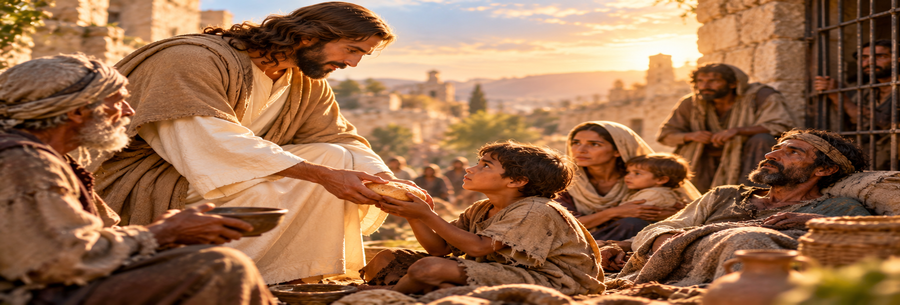
‘For I was hungry, and you gave me food. ” (Matthew 25:35)
Hunger is one of the most fundamental forms of human suffering.
It reminds us of our fragility and our dependence on the essentials of life.
In the ancient world, as today, many people experienced poverty, crop failures and food insecurity.
By asking his disciples to feed the hungry, Jesus reminds them that love for God must be expressed through concrete care for material needs.
It is not enough simply to wish well for someone who is suffering.
When we have the opportunity, we are called to offer them real help.
Today, this teaching can take many forms: offering a meal to a homeless person, supporting a charity, taking part in a food drive, or discreetly helping a family facing financial difficulties.
Christian charity is not measured solely by the size of the gift.
A modest gesture, performed with sincerity and love, is of great value in God’s eyes.
Jesus teaches us that the greatness of an act depends not only on what we give, but also on the love with which we do it.
4. ‘I was thirsty and you gave me a drink’: the value of small gestures
After hunger, Jesus speaks of thirst.
‘I was thirsty, and you gave me a drink. ’ (Matthew 25:35)
Giving a glass of water seems like an almost insignificant gesture.
Yet Jesus attaches particular importance to it.
In the hot regions of Palestine, offering water to a traveller was an essential act of hospitality.
This simple gesture could bring real relief.
Through this image, Jesus reminds us that charity does not necessarily require extraordinary actions.
A glass of water, a comforting word, a few minutes of listening, or spontaneous help can become profound expressions of Christian love.
We sometimes tend to think that serving God requires great achievements.
But the Gospel teaches us that small acts carried out with love can have immense spiritual value.
This truth is particularly evident in the spirituality of Saint Thérèse of the Child Jesus, who showed how the most ordinary gestures could become a path to holiness when performed out of love.
The disciple of Christ thus learns to recognise opportunities to do good in the simplest circumstances of their life.
5. ‘I was a stranger and you welcomed me’: hospitality at the heart of the Gospel
Welcoming the stranger occupies an important place in the biblical tradition.
Ever since the Old Testament, God’s people have been called to respect and protect those who find themselves far from their homeland and loved ones.
In the Gospel, Jesus reiterates this requirement:
‘I was a stranger, and you welcomed me. ’ (Matthew 25:35)
The stranger represents someone who finds themselves in a vulnerable situation, deprived of their usual points of reference and sometimes exposed to loneliness or rejection.
Welcoming someone does not simply mean physically opening a door.
It also means recognising a person’s dignity, showing them respect and refusing to reduce them to their origins or circumstances.
In our daily lives, welcoming others can take many different forms.
It may involve supporting someone who has recently arrived in our town, helping an isolated neighbour, taking the time to get to know someone who feels excluded, or taking part in a charitable initiative.
Christian charity calls us to overcome indifference.
It teaches us to see in every person a human being loved by God.
Hospitality thus becomes a concrete way of bearing witness to the Gospel.
6. ‘I was naked and you clothed me’: protecting human dignity
Jesus continues his teaching by referring to those who lack clothing.
‘I was naked, and you clothed me. ” (Matthew 25:36)
In ancient societies, clothing represented not only protection against the cold and the elements, but also an essential element of social dignity.
Being deprived of clothing could be associated with extreme poverty, humiliation or exclusion.
By asking us to clothe those who are naked, Jesus calls on us to protect the dignity of the most vulnerable.
Today, this work of mercy can take the form of donating clothes, helping families in need or supporting organisations that assist homeless people.
But this teaching also has a broader dimension.
Respecting human dignity means refusing to humiliate a person because of their poverty, their appearance or their difficulties.
Charity is not merely about giving something.
It requires giving with respect, sensitivity and discretion.
A gift given with contempt loses much of its spiritual significance.
Christians are called to help their neighbour without ever making them feel inferior.
7. ‘I was sick and you visited me’: accompanying those who suffer
Illness is one of the most trying experiences of human existence.
It confronts us with our fragility, with physical suffering and, at times, with the fear of death.
In the Gospel, Jesus shows constant concern for the sick.
He welcomes them, listens to them, touches them and heals them.
In his teaching on the Last Judgement, he declares:
‘I was sick, and you visited me.’ (Matthew 25:36)
It is remarkable that Jesus speaks here of visiting.
He does not ask everyone to perform a miracle or to heal illnesses.
He simply emphasises the importance of human presence.
A sick person may suffer as much from isolation as from their illness itself.
A visit, a phone call, a silent presence or a shared prayer can bring immense comfort.
This teaching is particularly relevant to the elderly, those in hospital and those living alone.
It reminds us that we must not abandon those whose suffering makes us feel uncomfortable.
Sometimes, we do not know what to say when faced with illness.
But charity does not always require us to find the perfect words.
It often consists of being present, listening and offering faithful support.
Christian compassion begins when we accept that we must not look away from suffering.
8. ‘I was in prison and you came to visit me’: never abandon those who have erred
The final situation mentioned in this passage concerns prisoners.
‘I was in prison, and you came to visit me. ’ (Matthew 25:36)
These words may seem particularly demanding.
Why does Jesus ask us to visit those who are imprisoned?
In ancient times, prison conditions could be extremely harsh.
Prisoners sometimes depended on outside help to receive food, clothing or material support.
But beyond this historical reality, Jesus is imparting to us an essential teaching on human dignity and mercy.
A person who has committed a wrong remains a human being.
Justice must be upheld, victims must be recognised and responsibility must be taken.
However, wrongdoing does not take away the dignity of the person who committed it.
Christianity teaches that conversion remains possible and that no one should be considered irretrievably lost.
Visiting a prisoner, supporting a prison chaplaincy or accompanying someone seeking to rebuild their life are all ways of putting these words of Christ into practice.
Mercy does not override the demands of justice.
It reminds us that justice must always leave room for human dignity, repentance and hope.
9. The Last Judgement: why will Jesus judge us on the basis of love?
One of the most striking aspects of Matthew 25 is the surprise of the righteous.
They ask the Lord:
‘Lord, when did we see you…?’ (Matthew 25:37)
They do not seem to have realised that they were serving Christ directly when they were helping those in need.
Their actions had become a natural expression of their love.
Jesus then reveals to them that by serving the least of these, they had served Him.
This scene teaches us that our relationship with God cannot be separated from our behaviour towards others.
It would be contradictory to claim to love Christ whilst remaining deliberately indifferent to the suffering of one’s neighbour.
St John expresses this truth forcefully in his first letter:
‘ ‘Whoever does not love their brother, whom they have seen, cannot love God, whom they have not seen.’ (1 John 4:20)
The Christian faith is founded on God’s grace, received in faith and called to bear fruit in charity.
The works of mercy are therefore not merely social obligations.
They are a concrete expression of the love that transforms the believer’s heart.
The Last Judgement reminds us of the gravity of our choices, but also of the beauty of our daily opportunities to serve God.
Every encounter can become a place where our love is called to grow.
10. The corporal and spiritual works of mercy in the Catholic Church
The teaching of Matthew 25 has profoundly shaped the tradition of the Church.
It constitutes one of the biblical foundations of the corporal works of mercy.
The Catholic Church traditionally distinguishes between seven corporal works of mercy and seven spiritual works of mercy.
The corporal works consist of meeting people’s material and physical needs.
They include feeding the hungry, giving drink to the thirsty, clothing the naked, sheltering the homeless, visiting the sick, visiting prisoners and burying the dead.
The spiritual works concern the needs of the soul and moral support.
In particular, they involve counselling those who are in doubt, instructing those who are ignorant, admonishing sinners with charity, comforting the afflicted, forgiving offences, patiently bearing with difficult people, and praying for the living and the dead.
These works are not reserved for priests, religious or those involved in organisations.
They concern all the baptised.
Every Christian can practise them according to their abilities, their state of life and the circumstances.
A mother who comforts her child, a neighbour who helps an elderly person, a volunteer who distributes meals, or a member of the congregation who prays for someone who is isolated – each, in their own way, takes part in this mission of charity.
Holiness is also built through faithfulness to small acts of love.
11. The example of the saints who recognised Jesus in the poorest
Over the centuries, many saints have dedicated their lives to putting the teaching of Matthew 25 into practice.
Saint Vincent de Paul remains one of the great figures of Christian charity.
In the 17th century, he was particularly committed to serving the poor, the sick and abandoned children.
He helped to organise relief efforts and encouraged Christians to regard service to the poor as a genuine encounter with Christ.
Saint Louise de Marillac, who worked alongside him, also devoted her life to the most vulnerable.
Together, they helped found the Daughters of Charity, a community dedicated to practical service to the poor.
Closer to our own time, Saint Teresa of Calcutta left her mark on the world through her commitment to the abandoned, the sick and the dying.
Through her work, she reminded us that human dignity never disappears, even in the most extreme poverty.
These saints show us that Christian charity is not an abstract idea.
It requires us to draw close to those who suffer, to devote time to them and to recognise their worth.
But their example must not discourage us.
We are not all called to carry out such significant works.
We are, however, all invited to love sincerely, wherever God has placed us.
12. How can we apply Matthew 25:31–40 in our daily lives?
It is sometimes difficult to know how to put Jesus’ words into practice in a life marked by work, family responsibilities and material concerns.
Yet there are many opportunities to practise charity.
Within our families, we can learn to listen more, to forgive more readily and to care for those who are vulnerable.
In our neighbourhood, we can be attentive to the elderly, those who are isolated or facing difficulties.
In our working lives, we can act with justice, honesty and respect towards our colleagues.
In our parish, we can take part in solidarity initiatives, support those in need or devote time to voluntary work.
Prayer also plays an essential role.
Praying for the sick, prisoners, the poor and the abandoned is a true work of spiritual mercy.
However, when we have the opportunity to provide practical help, prayer must not become an excuse for inaction.
Christian love seeks to unite prayer and action.
It is not a question of resolving all the world’s suffering on our own.
It is a matter of not deliberately closing our hearts to the needs we encounter.
We cannot help everyone, but we can always seek to do good around us.
13. Recognising Jesus in the least of these: a path of humility
The teaching in Matthew 25 also invites us to change the way we look at things.
We naturally tend to admire those who are powerful, famous or influential.
But Jesus asks us to pay particular attention to those whom society notices the least.
The poor, the sick, the elderly, prisoners and the marginalised become, in this teaching, the figures through whom our love is put to the test.
This perspective overturns the usual criteria for human greatness.
In God’s eyes, a quiet person who faithfully cares for the sick can demonstrate admirable charity.
A man who humbly shares his meal may be performing an act of great spiritual value.
A woman who devotes time to a lonely person may bear witness to the love of Christ without ever drawing attention to herself.
Christian humility consists, in particular, in recognising that we are not superior to those we help.
We are all fragile and dependent on divine grace.
The person who gives today may need to receive tomorrow.
Authentic charity does not create a relationship of superiority, but a fraternal encounter.
It teaches us to look at others through the eyes of Christ.
14. Frequently asked questions about Jesus’ teaching in Matthew 25, 31–40
What does ‘Whatever you did for one of the least of these, you did for me’ mean?
These words mean that acts of charity performed towards vulnerable people have a profound spiritual dimension. Jesus identifies with the least of these and teaches us that serving our neighbour is a way of responding to his love.
Who are the ‘least of my brothers’ in the Gospel?
Depending on biblical interpretations, the expression may refer to Jesus’ disciples facing weakness or persecution. In the Catholic moral and spiritual tradition, this passage also underpins the call to recognise and serve Christ in the poor and those who are suffering.
Why does Jesus speak of the Last Judgement?
Jesus reminds us that our choices have eternal consequences. The Last Judgement reveals the truth of our lives before God and emphasises the importance of faith lived out in love and charity.
What are the six acts mentioned by Jesus in Matthew 25, 35–36?
Jesus refers to feeding the hungry, giving drink to the thirsty, welcoming the stranger, clothing the naked, visiting the sick and visiting those in prison.
Is doing good deeds enough to be saved?
In the Catholic faith, salvation is a gift of God’s grace, received through faith and lived out in love. Good works do not replace divine grace, but they are essential fruits of a living faith.
How can one practise Christian charity without having much money?
Charity does not depend solely on financial means. Giving one’s time, listening to someone who is lonely, visiting the sick, forgiving an offence or helping a neighbour are acts that are within the reach of many people.
Why is this teaching important for Christians today?
It reminds us that faith cannot be limited to words or religious practices. It must transform the way we live and make us attentive to the most vulnerable.
15. Prayer to recognise Jesus in the least of our brothers and sisters
Lord Jesus,
You who welcomed the poor, comforted the afflicted and reached out to those who were rejected, teach me to look at the world through Your heart.
Open my eyes to the suffering I do not see and to the cries for help I do not hear.
Forgive me when I walk past someone in need too quickly.
Forgive me when my own concerns prevent me from recognising my neighbour’s distress.
Lord, grant me a generous heart, capable of sharing without calculation and of loving without expecting a reward.
When I meet someone who is hungry, inspire me with the desire to feed them.
When I see someone suffering from loneliness, give me the courage to offer them my company.
When I meet someone who is ill, teach me patience and compassion.
When I am tempted to judge or condemn, remind me that every human being remains loved by You.
Help me to recognise Your presence in the least, the poorest and the most forgotten.
May my words bring peace, may my hands become instruments of charity, and may my actions bear witness to Your love.
Lord Jesus, do not let my faith remain merely in my thoughts or in my prayers.
Grant that it may be expressed every day through acts of kindness, justice and mercy.
And when the day comes when I stand before You, may I have learnt to love You by loving my brothers and sisters.
Lord, teach me to recognise You and to serve You in each and every person You place in my path.
Amen.
Conclusion: to love the least among us is to welcome Christ into our lives
Jesus’ teaching in Matthew 25:31–40 is one of the most powerful calls in the Gospel.
Through the scene of the Last Judgement, Christ reminds us that our faith must be expressed in concrete love for our neighbour.
Feeding the hungry, welcoming the stranger, clothing those in need, visiting the sick and those in prison: these simple acts become profound expressions of our relationship with God.
Jesus does not necessarily ask us to perform extraordinary deeds.
He invites us to carry out ordinary acts with extraordinary love.
Every day offers us opportunities to serve, to comfort, to share and to forgive.
Sometimes all it takes is an attentive glance, a kind word or a little time set aside to bring light into someone’s life.
The true disciple of Christ does not seek to recognise Jesus only in prayer or in churches.
They also learn to recognise Him in the faces of those who suffer.
For, as the Lord reminds us:
‘Whatever you did for one of the least of these brothers and sisters of mine, you did for me. ’ (Matthew 25:40)
These words are far more than a moral teaching. They are an invitation to transform our lives into a living testimony to God’s love.