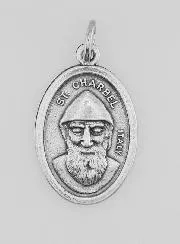
Among the great spiritual figures of Eastern Christianity, Saint Charbel Makhlouf holds a very special place. A Lebanese monk and hermit of the Maronite Church, he devoted his life to prayer, silence, penance and a profound union with God.
During his lifetime, Saint Charbel sought a life of humility and solitude. Yet, after his death, his reputation spread far beyond the walls of his monastery and the borders of Lebanon.
Today, Christians from all over the world turn to him in prayer. His tomb, located at the Saint Maron Monastery in Annaya, Lebanon, has become an important place of pilgrimage.
Saint Charbel is particularly well known for the numerous accounts of healings and graces obtained through his intercession. But before he became associated with miracles, he was above all a man wholly devoted to God.
Who was Saint Charbel? Why did he choose to become a hermit? What miracles are attributed to him? When is he celebrated? Why do so many people pray to him for healing?
Let us discover the extraordinary life of Saint Charbel Makhlouf, the great Maronite saint of Lebanon.
Who was Saint Charbel Makhlouf?
Saint Charbel was born Youssef Antoun Makhlouf on 8 May 1828, in the village of Bqaa Kafra, in northern Lebanon.
He grew up in a deeply devout Maronite Christian family.
Daily life was simple and demanding.
Youssef lost his father whilst he was still very young. His mother raised her children in the faith and in prayer.
From childhood, Youssef showed a particular inclination towards solitude and contemplation.
When tending his family’s animals, he liked to withdraw to a quiet spot to pray.
Gradually, a desire grew within him to devote his life entirely to God.
Why did Youssef Makhlouf become a monk?
At the age of about 23, Youssef made a radical decision.
He left his village to enter monastic life.
He first entered the Monastery of Our Lady of Mayfouq before continuing his training at the Monastery of Saint Maron in Annaya.
When he became a monk, he was given the name Charbel.
This change of name symbolised a new birth.
From then on, his life belonged entirely to the Lord.
Saint Charbel took his religious vows in 1853.
He then continued his theological studies and was ordained a priest in 1859.
Thus began a long life of prayer, work, obedience and silence.
How did Saint Charbel live?
Saint Charbel’s life was one of great simplicity.
He sought neither fame nor positions of authority.
He wished only to belong to God.
His days were organised around prayer, the celebration of the Eucharist, manual labour, meditation and community life.
Charbel also practised a rigorous asceticism.
He ate simply, slept little and sought to detach himself from material possessions.
This austerity may seem difficult to understand today.
But his aim was not to despise his body or the world.
He wanted to become inwardly free.
For him, the less his heart was burdened, the more open it became to God.
Why did Saint Charbel choose to become a hermit?
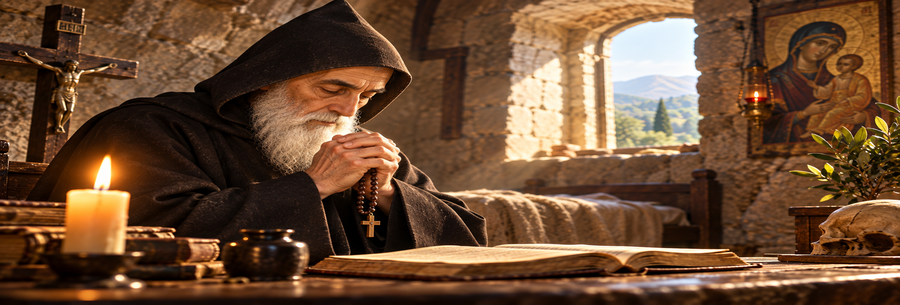
After many years of monastic life, Charbel felt an even deeper call to solitude.
In 1875, he obtained permission to become a hermit.
He settled in the Hermitage of Saints Peter and Paul, situated near the monastery of Annaya.
He remained there for around twenty-three years.
His life then became even more silent.
Yet the hermit was not a man who rejected the world.
In the Christian tradition, he withdrew in order to seek God more intensely and to carry the world in his prayers.
Saint Charbel thus prayed for the Church, for sinners, for those who were suffering, and for all those who sought his intercession.
The silence of Saint Charbel
One of the most striking aspects of his life is his love of silence.
Saint Charbel spoke little.
His very existence was a prayer.
At a time when we are constantly bombarded by conversations, screens, news and notifications, his example is strikingly relevant today.
Christian silence is not merely the absence of noise.
It creates an inner space in which a person can listen to God.
Saint Charbel thus reminds us that some answers are not to be found in more words.
Sometimes they are discovered in silence.
Saint Charbel and the Eucharist
The centre of Saint Charbel’s spiritual life was Jesus Christ present in the Eucharist.
He would prepare for the celebration of Mass with deep contemplation and could devote a great deal of time to giving thanks.
For him, the Eucharist was not merely a rite.
It formed the heart of his day.
His entire life seemed to revolve around this encounter with Christ.
This profound Eucharistic spirituality goes a long way towards explaining the power of his witness.
Saint Charbel invites us to rediscover the Mass not as a mere habit, but as an encounter with Jesus.
How did Saint Charbel die?
In December 1898, whilst celebrating the Divine Liturgy in his hermitage, Charbel suffered a severe fainting spell.
He was carried back to his cell.
His condition deteriorated rapidly.
After several days of suffering, he died on 24 December 1898, on Christmas Eve.
He was 70 years old.
The monk, who had spent his entire life seeking silence, thus left this world just as Christians were preparing to celebrate the birth of Christ.
He was buried at the Monastery of Saint Maron in Annaya.
But after his death, a series of unusual events would help to make his name known far beyond Lebanon.
What happened after Saint Charbel’s death?
Shortly after his death, extraordinary phenomena were reported around his tomb.
Witnesses spoke in particular of the appearance of an unusual light near his tomb.
The monk’s reputation then began to spread.
His body was exhumed on several occasions, and observations deemed unusual were reported by the clergy and ecclesiastical authorities of the time.
These events gradually drew large numbers of pilgrims to Annaya.
But it was above all the testimonies of people claiming to have been healed or to have received a grace after praying to Saint Charbel that helped spread his reputation throughout the world.
Why is Saint Charbel associated with healings?
Saint Charbel is today particularly invoked by those who are ill.
Over the decades, the monastery at Annaya has collected a great many testimonies from people claiming to have experienced an improvement, a healing or a grace after seeking his intercession.
The Catholic Church, however, distinguishes between personal testimonies and miracles officially recognised as part of a process of beatification or canonisation.
Several healings have been the subject of ecclesiastical investigations as part of the process of recognising Charbel’s holiness.
This is why his name is now closely associated with prayer for the sick and with hope in times of trial.
The miracles of Saint Charbel
A great many accounts of healing are associated with Saint Charbel.
Some people say they prayed at his tomb.
Others say they used blessed oil or an image of the saint whilst asking for his intercession.
Still others testify to having felt his presence during a particularly difficult time.
For Christians, however, it is essential to remember that the saint does not act through a power independent of God.
When a Catholic seeks the intercession of Saint Charbel, they are asking him to pray to God with them and on their behalf.
Grace always comes from God.
The saint is an intercessor.
Saint Charbel and the miracle of Nouhad El-Chami
Among the best-known modern accounts linked to Saint Charbel is that of Nouhad El-Chami, a Lebanese woman who suffered from serious health problems in the 1990s.
She claimed to have had an extraordinary experience after seeking the intercession of Saint Charbel and subsequently experiencing a spectacular healing.
Her testimony has contributed significantly to the saint’s contemporary popularity in Lebanon and other countries.
As with other accounts of religious healings, a distinction should be made between testimonies of popular devotion and miracles that have been specifically recognised by the Church.
However, these accounts explain why so many sick people still travel to Annaya today to pray.
Where is Saint Charbel’s tomb?
Saint Charbel’s tomb is located at the Saint Maron Monastery in Annaya, Lebanon.
This site has become one of the country’s main centres of Christian pilgrimage.
Pilgrims from Lebanon, as well as from abroad, come here to pray.
Some ask for healing.
Others come to entrust their families, their difficulties or their decisions to him.
Still others come simply to give thanks for a grace received.
The site bears witness to the extraordinary paradox of Charbel’s story:
the man who had spent his whole life seeking to remain out of the public eye now attracts pilgrims from all over the world.
When was Saint Charbel canonised?
Charbel’s reputation for holiness grew gradually after his death.
He was beatified by Pope Paul VI in 1965.
He was subsequently canonised by Paul VI on 9 October 1977.
His canonisation helped to make him known far beyond Lebanon and the Maronite Church.
Saint Charbel gradually became a saint beloved by Catholics all over the world.
When is Saint Charbel’s feast day?
In the Roman liturgical calendar, Saint Charbel Makhlouf is celebrated on 24 July.
In the Maronite tradition, his feast day also holds a particularly important place.
Many communities organise Masses, prayers and novenas to mark the occasion.
The faithful particularly entrust to the saint their intentions concerning health, family and situations that seem humanly difficult.
Who are the Maronites?
To understand Saint Charbel, it is helpful to have a brief understanding of the Church to which he belonged.
The Maronites are Eastern Christians belonging to the Maronite Church, an Eastern Catholic Church in communion with the Pope.
This Christian tradition has historically had a strong presence in Lebanon.
It has its own spirituality, liturgical heritage and traditions.
Saint Charbel has become one of the best-known figures of this Church throughout the world.
He thus also stands as a magnificent testament to the richness of the various traditions present within the Catholic Church.
Why does Saint Charbel attract so many people?
Saint Charbel’s influence is astonishing.
He did not found a major institution.
He did not write any famous theological treatises.
He did not travel the world.
He did not seek out crowds.
He spent much of his life in a monastery and then in a hermitage.
And yet, today, his face is recognised in many countries.
Perhaps this is precisely because his life reminds us of a truth that has become rare:
a hidden life can be extraordinarily fruitful.
In a society where people often seek to be seen, recognised or followed, Charbel reminds us that the value of a life does not depend on the gaze of others.
It depends on the love with which it is lived before God.
Why pray to Saint Charbel?
The faithful turn to Saint Charbel for many intentions.
He is particularly invoked when illness strikes, especially when the situation seems difficult or when treatments are lengthy.
One may also entrust to him a person in hospital, an operation, a period of convalescence or simply the strength needed to bear an illness.
But Saint Charbel may also be prayed to for the family, inner peace, an important decision or a situation that seems hopeless.
Above all, his example teaches us to place our lives in God’s hands.
Praying to Saint Charbel therefore does not mean demanding a miracle.
It means asking for his intercession whilst saying to the Lord:
‘Thy will be done.’
What does Saint Charbel teach us today?
First and foremost, Saint Charbel teaches us a great lesson in silence.
We live in a world where we are constantly bombarded with information.
Our attention is constantly being demanded.
We may end up no longer hearing what is happening deep within our hearts.
Charbel invites us to find a few moments of silence.
Switch off a screen.
Go into a church.
Sit down.
Breathe.
And simply place ourselves before God.
He also teaches us faithfulness.
Charbel’s holiness does not rest on a constant succession of extraordinary events.
It was built up over decades through the same simple acts:
praying,
working,
celebrating the Eucharist,
serving,
keeping silent,
starting afresh.
This daily faithfulness is perhaps one of his most beautiful teachings.
Saint Charbel and hope in the face of illness
When someone falls seriously ill, the whole family can be thrown into turmoil.
Fear sets in.
Questions multiply.
The future becomes uncertain.
At such times, prayer can become a precious source of support.
Of course, it is never a substitute for medical care.
But it ensures that the believer does not have to face this ordeal alone.
For many Christians, Saint Charbel has become a spiritual companion in these difficult times.
His intercession is sought with confidence, but always in surrender to God.
Prayer to Saint Charbel to ask for a favour
Saint Charbel,
you who devoted your whole life
to God in silence and prayer,
we come to you today
to entrust our intentions to you.
You who chose solitude
to remain closer to the Lord,
help us to rediscover inner silence
when our thoughts are troubled
and our worries become too heavy to bear.
Saint Charbel,
to whom so many sick people
turn with confidence,
intercede for those who are suffering.
We entrust to you those who are ill,
those awaiting a diagnosis,
those who must undergo an operation,
those undergoing difficult treatment
and those who have lost heart.
Present their sufferings to the Lord.
Ask for their healing,
if such is God’s will,
but above all ask for strength,
peace and hope.
Saint Charbel,
we also entrust our families to you.
Protect those we love.
Be with those who are far away.
Comfort those who are weeping.
Support those who are going through a trial.
And when we no longer know how to pray,
simply teach us to remain
in God’s presence.
May your example help us
to seek less the approval of men
and more that of the Lord.
Teach us faithfulness,
humility,
patience
and trust.
Saint Charbel Makhlouf,
great saint of Lebanon,
monk of silence
and witness to the love of Christ,
pray for us.
Amen.
Saint Charbel: the saint of silence and hope
There is something profoundly paradoxical about the story of Saint Charbel.
Throughout his life, he sought to disappear.
He left his village.
He left the world.
Then he withdrew even from the monastic community to live in a hermitage.
He wanted to be alone with God.
And yet, after his death, his name spread throughout the world.
Thousands of people now come to pray at his tomb.
The sick seek his intercession.
Families entrust their worries to him.
People who had lost hope discover his story.
Perhaps this is Saint Charbel’s greatest lesson:
we do not need to be known by people to be precious in God’s eyes.
A humble life can bear much fruit.
A prayer said in secret can sustain someone we do not even know.
A life offered to God can shine far beyond what we can imagine.
Saint Charbel therefore invites us to rediscover the path to inner life.
To be still.
To pray.
To persevere.
And when we are facing illness, uncertainty or trials, never to forget that even when we can no longer see the way forward, God remains present.