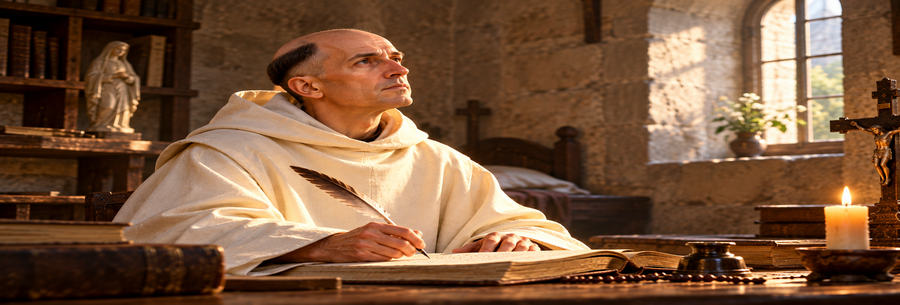
Among the great spiritual figures of the Middle Ages, Saint Bernard of Clairvaux holds a special place. A Cistercian monk, abbot, preacher, theologian, adviser to the popes and spiritual writer, he exerted a considerable influence on the Church and European society in the 12th century.
But behind this impressive historical figure lies, above all, a man deeply driven by the search for God, love for Christ and immense devotion to the Virgin Mary.
As the founder and first abbot of Clairvaux, Bernard made a powerful contribution to the development of the Cistercian Order. His sermons and spiritual writings have endured through the centuries and earned him the title of Doctor of the Church.
Who was Saint Bernard of Clairvaux really? Why did he become so famous? What role did he play in the history of the Church? What was his relationship with the Virgin Mary? And why do Christians continue to pray to him today?
Let us set out to discover one of the greatest spiritual masters in Christian history.
Who was Saint Bernard of Clairvaux?
Bernard of Clairvaux was born in 1090 in Fontaine-lès-Dijon, Burgundy, into a noble family.
He grew up in a Christian environment and received a thorough education.
His mother, Aleth, played a particularly important role in his religious upbringing.
From a very young age, Bernard possessed great spiritual sensitivity as well as remarkable intelligence.
He could have chosen a comfortable life befitting his social standing.
However, following his mother’s death and a period of deep reflection, he felt an increasingly strong calling towards monastic life.
He therefore decided to renounce the career and privileges to which his birth might have led him.
His choice would transform not only his own life, but also the history of Western monasticism.
Why did Bernard enter the Abbey of Cîteaux?
Around 1112 or 1113, Bernard decided to enter the Abbey of Cîteaux, founded a few years earlier in Burgundy.
The monks of Cîteaux wished to return to a more rigorous observance of the Rule of Saint Benedict.
They sought a life characterised by simplicity, prayer, silence, work and a certain degree of poverty.
Bernard’s choice was radical.
But what is even more astonishing is his ability to inspire others to follow him.
He persuaded several members of his family and many companions to take up the monastic life.
According to tradition, some thirty men are said to have accompanied Bernard when he entered Cîteaux.
This arrival marked a significant event for the young Cistercian community.
Bernard was then only in his early twenties.
The founding of Clairvaux Abbey
Just a few years after joining Cîteaux, Bernard was sent with a group of monks to found a new abbey.
In 1115, they settled in a valley in what is now the Aube region.
The place took the name Clairvaux, Clara Vallis, meaning ‘the clear valley’.
Bernard became its first abbot.
He remained deeply associated with Clairvaux throughout his life, to the extent that history would henceforth know him as Bernard of Clairvaux.
The early days were difficult.
The lives of the first monks were extremely austere.
They prayed, worked and lived in great simplicity.
Bernard himself subjected his body to such severe discipline that his health was permanently compromised.
Over time, however, he came to realise that the spiritual life did not simply consist of multiplying privations.
The essence lay elsewhere: seeking God and learning to love.
Why is Saint Bernard of Clairvaux so important in the history of the Cistercians?
Bernard’s influence contributed enormously to the development of the Cistercian Order.
His charisma attracted many vocations.
Clairvaux quickly became an important abbey and gave rise to numerous other monastic foundations.
By the time Bernard died, the Cistercian movement had expanded considerably throughout Europe.
However, this expansion was not based solely on organisation.
Bernard proposed a very demanding yet profoundly spiritual vision of monastic life.
The monk must gradually free himself from whatever distances him from God.
Silence, prayer, work, poverty and fraternal life are means of opening one’s heart more fully to the Lord.
The aim is therefore not austerity for its own sake.
The ultimate goal is the love of God.
Saint Bernard, a man of silence at the heart of Europe
Bernard deeply desired the contemplative life.
He would probably have wished to spend most of his life in his monastery.
However, circumstances constantly led him away from Clairvaux.
His reputation for wisdom grew immensely.
Bishops, abbots, princes and popes sought his counsel.
He intervened in numerous religious and political conflicts.
He travelled throughout Europe.
He wrote letters.
He preached.
He gave advice.
He attempted to reconcile adversaries.
This paradox characterised his entire life.
Bernard sought silence, but the world constantly sought him out.
Saint Bernard and the papal crisis
One of the major episodes of his life occurred after the death of Pope Honorius II in 1130.
Two men then laid claim to the papacy: Innocent II and Anacletus II.
Western Christendom found itself divided.
Bernard threw his support behind Innocent II.
His influence and his travels helped to rally various rulers and religious leaders to this cause.
This episode demonstrates the considerable influence acquired by the Abbot of Clairvaux.
Although neither a bishop nor a cardinal, Bernard possessed such moral authority that his words were heeded across much of Christian Europe.
Bernard of Clairvaux and Pope Eugene III
Bernard’s influence became even more remarkable when one of his former monks became pope.
In 1145, Bernardo Paganelli, a former monk of Clairvaux, was elected Pope under the name of Eugene III.
Bernard then addressed an important work to him, generally known by the title On Consideration (De consideratione).
In it, he reflects in particular on the spiritual responsibilities associated with the exercise of power.
Bernard reminds the Pope that, amidst his many obligations, he must never lose sight of what is essential: his relationship with God.
This teaching extends far beyond the medieval context.
It raises a question that remains relevant today:
How can one fulfil important responsibilities without losing one’s inner life?
St Bernard and the Second Crusade
Bernard’s life also includes episodes that must be placed in their historical context.
In 1146, at the request of Pope Eugene III, Bernard preached in favour of the Second Crusade.
His eloquence played a major part in mobilising the people and the rulers.
The expedition, however, ended in a serious failure.
This episode remains one of the most debated historical aspects of his life.
It is important to understand Bernard as a man of the 12th century, living in a religious, political and cultural context very different from our own.
His involvement in the crusade is an integral part of this medieval history and cannot be separated from his era.
At the same time, Bernard also spoke out to condemn acts of violence committed against Jewish communities during sermons linked to the crusade, reminding people that they should not be persecuted.
Bernard is therefore a complex figure, as great historical figures often are.
Why is Saint Bernard known as the ‘Mellifluous Doctor’?
Saint Bernard has a particularly poetic title: Doctor Mellifluus, generally translated as ‘Mellifluous Doctor’ or ‘doctor whose words flow like honey’.
This title refers to the gentleness and spiritual richness of his teaching.
Bernard possessed a remarkable talent for speaking of God’s love.
His theology was not merely intellectual.
It is deeply contemplative.
He does not simply wish to know God through the intellect.
He wishes to love God and lead others to experience this love.
This dimension explains the extraordinary power of his spiritual writings.
The love of God at the heart of St Bernard’s spirituality
One of Bernard’s most famous works is his Treatise on the Love of God.
In it, he sets out a genuine spiritual journey.
Human beings often begin by loving according to their own needs.
Then they gradually discover God.
As their relationship with the Lord grows, their love becomes freer and more selfless.
For Bernard, the whole of the Christian life can ultimately be understood as a school of love.
It is not enough to merely observe rules outwardly.
The heart must be transformed.
Prayer, the sacraments, reading the Bible and charity must gradually lead a person towards a deeper love of God and one’s neighbour.
Saint Bernard and Jesus Christ
Bernard’s spirituality is deeply centred on Christ.
He meditates in particular on the humanity of Jesus.
The birth of Christ, his earthly life, his Passion and his Cross occupy a central place in his contemplation.
Bernard understands that God is not a distant reality.
In Jesus Christ, God has drawn near to humanity.
He has made himself accessible.
This contemplation fosters an extremely personal relationship with Christ.
Bernard does not simply speak of Jesus.
He seeks to live with Jesus.
Saint Bernard of Clairvaux and the Virgin Mary
Saint Bernard is also renowned for his profound devotion to the Virgin Mary.
Over the centuries, he would become one of the great figures of Western Marian spirituality.
For Bernard, Mary is above all the one who leads to Christ.
He contemplates her humility, her obedience and her trust in God.
Her ‘yes’ at the Annunciation becomes the model for every soul that wishes to welcome the divine will.
Christian tradition also associates Bernard with several Marian texts and prayers.
Not all the writings attributed to him over the centuries were necessarily penned by him, but this tradition bears witness to the immense influence of his Marian spirituality.
‘Look to the star, call upon Mary’
One of St Bernard’s most famous passages compares the Virgin Mary to a star guiding people through storms.
This image has left a deep mark on Christian spirituality.
Human life sometimes resembles a stormy sea.
We go through periods of doubt, fear, temptation or discouragement.
Bernard therefore invites Christians to turn their gaze towards Mary.
Not to dwell on her, but because she leads us to her Son.
The image of Mary, Star of the Sea, thus expresses a very deep trust in her intercession.
St Bernard and the ‘Remember’
A famous Marian prayer begins with the words:
‘Remember, O most merciful Virgin Mary… ”
It is often associated with Saint Bernard of Clairvaux in popular tradition.
However, historians do not generally regard Bernard as the definite author of the current form of this prayer.
This clarification is interesting, as it helps to distinguish between history and tradition.
Whilst the ‘Remember’ was probably not composed directly by Bernard, his immense Marian devotion easily explains why his name has become associated with it over time.
St Bernard’s sermons on the Song of Songs
Among Bernard’s major works are his famous Sermons on the Song of Songs.
The Song of Songs is a biblical book that uses the language of love.
Bernard sees in it an image of the relationship between God and the soul.
He devotes numerous sermons to meditating on this encounter.
These texts are counted amongst the masterpieces of Christian mystical literature.
They show that, for Bernard, faith is not merely a matter of believing that God exists.
Faith is an invitation to enter into a genuine loving relationship with God.
St Bernard and humility
Humility is another pillar of his spirituality.
Bernard knew how easily human beings can become prisoners of their own pride.
The desire to be admired, recognised or to feel superior to others can gradually take over completely.
Humility, on the other hand, enables us to face the truth.
It consists in recognising who we are before God, with our strengths but also with our limitations.
This self-knowledge must lead not to discouragement, but to trust.
For Christian holiness does not consist in becoming perfect through one’s own efforts alone.
It consists in letting God act within us.
Why is Saint Bernard a Doctor of the Church?
St Bernard was canonised in 1174 by Pope Alexander III, only about twenty years after his death.
In 1830, Pope Pius VIII proclaimed him a Doctor of the Church.
This title recognises the exceptional importance of his teaching for the Christian faith.
His writings on the love of God, Christ, the Virgin Mary, humility and the contemplative life have profoundly influenced Western spirituality.
Bernard thus became one of the great masters of the Christian monastic tradition.
When is Saint Bernard of Clairvaux’s feast day?
Saint Bernard of Clairvaux is commemorated on 20 August in the Catholic Church.
This date marks the anniversary of his death, which occurred on 20 August 1153 in Clairvaux.
He was around 63 years old.
After an extraordinarily active life, the man who had travelled so extensively and played such a prominent role in the major events of his time ended his life in the abbey of which he had been the first abbot.
What is Saint Bernard of Clairvaux the patron saint of?
Saint Bernard is traditionally associated with monastic life and particularly with the Cistercians.
He is also invoked by those seeking to deepen their inner life and their relationship with God.
His immense devotion to Mary also makes him a figure particularly cherished by Christians wishing to draw closer to the Virgin Mary.
His example can guide all those seeking to balance responsibilities, daily life and their spiritual life.
Why pray to Saint Bernard of Clairvaux?
We can ask for Saint Bernard’s intercession when our lives become too hectic.
He can help us rediscover inner stillness.
We can also turn to him when we find it difficult to pray or when our faith becomes more fragile.
Saint Bernard teaches us to return to what really matters:
God loves us and calls us to love Him.
He may also be invoked when we wish to entrust a particular intention to the Virgin Mary.
His entire spirituality reminds us that Mary accompanies the Christian and leads them to Jesus.
What does Saint Bernard teach us today?
Our times seem a world away from those of Bernard of Clairvaux.
We live surrounded by screens, notifications, news and constant demands.
Bernard lived in a 12th-century monastery.
And yet, his teaching sometimes seems as though it were written for our own time.
First and foremost, he reminds us of the need for silence.
There is an external silence, but also an inner silence.
We can distance ourselves from noise whilst still harbouring a thousand worries within us.
Bernard invites us to create a space where God can be heard.
He also teaches us not to confuse activity with fruitfulness.
A life can be extremely full whilst still missing the point.
The real question, then, is not merely:
‘What have I achieved today?’
But perhaps also:
‘What space have I made for God today?’ ”
St Bernard and our relationship with time
Bernard himself experienced this struggle.
He loved the solitude of Clairvaux, but he was constantly in demand.
He had to travel, give advice, write and intervene in the affairs of the Church.
He therefore knew full well what it means to be absorbed by responsibilities.
His teaching invites us not to let urgency swallow up what is essential.
Even when we are very busy, we need moments to return to God.
A few minutes of prayer.
A passage from the Gospel.
A time of silence.
A visit to a church.
A rosary recited slowly.
These moments may seem small.
But they can sometimes help our whole day to rediscover its true centre.
The great spiritual lessons of Saint Bernard of Clairvaux
The life of Saint Bernard offers us several particularly valuable lessons.
Seek God above all else.
Success, responsibilities and recognition can never replace a true inner life.
Learn to love.
For Bernard, the whole of the Christian life is a journey of growth in love.
Make room for silence.
Silence allows the heart to rediscover what truly matters.
Contemplate Christ.
Jesus is not merely a figure from history. He is the One with whom the Christian is called to live.
Entrusting oneself to the Virgin Mary.
Bernard invites us to look to Mary as a guiding star when our path grows dark.
Remain humble.
The closer a person draws to God, the more they discover that everything is grace.
Prayer to Saint Bernard of Clairvaux
Saint Bernard of Clairvaux,
you who left behind the honours of the world
to seek God in silence,
teach us to return to what really matters.
When our days become too hectic,
when our thoughts wander
and when worries fill our hearts,
help us to find our way back to prayer.
Saint Bernard,
you who meditated so deeply on God’s love,
teach us to love the Lord
not only with our words,
but with our whole lives.
Let there grow within us
a humble,
patient and generous heart.
You who contemplated Christ
and meditated on the mystery of his love,
help us to remain close to him
in happy times
as well as in difficult times.
Saint Bernard,
you who loved the Virgin Mary so dearly,
teach us to entrust ourselves to her.
When we are weathering storms,
when doubt overwhelms us
and when we no longer know which path to follow,
remind us to look to Mary,
the star who guides us to her Son.
Entrust to her our families,
our worries,
our plans,
our sufferings
and all the intentions we hold in our hearts.
Intercede for those who have lost their peace.
For those who are searching for their path.
For those who can no longer pray.
For those who feel far from God.
And for all those who need
to rediscover hope.
Saint Bernard of Clairvaux,
Doctor of the Church
and faithful servant of the Virgin Mary,
lead us to Jesus
and teach us to make our lives
a response to his love.
Pray for us.
Amen.
Saint Bernard of Clairvaux: seeking God amidst the noise
Saint Bernard died nearly nine centuries ago.
Yet his message remains surprisingly relevant.
His entire life ultimately poses a very simple question to us:
What place does God really occupy in our lives?
Bernard experienced responsibilities, travels, conflicts and concerns.
He advised popes and sovereigns.
He played a part in the major events of his century.
But behind all this activity lay a much deeper desire:
to seek God.
Perhaps this is what Saint Bernard of Clairvaux can still teach us today.
Amidst the noise, to rediscover silence.
Amidst our worries, to rediscover trust.
Amidst our ambitions, to rediscover humility.
Amidst our busyness, to rediscover prayer.
And when the path grows dark, to lift our eyes to that star which Bernard loved so much to contemplate: the Virgin Mary, who always leads the Christian to her Son, Jesus Christ.