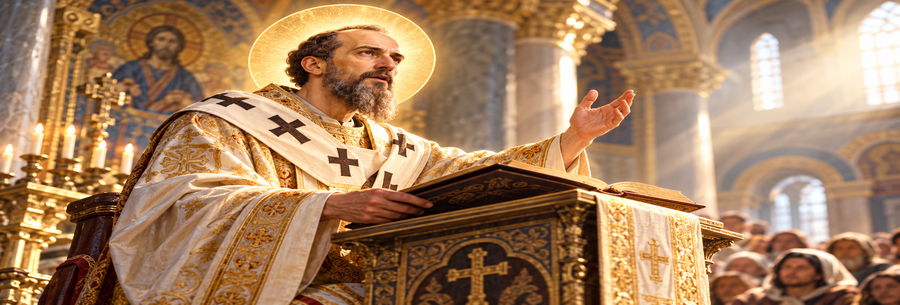
Among the leading figures of the early centuries of Christianity, Saint John Chrysostom holds a special place. Bishop of Constantinople, a remarkable preacher, theologian and tireless defender of the poor, he is regarded as one of the greatest Church Fathers.
Even his nickname bears witness to the power of his words: ‘Chrysostom’ means ‘golden-mouthed’.
John Chrysostom knew how to speak of God with a force and clarity capable of moving both the powerful and the humblest of people. But this freedom of speech also earned him many enemies.
Refusing to compromise when he felt the Gospel was at stake, he denounced excessive luxury, indifference towards the poor and certain abuses of power. His courage led to violent conflicts with some of the political and religious authorities of his time.
He was eventually exiled and died far from Constantinople in 407.
Who was Saint John Chrysostom really? Why is he called ‘Golden-Mouthed’? What were his main teachings? Why was he sent into exile? And what can this great saint still teach us today?
Let us discover the story of a man whose words continue to resonate more than sixteen centuries after his death.
Who was Saint John Chrysostom?
Saint John Chrysostom was born around 349 in Antioch, one of the great cities of the ancient world, situated in present-day Turkey.
At that time, Antioch was an extremely important political, commercial and cultural centre of the Roman Empire.
John came from a relatively well-off family. His father died whilst he was still very young, and he was mainly brought up by his mother, Anthousa, who played a vital role in his upbringing.
The young John received an excellent education.
In particular, he studied rhetoric, a fundamental discipline in antiquity for those wishing to hold public office.
He soon demonstrated an exceptional talent for public speaking.
Everything therefore seemed to point to a brilliant career for him.
However, John gradually chose a completely different path.
Why did John Chrysostom choose the Christian life?
During his youth, John deepened his Christian faith.
He was baptised as an adult, in accordance with a practice still common at that time, and then began to study the Holy Scriptures intensively.
He gradually turned towards the ascetic life.
For several years, he led an extremely austere life devoted to prayer, silence and the study of the Bible.
In particular, he stayed with ascetics in the vicinity of Antioch and spent a period in solitude.
However, the privations he imposed on himself severely undermined his health.
He was eventually forced to return to Antioch.
This experience would nevertheless leave a profound mark on his entire spirituality.
For John Chrysostom, a Christian must learn to detach themselves from whatever prevents them from placing God at the centre of their existence.
John Chrysostom became a priest
After his return to Antioch, John continued his service in the Church.
He was first ordained a deacon and then became a priest around 386.
It was at this time that his extraordinary talent as a preacher became renowned.
For several years, he preached regularly to the faithful in Antioch.
His homilies drew large crowds.
Unlike some highly complex theological discourses, John sought to explain Scripture in a practical way.
He commented on the Gospels, the letters of Saint Paul and numerous biblical passages.
But he did not merely wish to impart knowledge.
For him, the Word of God must transform everyday life.
Faith must be expressed through deeds.
Why is Saint John called ‘Chrysostom’?
The name Chrysostom comes from the Greek Chrysostomos and literally means ‘golden-mouthed’.
He was given this nickname because of his immense talent as an orator and preacher.
John possessed a remarkable ability to explain biblical texts and make them accessible.
His sermons could be at once deeply spiritual, very direct and at times stern.
He knew how to encourage his listeners, but he also knew how to challenge them.
For him, a preacher should not simply seek to please.
He was to lead people towards conversion.
It was this powerful message, combined with a profound knowledge of Scripture, that earned him his place in history as Saint John Chrysostom, ‘John the Golden-Mouthed’.
A great defender of the poor
One of the most important themes in John Chrysostom’s preaching is charity towards the poor.
He was deeply shocked by the inequalities he observed.
In the great cities of the Empire, some families lived in extraordinary luxury whilst others suffered from hunger.
John refuses to view this situation with indifference.
He continually reminds his listeners that the wealth possessed by a Christian must also be used to relieve those in need.
Charity, in his view, is not merely an optional addition to faith.
It is a necessary consequence of it.
John Chrysostom places particular emphasis on the dignity of every person.
To help a poor person is to serve Christ himself.
This conviction runs through much of his homilies.
John Chrysostom and wealth
John Chrysostom does not simply assert that the possession of material goods is inherently bad.
What he condemns above all is excessive attachment to wealth and indifference towards those who suffer.
He vigorously criticises ostentatious luxury.
How, he asks his listeners in essence, can one spend considerable sums on clothes, banquets or decorations whilst ignoring someone who lacks food?
This preaching obviously does not please everyone.
John’s words may upset the wealthiest classes.
But he refuses to alter his message to win their favour.
For him, fidelity to the Gospel takes precedence over popularity.
How did John Chrysostom become Bishop of Constantinople?
John’s reputation gradually spread beyond the borders of Antioch.
In 397, he was chosen to become bishop — or patriarch — of Constantinople, the capital of the Eastern Roman Empire.
At that time, the city was one of the most important political centres in the world.
John suddenly found himself at the heart of imperial power.
But his behaviour was surprising.
Whilst his position could have allowed him to lead a comfortable life, he maintained a relatively simple lifestyle.
He also sought to reform certain practices within the clergy and to combat abuses.
He used part of the available resources to help the poor and support charitable works.
This desire for reform, however, was to attract powerful opposition.
Why did John Chrysostom oppose the powerful?
John Chrysostom possessed a trait that would be both his greatest strength and his greatest weakness: he spoke freely.
He did not reserve his criticism for those of humble standing.
When the wealthy, members of the clergy or political leaders acted in a way he deemed contrary to the Gospel, he did not hesitate to speak out.
He condemned abuses, ambition, corruption and luxury.
His sermons are sometimes interpreted as attacks on the imperial court.
Tensions became particularly acute with Empress Eudoxia and with certain bishops hostile to John.
His opponents then sought to have him removed from office.
Why was Saint John Chrysostom exiled?
In 403, several of John’s opponents gathered at a synod generally known as the Synod of the Oak.
John was accused of various offences and deposed.
He was sent into exile.
But the people of Constantinople were deeply attached to their bishop.
The unrest caused by his departure quickly led the authorities to recall him.
However, the conflict was not over.
John continued to preach with the same freedom.
Tensions with the imperial authorities flared up again.
In 404, he was once more sent into exile.
This time, the exile would be permanent.
The final years of John Chrysostom
John was sent far from Constantinople, to harsh regions.
Despite his distance and his already frail health, he continued to write.
Numerous letters bear witness to his faith and his constant concern for the Christian communities.
But his opponents still feared his influence.
It was finally decided to transfer him even further away.
The journey was extremely gruelling.
John was ill and exhausted.
Yet he had to walk long stretches under the watchful eye of soldiers.
His strength gradually waned.
He finally died in 407, near Comana, in what is now Turkey.
Tradition records this magnificent declaration of trust among his last words:
‘Glory to God for all things. ”
These words sum up his life admirably.
Even stripped of his office, far from his people and dying in exile, John Chrysostom remained turned towards God.
What happened after John Chrysostom’s death?
The memory of John Chrysostom did not fade with his death.
On the contrary, his influence continued to grow.
A few decades later, his relics were solemnly returned to Constantinople.
The man who had been driven from the city was now honoured as one of its greatest pastors.
His numerous writings and homilies circulated widely throughout the Christian world.
They would become a major source for Christian theology and spirituality.
Why is Saint John Chrysostom a Church Father?
Saint John Chrysostom is regarded as one of the great Church Fathers because of the exceptional importance of his teaching.
His biblical commentaries constitute a major part of his work.
In particular, he left behind numerous homilies devoted to the Gospels and the letters of Saint Paul.
His approach is often very practical.
He does not merely seek to understand what the biblical text meant in the past.
He constantly asks:
How should we live out this Word today?
It is this desire to connect Scripture with everyday life that partly explains the enduring power of his teachings.
St John Chrysostom and prayer
John Chrysostom attaches great importance to prayer.
For him, it should not be reserved for monks or priests.
Every Christian is called to develop a personal relationship with God.
The family home itself should be able to become a place of prayer.
John places particular emphasis on regular prayer, reading the Bible and participating in the life of the Church.
But he also reminds us that authentic prayer must transform the way we live.
It would be contradictory to pray to God whilst refusing to love one’s neighbour.
Prayer and charity are therefore intimately linked.
St John Chrysostom and the Christian family
Another particularly relevant aspect of his teaching concerns the family.
John Chrysostom spoke at length about marriage and the upbringing of children.
For him, the family must become a true ‘little Church’.
Parents have a responsibility to pass on the faith not only through their words, but above all by their example.
The Christian home must be a place where one learns to pray, to forgive, to share and to love.
This vision retains great power even today.
The Christian faith is not lived out solely within a church.
It also begins in the simple acts of family life.
St John Chrysostom and the Eucharist
John Chrysostom also possessed a profound Eucharistic spirituality.
He reminds us that receiving Christ in the Eucharist must lead us to recognise Christ present in the poor and the suffering.
One cannot honour Jesus at the altar and then look down on a person in need.
This idea recurs regularly in his teaching.
It establishes a very strong link between the Eucharist, charity and justice.
Encountering God must lead to encountering one’s neighbour.
What is John Chrysostom’s place in the liturgy?
The influence of Saint John Chrysostom is particularly significant in the Eastern Christian Churches.
The Divine Liturgy of St John Chrysostom is one of the most widely used Eucharistic celebrations in the Byzantine tradition.
It is celebrated, in particular, in many Orthodox and Eastern Catholic Churches.
His name therefore remains associated daily with the prayers of millions of Christians across the world.
Few saints of the early centuries still have such a significant liturgical presence today.
When is Saint John Chrysostom’s feast day?
In the Latin Catholic Church, St John Chrysostom is celebrated on 13 September.
He is honoured as a bishop and Doctor of the Church.
In Eastern Christian traditions, several commemorations are also dedicated to him.
His memory remains particularly vivid in Eastern Christianity, where his theological and liturgical influence remains immense.
What is Saint John Chrysostom the patron saint of?
Owing to his extraordinary gift of speech, Saint John Chrysostom is notably regarded as the patron saint of preachers and orators.
He may therefore be invoked in particular by those who are called upon to pass on the faith, to teach, to proclaim the Gospel or to speak in public.
His example can also inspire priests, teachers, catechists and all those whose mission is to pass on the Word of God.
Why pray to Saint John Chrysostom?
We can ask for Saint John Chrysostom’s intercession when we need to find the right words.
He can be invoked before a lesson, a sermon or an important speech.
But we may also seek his intercession to receive greater courage.
John Chrysostom reminds us that it is not always easy to remain true to one’s convictions.
He experienced opposition, injustice, loneliness and exile.
Yet he continued to place his trust in God.
We can therefore entrust to him in particular those who have been unjustly rejected, those who suffer because of their fidelity to their conscience, or those going through a period of loneliness.
What does Saint John Chrysostom teach us today?
More than sixteen centuries separate us from John Chrysostom.
Yet many of his teachings seem surprisingly contemporary.
Firstly, he reminds us that faith must become a reality.
Praying without loving one’s neighbour is not enough.
Reading the Gospel without trying to put it into practice is not enough.
Talking about charity whilst turning a blind eye to the suffering right before us is not enough.
John Chrysostom then invites us to reflect on our relationship with material possessions.
Should what we own serve only our comfort?
Or can we also use some of our resources to bring relief to those who are suffering?
His message also urges us not to be afraid of the truth.
John could have chosen to remain silent in order to keep his position in Constantinople.
He could have sought to please those in power.
He could have toned down his sermons.
Instead, he chose to remain faithful to what he believed to be right.
That choice cost him dearly.
But it is precisely this faithfulness that continues to inspire Christians today.
The great spiritual lessons of Saint John Chrysostom
The life of Saint John Chrysostom can be summarised around a few key teachings.
Placing the Word of God at the heart of our lives.
John had a profound knowledge of the Holy Scriptures. He encourages us not to regard the Bible as a book reserved for specialists, but as a Word capable of illuminating our lives.
Never forget the poor.
Charity occupies a central place in his preaching. For John Chrysostom, Christians must learn to recognise Christ in those who suffer.
Live simply.
He urges us not to become slaves to luxury, appearances or wealth.
Have the courage to speak the truth.
John did not systematically seek confrontation, but he refused to remain silent when he felt the Gospel was being betrayed.
Remaining faithful in the face of adversity.
Exile could have led him to despair.
On the contrary, he continued to pray, to write and to encourage others right up until his final days.
Prayer to Saint John Chrysostom
Saint John Chrysostom,
you who devoted your life
to proclaiming the Word of God,
teach us to listen to the Gospel
with an open and sincere heart.
You whom the Church has called
‘the Golden-Mouthed’,
help us to find the right words,
those that comfort rather than hurt,
those that enlighten rather than divide,
those that lead us to God.
Grant us the courage
to remain faithful to the truth,
even when that faithfulness becomes difficult.
You who defended the poor
and ceaselessly reminded us of their dignity,
open our eyes to those who are suffering around us.
Teach us to share,
to welcome,
to forgive
and to serve.
Saint John Chrysostom,
you who experienced injustice,
loneliness and exile,
support those who are going through trials today.
Intercede for those who are rejected,
for those who feel forgotten,
for those who suffer in silence
and for those who seek the strength to carry on.
Help our families
to become places of prayer,
of peace and of passing on the faith.
Teach us to recognise Christ
in the Eucharist
but also in the face of our neighbour.
And when we face difficulties,
grant us that trust which dwelt in your heart
until the very last moments of your life.
May we, too,
in happy days as well as in difficult ones,
give thanks to the Lord.
Saint John Chrysostom,
bishop, Doctor of the Church
and great servant of the Word of God,
pray for us.
Amen.
Saint John Chrysostom: words that span the centuries
Saint John Chrysostom left behind neither wealth nor political power.
He died far from Constantinople, worn out by exile.
And yet, more than sixteen centuries after his death, his words continue to be read, studied and meditated upon throughout the world.
The man whom his adversaries had sought to silence has become one of the most famous preachers in the entire history of Christianity.
His life reminds us that the power of a word does not come solely from its eloquence.
It comes above all from the consistency between what one proclaims and how one lives.
John Chrysostom spoke of simplicity and chose a simple life.
He spoke of the poor and defended them.
He spoke of faithfulness and remained faithful even in exile.
He spoke of God and, even in his final sufferings, he continued to place his trust in Him.
That is why Saint John Chrysostom remains, even today, a valuable guide for all those who wish to deepen their faith.
His message can ultimately be summed up in a simple invitation: to listen to the Word of God, to let it transform our hearts and to make our lives a concrete response to the love of Christ.