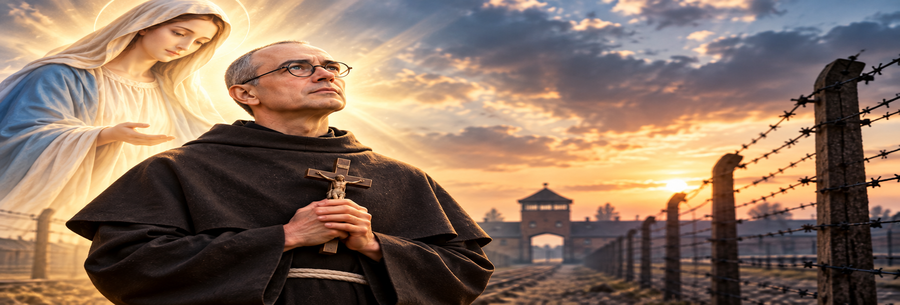
Among the great Christian figures of the 20th century, Saint Maximilian Kolbe holds a very special place. A Polish Franciscan priest, missionary, apostle of the Virgin Mary and martyr at Auschwitz, he remains to this day an extraordinary witness to faith, courage and charity.
His name is chiefly associated with a deeply moving act: at Auschwitz, Maximilian Kolbe voluntarily chose to die in the place of another prisoner, a family man sentenced to death.
But to reduce his life to this final sacrifice would be to overlook a lifetime devoted to God, to the Immaculate Virgin and to evangelisation.
Who was Saint Maximilian Kolbe? Why was he so devoted to the Virgin Mary? How did he die? Why did he become one of the best-known saints of the 20th century?
Let’s discover his story.
Who was Saint Maximilian Kolbe?
Saint Maximilian Kolbe was born Rajmund Kolbe on 8 January 1894 in Zduńska Wola, in what is now Poland.
He grew up in a modest, deeply devout Catholic family. From a very young age, Rajmund had a lively and energetic character. However, a spiritual event was to have a profound impact on his childhood and shape the rest of his life.
According to the account he would later give, whilst still a child he is said to have had a particularly powerful inner experience with the Virgin Mary.
He recounted that the Blessed Virgin had appeared to him, presenting him with two crowns: one white and one red.
The white crown represented purity.
The red crown represented martyrdom.
Mary is said to have asked him which one he wished to choose.
The young Rajmund replied:
‘I choose both.’
This scene seems to foreshadow, in a striking way, the two great dimensions of his future vocation: a life entirely consecrated to God and, ultimately, the gift of his own life.
Maximilian Kolbe becomes a Franciscan
As a teenager, Rajmund entered the Conventual Franciscans.
When he received the religious habit, he took the name Maximilian. He then continued his training, notably in Rome, where he studied philosophy and theology.
He was ordained a priest in 1918.
The young friar possessed remarkable intelligence, but his health was fragile. In particular, he suffered from lung problems that would plague him for much of his life.
However, this never prevented him from carrying out a considerable amount of missionary work.
For him, every available means should be used to proclaim the Gospel.
An immense devotion to the Virgin Mary
To understand Saint Maximilian Kolbe, one must understand the central place held by the Virgin Mary in his spirituality.
He very often referred to her as the Immaculate One.
For Maximilian Kolbe, entrusting oneself to Mary does not divert the Christian from Jesus Christ. On the contrary, Mary always leads one to her Son.
This conviction became the heart of his mission.
In 1917, whilst he was still in Rome, he founded, together with several Franciscan friars, the Militia of the Immaculate (Militia Immaculatae).
His aim was to encourage Christians to consecrate themselves to the Virgin Mary in order to serve Christ more effectively and to take part in evangelisation.
This work would subsequently grow considerably.
Niepokalanów: the ‘City of the Immaculate’
On his return to Poland, Father Maximilian Kolbe wished to use modern means of communication to evangelise.
He realised the importance of the press at a very early stage.
In 1922, he launched a Catholic magazine called The Knight of the Immaculate.
It quickly became a huge success.
A few years later, he founded a huge monastery near Warsaw: Niepokalanów, whose name roughly translates as ‘City of the Immaculate’.
This place became both a Franciscan monastery and a true centre of apostolate.
Hundreds of religious worked there. Newspapers and magazines were printed there and distributed on a large scale.
Maximilian Kolbe did not regard new technologies as a threat to the faith. On the contrary, he wished to put them at the service of the Gospel.
He took an interest in the press, radio and the various means of conveying a message to as many people as possible.
A surprisingly modern insight.
Maximilian Kolbe, missionary in Japan
His desire for evangelisation knew no bounds.
In 1930, Maximilian Kolbe set off as a missionary to Asia.
He spent time in Japan in particular and founded a new Franciscan centre dedicated to the Immaculate Conception near Nagasaki.
Despite his fragile health and material difficulties, he also launched a publication in Japanese.
His missionary work bears witness to his extraordinary energy.
He wanted to proclaim Christ wherever possible.
After several years in Asia, he finally returned to Poland and resumed his role as head of Niepokalanów.
But Europe was then on the brink of one of the darkest periods in its history.
Maximilian Kolbe during the Second World War
In September 1939, Nazi Germany invaded Poland.
The war completely disrupted life at the monastery in Niepokalanów.
Maximilian Kolbe and several other monks were arrested for the first time, before being released a few months later.
On his return to the monastery, he continued his work.
Niepokalanów also became a place of refuge for displaced persons and refugees, including many Jews.
Father Kolbe refused to abandon his mission despite the danger.
On 17 February 1941, the Gestapo arrested him once again.
This time, he would never return to Niepokalanów.
Maximilian Kolbe’s arrival at Auschwitz
After being detained in Warsaw, Maximilian Kolbe was transferred to the Auschwitz concentration camp in May 1941.
He became prisoner No. 16670.
In the camp, like the other prisoners, he endured hunger, humiliation, violence and forced labour.
His status as a priest also subjected him to particular mistreatment.
Yet several accounts report that, even in this hell, he continued to carry out his ministry.
He prayed.
He listened.
He comforted the other prisoners.
He shared what little he had.
In a world built on dehumanisation and fear, Maximilian Kolbe tried to remain a brother to those around him.
A few weeks later, he would perform the act that would make him one of the great Christian symbols of the 20th century.
Why did Saint Maximilian Kolbe give his life?
At the end of July 1941, a prisoner from Maximilian Kolbe’s block went missing.
In retaliation, the camp authorities decided to select several prisoners to be left to starve to death.
The men were singled out.
Among them was a Polish man named Franciszek Gajowniczek.
When he realised he was doomed, he spoke desperately of his wife and children.
It was then that Maximilian Kolbe stepped out of the ranks.
This was an extremely dangerous act: in a concentration camp, leaving one’s place could result in immediate death.
Nevertheless, he stepped forward towards a camp official.
He asked to take the place of the condemned prisoner.
Maximilian Kolbe explained that he was a Catholic priest and wished to die in place of this man, who had a wife and children.
His request was granted.
Franciszek Gajowniczek is spared.
Maximilian Kolbe joins the condemned.
The death of Saint Maximilian Kolbe
The prisoners are locked in an underground cell without food or water.
A long agony then begins.
Witnesses would later report that, unlike the cries of despair usually heard in these cells, the group of condemned men were praying and singing hymns, led by Father Kolbe.
The days passed.
The prisoners gradually died.
Maximilian Kolbe remained amongst the last survivors.
As the guards needed to clear the cell, he was finally killed by a lethal injection on 14 August 1941.
His body was then cremated in the crematorium.
The following day, 15 August, the Church celebrates the Assumption of the Virgin Mary.
This proximity between Maximilian Kolbe’s death and a major Marian feast day holds particular significance for one who had devoted his entire life to the Immaculate Virgin.
What became of the man saved by Maximilian Kolbe?
The man for whom Maximilian Kolbe gave his life, Franciszek Gajowniczek, survived Auschwitz and the war.
He lived for several more decades.
On numerous occasions, he bore witness to the sacrifice of the Franciscan priest who had enabled him to live.
The story of Maximilian Kolbe thus reminds us that his sacrifice was not an abstract idea.
He truly gave his life so that another man might keep his.
A man who had a name, a family and a story.
Why is Maximilian Kolbe called the ‘martyr of charity’?
Traditionally, a Christian martyr is someone who dies because of their faith.
The case of Maximilian Kolbe has a particular dimension.
He was not executed simply because he refused to publicly renounce Christianity. He voluntarily chose to take the place of another condemned man.
His martyrdom is thus deeply linked to Christian charity, that is to say, love taken to the point of self-sacrifice.
His sacrifice directly echoes the words of Christ in the Gospel according to Saint John:
‘ There is no greater love than to lay down one’s life for those one loves.”
These words seem to sum up the entire final stage of Maximilian Kolbe’s life.
When was Saint Maximilian Kolbe canonised?
Father Maximilian Kolbe was beatified in 1971 by Pope Paul VI.
He was subsequently canonised on 10 October 1982 by Pope John Paul II.
At this canonisation, John Paul II described him as a martyr of charity.
Franciszek Gajowniczek, the man whose life Maximilian Kolbe had saved at Auschwitz, was present at the ceremony.
This image is exceptionally powerful: more than forty years after Auschwitz, the man whose life had been saved was able to witness the canonisation of the man who had chosen to die in his place.
When is the feast day of Saint Maximilian Kolbe?
The Catholic Church celebrates Saint Maximilian Kolbe on 14 August, the anniversary of his death in 1941.
His feast day therefore immediately precedes the great solemnity of the Assumption of the Virgin Mary, celebrated on 15 August.
This date takes on special significance when one considers his immense love for Mary.
What is Saint Maximilian Kolbe the patron saint of?
Owing to his life story and his work, Saint Maximilian Kolbe is particularly invoked in a number of circumstances.
In particular, he is associated with prisoners, those facing oppression and families in distress.
His early and extensive use of the press and the media also explains his association with the world of the media, journalists and communication.
He is also particularly invoked in certain organisations providing support to people struggling with addiction.
However, beyond these patronages, Maximilian Kolbe remains above all a powerful intercessor for all those who seek courage, faithfulness, hope and the strength to love in difficult situations.
What does Saint Maximilian Kolbe teach us today?
The story of Maximilian Kolbe might seem to belong to a distant and tragic era.
Yet his message remains deeply relevant today.
His life teaches us, first and foremost, that the Christian faith is not limited to words.
It must be put into practice.
To love sometimes means giving of one’s time, giving up one’s comforts, forgiving, supporting someone through hardship, or defending the dignity of a vulnerable person.
Maximilian Kolbe went as far as making the supreme sacrifice of his own life.
But his example also invites us to look at all the small daily sacrifices that can become acts of love.
He also teaches us to never lose hope.
At Auschwitz, everything seemed designed to destroy human dignity.
Yet, even in that environment, Maximilian Kolbe showed that a man could still choose to love.
His freedom could be taken away from him.
He could be starved.
He could be beaten.
He could ultimately be deprived of his life.
But no one could take away his inner freedom to choose charity.
This is perhaps one of the most powerful messages left by Saint Maximilian Kolbe.
Saint Maximilian Kolbe and the Virgin Mary
Maximilian Kolbe’s devotion to Mary also serves as an invitation to rediscover Mary’s place in Christian life.
For him, Mary is the one who leads to Jesus.
To consecrate oneself to the Immaculate One means making oneself available to fulfil God’s will.
His entire missionary life was shaped by this perspective.
From his childhood and the episode of the two crowns, through to his missions in Poland and Japan, and then in the final hours of his life at Auschwitz, Maximilian Kolbe remained faithful to this trust.
His life thus appears as an immense ‘yes’ given to God.
Why pray to Saint Maximilian Kolbe?
We can turn to Saint Maximilian Kolbe when we are going through a period of fear, discouragement or trial.
We can also ask for his intercession when we find it difficult to forgive or to love someone.
He may be invoked on behalf of prisoners, victims of persecution, families separated by war, and people facing violence or loneliness.
Finally, we can ask him to teach us to place our trust in God and to entrust ourselves more fully to the maternal protection of the Virgin Mary.
Prayer to Saint Maximilian Kolbe
Saint Maximilian Kolbe,
you who devoted your whole life to Christ
under the gaze of the Immaculate Virgin,
teach us to love with a generous heart.
You who kept hope alive
amidst suffering and fear,
come and support those who are going through trials today.
Intercede for prisoners,
for the persecuted,
for the victims of war and violence,
for separated families
and for all those who feel abandoned.
Saint Maximilian,
you who gave your life to save another man’s,
teach us not to live only for ourselves.
Grant us the courage to serve,
the strength to forgive,
patience in times of trial
and faithfulness in prayer.
Help us to recognise in every person
a brother or sister loved by God.
Through your intercession,
entrust our families, our concerns and our intentions
to the Virgin Mary, the Immaculate One
whom you loved and served so dearly.
And when fear overwhelms us,
remind us that love can be stronger than hatred,
that light can pierce the darkness
and that God never abandons us.
Saint Maximilian Kolbe,
martyr of charity,
pray for us.
Amen.
Saint Maximilian Kolbe, witness to a love stronger than hatred
Saint Maximilian Kolbe remains one of the most moving Christian figures of the 20th century.
A Franciscan friar, missionary, founder, man of communication and great servant of the Virgin Mary, he devoted his entire life to proclaiming Christ.
But it was in the heart of Auschwitz that his message took on its most radical form.
Faced with a system founded on hatred, fear and the destruction of human beings, he responded with an act of freedom and love.
He gave his life so that another might live.
His sacrifice thus continues to pose a question to each and every one of us: how far are we capable of loving?
We will probably never be faced with the terrible choice that Maximilian Kolbe had to make.
But every day offers us the chance to choose between indifference and compassion, between resentment and forgiveness, between self-absorption and service.
This is how the example of Saint Maximilian Kolbe remains alive.
And more than eighty years after his death, his life continues to remind the world of a profoundly Christian truth:
in the midst of the deepest darkness, a single act of love can become a light that never goes out.