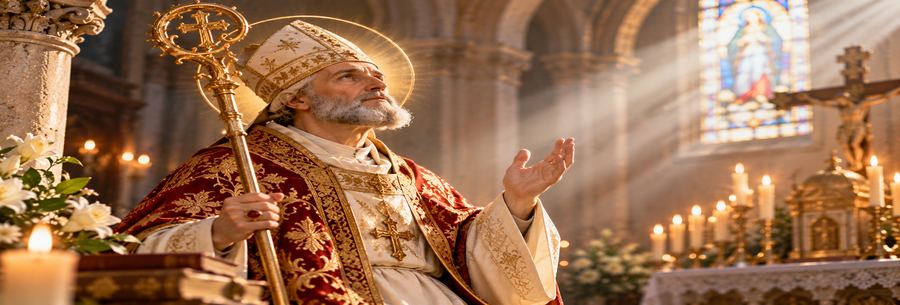
Every year, on 14 October, the Catholic Church commemorates Saint Callixtus I, a pope of the early 3rd century and a martyr for the Christian faith.
His story is one of the most remarkable among those of the early successors of Saint Peter.
Before becoming Pope, Callixtus is said to have led a particularly turbulent life. Of humble origins and probably a slave in his youth, he endured failure, imprisonment, hard labour and exile before becoming one of Pope Zephyrinus’s trusted aides, and subsequently being elected Bishop of Rome himself.
His pontificate took place at a time when being a Christian could still lead to persecution and death.
But Saint Callixtus is also known for another reason: his understanding of mercy and forgiveness.
Faced with those who wanted the Church to be extremely harsh towards sinners, Callixtus defended the possibility of repentance and reconciliation.
His story thus raises a question that remains relevant today:
To what extent are we capable of believing in God’s forgiveness and mercy?
Who was Saint Callixtus I?
We know Saint Callixtus mainly through ancient sources, but certain episodes of his life remain difficult to establish with absolute certainty.
This is due in particular to the fact that some of the information about him comes from one of his theological opponents, Hippolytus of Rome, who paints a particularly critical picture of him.
Certain biographical details must therefore be treated with caution.
Callistus is thought to have been born in the second half of the 2nd century.
He is said to have been a slave of a Christian named Carpophorus.
This background makes his life story particularly remarkable: in Roman society, a slave belonged to one of the most disadvantaged social classes.
And yet, a few decades later, Callixtus would become Bishop of Rome, that is to say, Pope.
His life thus bears witness to an important reality of early Christianity: in the eyes of God, a person’s dignity depends neither on their wealth, nor on their social background, nor on their position in society.
A youth marked by trials
According to ancient accounts, Carpophorus is said to have entrusted Callistus with the management of sums of money.
The matter went wrong.
The exact circumstances are a matter of debate, but Callistus found himself facing serious financial difficulties.
He then attempted to flee.
He was caught and punished.
His situation deteriorated further when he came into conflict with a Jewish community in Rome, an incident which led to him being sentenced to hard labour in the mines of Sardinia.
In Roman times, being sent to the mines was a particularly terrible punishment.
Prisoners there were subjected to extremely harsh working conditions, and many never returned.
Callixte could therefore have disappeared from history at that point.
But his fate was to take an unexpected turn.
Released from the mines of Sardinia
Following an intervention on behalf of condemned Christians, Callixtus was finally released.
After his return, he spent some time away from Rome.
Then his situation changed profoundly during the pontificate of Pope Zephyrinus, who became Bishop of Rome around the year 199.
Zephyrinus recognised Callistus’s qualities and placed his trust in him.
The man who had experienced slavery, prison and the mines gradually became an important figure in the service of the Church of Rome.
This transformation lies at the heart of the story of Saint Callixtus.
His past did not prevent him from serving God.
His failures did not become his defining identity.
His story seems to remind us that God can restore a life that people might consider irretrievably broken.
The Catacombs of Saint Callixtus
Pope Zephyrinus entrusted Callixtus, in particular, with the responsibility for a Christian cemetery situated along the Via Appia, the Appian Way, to the south of Rome.
This site would become famous as the Catacombs of Saint Callixtus.
Today, these catacombs are among the most important testimonies to early Christianity.
They extend over several levels and comprise a vast network of underground galleries.
A great many Christians were buried there.
Notably, it is home to the famous Crypt of the Popes, in which several 3rd-century bishops of Rome were laid to rest.
Contrary to a sometimes widespread belief, the catacombs were not primarily built as secret hideouts enabling Christians to continually evade the Roman authorities.
They were, above all, places of burial.
They bear witness, however, to the faith of the early Christian communities, particularly their hope in the resurrection.
Callistus becomes Pope
On the death of Pope Zephyrinus, around 217, Callistus was elected Bishop of Rome.
He thus became Callistus I.
His pontificate lasted for around five years, until 222.
However, his election was not unanimously supported.
One of his main opponents was Hippolytus of Rome, an important theologian but one who was particularly critical of Callixtus.
The conflict centred in particular on issues of discipline and on how to welcome Christians who had committed serious sins.
Callistus adopted an attitude that his opponents deemed too lenient.
For him, however, the Church must not become a community reserved for those who consider themselves perfect.
It must also be a place where the repentant sinner can find a way back to God.
A Pope of forgiveness
This is probably one of the most striking aspects of Saint Callixtus’s pontificate.
In the early Church, an important question arose: what should be done with Christians who had committed particularly serious offences after their baptism?
Some factions advocated extremely strict discipline.
For certain offences, they believed that it should be virtually impossible to be fully reconciled with the Church.
Callistus advocated an approach more oriented towards repentance and forgiveness.
He certainly did not claim that sin was of no consequence.
Rather, he asserts that a sincerely repentant sinner must not be regarded as irretrievably lost.
This conviction earned him severe criticism.
But it touches on a fundamental aspect of the Gospel:
Christ came to call sinners and to open a path of conversion for them.
A Church for sinners who seek God
The story of Saint Callixte reminds us of a truth that is sometimes difficult to accept:
the Church is not a gathering of perfect people.
It is made up of men and women with their virtues, their wounds, their weaknesses and their faults.
This does not mean that everything is of equal value.
It means that sin does not necessarily prevent conversion.
In the Gospels, Jesus welcomes people whose lives are far from perfect.
He eats with tax collectors.
He forgives.
He lifts people up.
He calls them to change their lives.
Callixte seems to have deeply understood this aspect of the Christian message.
Forgiveness does not remove the need for conversion.
But conversion would be impossible if no door remained open.
Did his own past influence his view of forgiveness?
We cannot say for certain.
But the parallel is naturally striking.
Callixte himself had led a life marked by hardship, failure, condemnation and imprisonment.
He probably knew what it meant to be judged on the basis of his past.
He also knew that a life could take a completely different turn.
The former slave condemned to work in the mines had become Pope.
His entire life thus bore witness to a conviction:
a man is never defined solely by the worst period of his history.
For the Christian, conversion is always possible.
Saint Callixtus and divisions within the Church
Callixtus’s pontificate also reminds us that disagreements within the Church are not a recent phenomenon.
From the earliest centuries, Christians experienced debates that were at times very heated.
Doctrinal, disciplinary and pastoral issues were already giving rise to deep divisions.
The conflict between Callixtus and Hippolytus is one such example.
This can help us to view the history of the Church with greater realism.
The Church is holy through the One who founded it and through the grace it receives, but it is also made up of human beings.
Christian history therefore includes periods of extraordinary holiness, but also conflicts, misunderstandings and divisions.
Amidst all this, however, the Gospel continues to be proclaimed.
Did Saint Callixtus die a martyr?
Christian tradition venerates Saint Callixtus as a martyr.
He is said to have died in 222, probably in Rome, during a period of unrest under Emperor Alexander Severus.
One tradition recounts that he was killed during a riot and thrown into a well.
However, the exact circumstances of his death remain historically uncertain.
What endures is the very ancient veneration he has received as both pope and martyr.
His liturgical feast day is celebrated on 14 October.
Why is Saint Callixtus important today?
Nearly eighteen centuries after his death, Saint Callixtus still has something to say to us.
His story teaches us, first and foremost, not to confine a person to their past.
We sometimes do this all too easily.
A mistake.
A fault.
A bad decision.
A reputation.
And we end up thinking that this person will never change.
But Christianity is based precisely on the possibility of conversion.
St Peter himself denied Jesus.
St Paul persecuted the early Christians.
And yet, God called them to fulfil an extraordinary mission.
Saint Callixtus also reminds us that our past does not necessarily have the final say.
Learning to ask for forgiveness
We often talk about the difficulty of forgiving.
But it can be just as difficult to ask for forgiveness.
Admitting that we were wrong requires humility.
Sometimes we have to be willing to say:
‘I was wrong. ”
“I’ve hurt you.”
“Forgive me.”
“I want to try to change.”
The spiritual lessons we can draw from the life of Saint Callixtus invite us not to be afraid of taking this step.
Asking for forgiveness is not a sign of weakness.
It can be the beginning of true inner liberation.
Learning to forgive as well
Conversely, there are sometimes wounds that linger for a long time.
A betrayal.
A hurtful word.
An injustice.
A break-up.
A humiliation.
Christian forgiveness does not mean pretending that nothing has happened.
Nor does it necessarily mean resuming a dangerous relationship or denying the need for justice.
To forgive means gradually refusing to let hatred and resentment rule our hearts.
And this journey can take time.
We can then ask God:
‘Lord, I am not yet able to forgive, but at least give me the desire to do so.’
Sometimes, forgiveness simply begins like this.
Never give up on anyone
Saint Callixtus also urges us not to give up on others too quickly.
A person can change.
A life can be transformed.
A relationship can sometimes be mended.
A person who has strayed from God can return to Him.
We never fully know what is going on in someone’s heart.
That is why prayer remains essential.
When we can no longer speak to someone, we can still pray for them.
When we cannot change someone, we can entrust them to God.
And when we no longer know what to do, we can ask the Lord to do what we ourselves cannot achieve.
A feast to rediscover God’s mercy
The feast of Saint Callixtus can therefore be a wonderful opportunity to reflect on our own relationship with forgiveness.
Is there anything we need to ask God to forgive us for?
Is there someone we need to ask for forgiveness?
Is there someone we have kept trapped in their past?
Is there a wound we are still carrying that we would finally like to place in God’s hands?
14 October can become a day of reconciliation.
Not necessarily through some spectacular gesture.
Sometimes, it all begins with a simple prayer.
? Prayer to Saint Callixtus I
Saint Callixtus,
you who experienced trials, humiliation and suffering
before becoming a servant of the Church of Christ,
intercede for us today.
You whose life reminds us
that our past must never prevent us
from answering God’s call,
help us never to lose hope in His mercy.
When we look upon our faults with shame,
remind us that God can forgive.
When we think we have failed too many times to start again,
remind us that God can lift us up.
When we are afraid to move forward,
give us the courage to take a new step.
Saint Callixius, apostle of forgiveness,
teach us to open our hearts to God’s mercy.
Help us to humbly acknowledge our mistakes.
Give us the strength to ask for forgiveness
when we have hurt someone.
And when we ourselves have been hurt,
help us not to let resentment take hold of our hearts.
We entrust to you today
divided families,
couples facing difficulties,
parents separated from their children,
brothers and sisters who no longer speak to one another
and all relationships in need of healing.
Intercede so that paths to dialogue may open up.
Where reconciliation is possible,
grant the courage to take the first step.
Where it is not yet possible,
grant at least inner peace.
Saint Callixtus,
we also entrust to you those who feel condemned by their past.
Those who think they no longer deserve to be loved.
Those who have lost hope.
Those who would like to change but do not know how to begin.
Those who are seeking the way back to God.
May each one discover
that no life is too damaged
to be touched by the Lord’s grace.
Teach us, too, to look upon others with greater mercy.
Not to judge too quickly.
Not to reduce a person to their mistakes.
Always to leave room for conversion.
And to remember that we ourselves need God’s forgiveness.
Saint Callixtus I, Pope and Martyr,
pray for us.
Help us to remain faithful to Christ in times of trial,
to believe in the power of forgiveness
and never to close the door on those who sincerely return to God.
May the Lord protect our families,
heal our wounds,
grant us the grace of reconciliation
and help a merciful heart to grow within us.
Amen. ?
Saint Callistus: no one is a prisoner of their past
This is perhaps the most powerful message we can take from Saint Callistus.
His life had seen episodes that could have condemned him to oblivion.
A slave.
A prisoner.
Condemned to work in the mines.
Then leader of a large Christian community and, finally, Pope.
His life reminds us that God sees a person differently from the way the world sees them.
We sometimes see the mistakes.
God also sees the possibility of a fresh start.
We see the past.
God also sees what we can still become.
On this 14 October, let us therefore ask Saint Callixtus to help us never to lose hope in God’s mercy.
For ourselves.
And for others.
Saint Callixtus I, Pope and Martyr, pray for us.
A happy Feast of Saint Callixtus to you all! ?