Every 5 October, the Catholic Church commemorates Saint Faustina Kowalska, a Polish nun who became one of the great spiritual figures of the 20th century.
Her life was short, humble and largely hidden from the eyes of the world. Yet, through her, a message was spread that is now known throughout the world: that of Divine Mercy.
At the heart of this message lies an invitation of extraordinary simplicity: to trust in Jesus and to accept his mercy, whatever our weaknesses and faults may be.
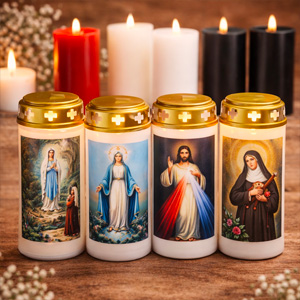
It is from the spirituality of Saint Faustina that we derive, in particular, the image of the Merciful Jesus bearing the words ‘Jesus, I trust in You’, the Chaplet of Divine Mercy and the special devotion to the Hour of Mercy, traditionally prayed at 3 pm.
But who was Saint Faustina really? How did this little-known nun become the ‘Apostle of Divine Mercy’?
A simple childhood in Poland
Saint Faustina was born Helena Kowalska on 25 August 1905 in Głogowiec, Poland.
She grew up in a large, modest and deeply devout family. Her parents, Stanisław and Marianna Kowalski, made a modest living from working the land.
From a very young age, Helena showed great spiritual sensitivity. According to her own account, she felt a special calling to religious life from childhood.
However, her family’s financial situation meant she was unable to continue her studies for long. As a teenager, she worked as a domestic servant to earn a living and support her family.
Her desire to devote her life to God did not, however, fade.
The call to religious life
Helena wished to enter a convent, but her plans were initially met with opposition from her parents.
For a time, she tried to set aside this inner calling and led the ordinary life of a young woman of her time.
But she would later recount a decisive event.
Whilst attending a dance with her sister, she is said to have suddenly seen the suffering Jesus, who reproached her inwardly for rejecting his call.
Deeply shaken, Helena left the party and went to a church to pray.
She then made the decision to respond definitively to her vocation.
After several attempts and several refusals, she was finally accepted in 1925 into the Congregation of the Sisters of Our Lady of Mercy, in Warsaw.
She was given the religious name Sister Marie Faustina of the Most Holy Sacrament.
She was twenty years old.
A humble and unknown nun
Sister Faustina’s life in the convent was extremely simple.
She held no prestigious position. She worked mainly as a cook, gardener or porter in various houses of her congregation.
To those around her, there was nothing to suggest the considerable spiritual influence she would exert after her death.
Her daily life consists of work, prayer, obedience and modest service.
But behind this ordinary existence lies a particularly intense inner life.
Faustina claimed to receive visions and words from Christ concerning a single message: the infinite depth of God’s mercy towards humanity.
At the request of her confessors, she began to write down her spiritual experiences.
These texts would later form her famous Diary, now translated into many languages.
Saint Faustina’s great message: Divine Mercy
The heart of Faustina’s spiritual mission can be summed up in one word:
Trust.
Throughout her writings, she constantly reminds us that God’s mercy is greater than our sins and that no one should despair of being able to return to Him.
Divine Mercy is therefore not an invitation to deny sin or human responsibility.
It is the proclamation that God’s forgiveness remains available to those who sincerely return to Him.
For Faustina, humanity’s response to this mercy rests particularly on two attitudes:
trusting in God and practising mercy towards others.
Receiving mercy must therefore lead us to become more merciful ourselves.
To forgive.
To help.
To listen.
To comfort.
Praying for others.
Performing small acts of love.
Saint Faustina’s spirituality is deeply practical: the mercy received from God must transform the way we view and love our neighbour.
‘Jesus, I trust in You’
One of the best-known events in Saint Faustina’s life took place on 22 February 1931, in Płock.
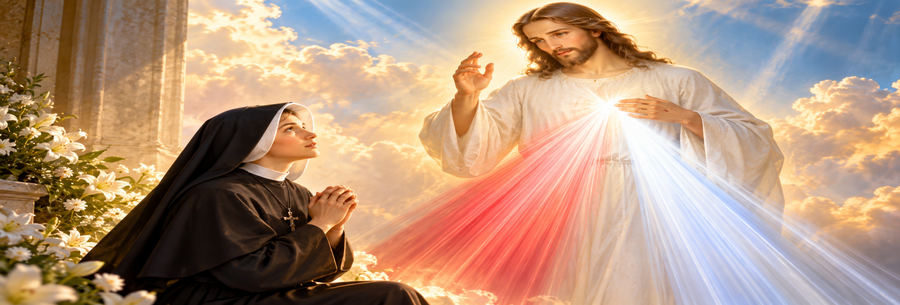
Faustina recounts seeing Jesus dressed in a white tunic, one hand raised in a gesture of blessing and the other resting on his chest.
Two rays were emanating from his heart: one red and the other pale.
According to her account, Jesus asked her to have a picture painted based on this vision and to inscribe on it:
‘Jesus, I trust in You. ”
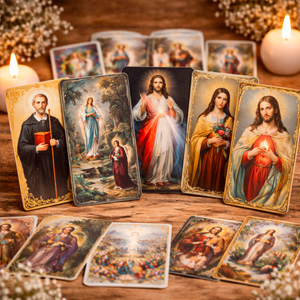
This depiction would become the world-famous image of the Merciful Jesus.
The two rays play a central role in this image. In the Little Diary, Faustina reports that Jesus gave her a meaning for them linked to blood and water.
The image thus becomes an invitation to contemplate Christ and, above all, to place all our trust in Him.
The first painting of the Merciful Jesus
Faustina was not a painter.
Creating the image she claimed to have seen therefore required the involvement of an artist.
With the help of her spiritual director, Father Michał Sopoćko, the painter Eugeniusz Kazimirowski produced the first depiction of the Merciful Jesus in Vilnius, based on Faustina’s instructions.
The painting was completed in 1934.
Faustina is said, however, to have been saddened to realise that no painting could exactly reproduce the beauty of the Christ she claimed to have beheld.
Other depictions were subsequently produced, notably that by Adolf Hyła, which became extremely famous and is associated with the Sanctuary of Divine Mercy in Kraków-Łagiewniki.
Today, the image of the Merciful Jesus can be found in churches, chapels and homes all over the world.
The Chaplet of Divine Mercy
The spirituality passed down by Saint Faustina also includes a prayer that has become very popular: the Chaplet of Divine Mercy.
Faustina reports having received the form of this prayer in 1935.
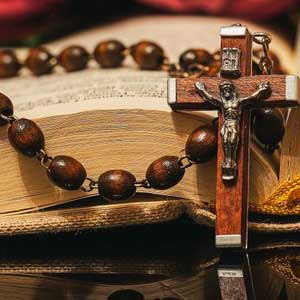
It is usually recited using a traditional rosary.
This prayer centres on offering Christ and his Passion to the Father and on a repeated plea for mercy:
‘Through his painful Passion, be merciful to us and to the whole world. ”
The Chaplet of Divine Mercy can be prayed at any time.
However, many of the faithful recite it particularly at 3.00 pm, in remembrance of the hour of Christ’s death.
3.00 pm: The Hour of Mercy
In the writings of Saint Faustina, 3.00 pm holds a special place.
This hour commemorates the Passion and death of Jesus on the Cross.
The tradition of Divine Mercy therefore invites the faithful, whenever possible, to pause for a few moments at 3 pm to reflect on the Passion of Christ and implore his mercy.
It is not necessary to recite a long prayer.
A simple invocation may suffice:
‘Jesus, I trust in You.’
This daily practice thus becomes a way of placing God back at the heart of our day.
The Feast of Divine Mercy
Faustina also recounts Christ’s desire for a special feast to be dedicated to His Mercy.
This celebration is now known as Divine Mercy Sunday, observed on the second Sunday after Easter.
Pope Saint John Paul II established this feast for the whole Catholic Church in the year 2000, on the occasion of Saint Faustina’s canonisation.
This connection between Faustina and John Paul II is particularly significant.
Both were Polish, and the Pope played a major role in spreading the message of Divine Mercy.
At Faustina’s canonisation on 30 April 2000, John Paul II presented her to the universal Church as a great witness to God’s Mercy.
A spirituality for those who feel they are too far from God
One of the reasons why Saint Faustina’s message resonates with so many people is probably its simplicity.
It speaks particularly to those who doubt.
To those who are afraid.
To those who regret their past.
To those who think they have sinned too much to be forgiven.
To those who feel unworthy of returning to God.
The answer offered by Faustina’s spirituality is always the same:
never despair of God’s mercy.
Trust does not mean believing that we will no longer face trials.
Rather, it consists in being able to say, even in the midst of difficulties:
‘Lord, I do not understand everything, but I trust in You. ”
It is probably in these few words that the essence of the ‘little way’ of Mercy proposed by Saint Faustina is to be found.
Saint Faustina and suffering
Faustina’s life was also marked by illness.
Suffering in particular from tuberculosis, she gradually became very physically weak.
She spent several periods in care facilities, but continued her religious life and spiritual mission as much as possible.
Her final years were particularly trying.
Faustina died in Kraków on 5 October 1938, aged just 33.
She was buried in Łagiewniki.
At that time, she was still virtually unknown to the world.
However, a few decades later, her message would cross the borders of Poland and spread to every continent.
From Sister Faustina to Saint Faustina
The Church’s official recognition of Faustina took place gradually.
Pope John Paul II beatified her on 18 April 1993.
Seven years later, on 30 April 2000, he canonised her in Rome.
She thus became Saint Faustina Kowalska.
Her liturgical feast day is celebrated on 5 October, the anniversary of her death.
Today, her tomb is located at the Shrine of Divine Mercy in Kraków-Łagiewniki, which has become an important place of pilgrimage.
How can we live out Saint Faustina’s message today?
Saint Faustina’s spirituality is not merely about reciting certain prayers.
She invites us to transform our lives.
We can begin by learning to trust God more, particularly when we no longer have control over events.
We can also rediscover the power of forgiveness, both by asking for forgiveness and by trying to forgive.
Every day, we can perform a work of mercy towards someone who is suffering, who is alone or who needs our help.
We can also get into the habit of pausing for a few moments at 3 pm to think of Jesus and simply say:
‘Jesus, I trust in You.’
And when we feel too weak, too imperfect or too far from God, we can remember the essence of the message entrusted to Saint Faustina:
God’s Mercy is greater than our misery.
Prayer to Saint Faustina
? Saint Faustina, Apostle of Divine Mercy,
you who devoted your life
to making known the love and mercy of Jesus,
teach us to place all our trust in Him.
When doubt fills our hearts,
help us to keep the faith.
When our faults distance us from God,
remind us that His mercy always calls us to return to Him.
When trials become too heavy to bear,
help us to say with confidence:
Jesus, I trust in You.
Saint Faustina,
teach us also to be merciful towards those around us.
Grant us a heart capable of forgiveness,
hands ready to help,
words that bring comfort
and a gaze that does not condemn.
Today we entrust to you our families,
our loved ones, those who are ill,
those who suffer
and all the intentions we carry silently in our hearts.
Intercede for us before the Lord
and help us to surrender ourselves ever more fully
to his love and his infinite Mercy.
Saint Faustina,
apostle of Divine Mercy,
pray for us.
Jesus, I trust in You.
Amen. ?