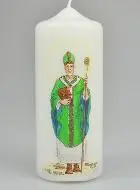
Saint Patrick is now one of Christianity's most famous saints, inseparably associated with Ireland. Yet he was not Irish by birth. Born towards the end of the fourth century, probably around the year 385, his real name was Maewyn Succat. He was born in Roman Britain into a relatively wealthy Christian family. His father was a deacon and his grandfather a priest, which shows that Christianity already had a certain place in his life before he fully embraced the faith.
At the age of sixteen, his life was turned upside down when he was kidnapped by Irish pirates during a raid on the British coast. He was then sold into slavery in Ireland, where he became a shepherd. This period of slavery lasted around six years. Isolated and suffering, he turned more and more to God. It was during these years of captivity that he developed a deep faith and a life of intense prayer.
Spiritual awakening and escape
According to his own writings, particularly in his "Confessions", one day Patrick heard a divine voice telling him that his ship was ready. He then decided to flee. He travelled miles across Ireland to the coast, where he found a ship ready to leave. After many adventures, he managed to return home. But on his return, he did not resume the life he had left behind. On the contrary, a new mission called him: that of returning to Ireland to convert the people who had enslaved him.
Patrick then entered holy orders and became a priest, then a bishop. He prepared for several years before returning to Ireland, this time free and as a missionary. He became convinced that his mission was divine: to bring the message of the Gospel to the Irish people.
The evangelisation of Ireland
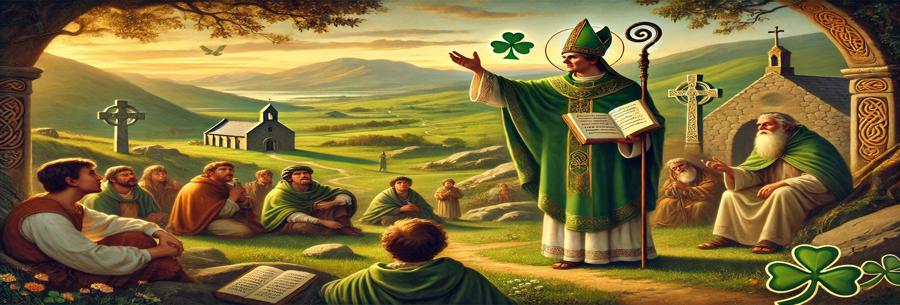
When he returned to Ireland, probably around the year 432, the country was still largely pagan. The dominant religion was that of the Druids, a deeply rooted spiritual and social system. Yet with courage and faith, Patrick began to preach. He travelled the country, founding churches, ordaining priests and baptising thousands of people.
According to legend, Patrick used a shamrock to explain the mystery of the Holy Trinity - the Father, the Son and the Holy Spirit - to the local people. Today, this symbol is associated with St Patrick's Day and Ireland as a whole.
He is also said to have performed several miracles, one of the most famous being that he drove all the snakes out of Ireland. Although scientists agree that Ireland has never been home to land snakes, this image symbolises the victory of the Christian faith over ancient pagan beliefs.
A difficult but fruitful mission
The evangelisation led by Patrick was not without opposition. He has faced many dangers, including death threats. But his determination never wavered. He himself writes that he baptised "thousands of people" and left behind a living Church, well established in many parts of Ireland.
Beyond religion, his work was also cultural. He helped introduce Latin writing to Ireland, create monasteries, and lay the foundations for what would become the golden age of Celtic Christianity.
The death and legacy of Saint Patrick
Patrick is thought to have died around the year 461, at Saul, a place in County Down, where he had founded one of the first churches in Ireland. According to tradition, he is buried in Downpatrick. After his death, his memory remains very much alive, thanks in particular to his spiritual writings, but also through oral tradition and the legends that develop around him.
His feast day, celebrated on 17 March, the supposed date of his death, is now a public holiday in Ireland. It has also become a worldwide festival, particularly among Irish communities abroad, who see it as an opportunity to celebrate their culture and faith. Parades, Celtic music, green clothing and shamrocks are the order of the day, paying tribute to this courageous missionary who changed the spiritual history of Ireland.
A universal figure
Over the centuries, Saint Patrick has become much more than just a bishop or a missionary. Today, he is a symbol of perseverance, forgiveness (he returned to his former tormentors), and unshakeable faith. He embodies the ability of a man, even in the worst of trials, to rise again, to find profound meaning in his suffering, and to transform his life into a message of hope.
His story continues to inspire believers and non-believers around the world.