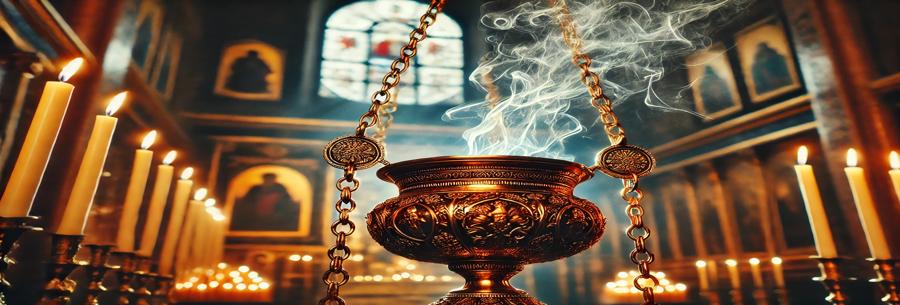
Incense and censers: at the heart of Christian ritual
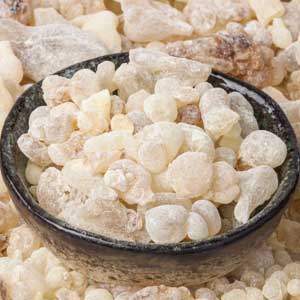
Incense plays an essential role in Christian liturgy, in both Catholicism and Orthodoxy. It is used to symbolise the prayer that rises up to God, the purification of the place of worship and the sanctification of the faithful. But its use would not be possible without two fundamental elements: the coal and the censer. These tools, charged with symbolism, enable the incense to burn in a controlled manner and spread harmoniously during religious services.
In this article, we will explore the history and significance of the use of charcoal and censers in the Christian tradition, as well as the different ways in which these instruments are used today.
Coal: the foundation of incense burning
Incense cannot release its mystical fragrance without a suitable heat source. In the Christian liturgy, charcoal plays this role. It allows slow, controlled combustion, which is essential for guaranteeing constant diffusion of the smoke and fragrance.
Origin and manufacture of liturgical charcoal
The charcoal used to burn incense is generally made from compressed wood or carbonised coconut shells. It is designed to burn at a high temperature and for a long time to prevent the incense from burning out too quickly.
There are several types of charcoal:
Traditional charcoal: made from natural wood, it requires a longer ignition time but burns more stably.
Self-flaming charcoal: enriched with flammable substances, it ignites quickly on contact with a flame and is commonly used for practical reasons.
Coconut charcoal: more environmentally friendly and durable, it gives off less odour and ensures a more even burn.
The use of charcoal in liturgy
Lighting charcoal follows a precise ritual:
Preparation: the charcoal is placed in the censer or an incense burner.
Lighting: A flame (lighter, candle, match) is applied to the charcoal until it begins to crackle.
Rise in temperature: The charcoal becomes glowing and begins to radiate sufficient heat.
Add incense: A few grains of incense are placed on the coal, immediately releasing a fragrant smoke.
Renewal: If necessary, new pieces of incense are added as the celebration progresses.
In some traditions, the priest or deacon blesses the coal before placing the incense on it, emphasising its sacred nature.
The incense burner: a sacred instrument of the liturgy
The incense burner, also known as a thurible, is a container suspended by chains used to burn incense while swinging it to spread the smoke. Its use is ubiquitous in the liturgy, where it accompanies solemn moments and processions.
Characteristics of the censer:
The censer is generally composed of several elements:
A perforated base: where the burning coal rests and where the incense is deposited.
A movable lid: often perforated to allow the smoke to escape while controlling combustion.
Three or four chains: allowing the censer to be handled and swung gracefully.
A ring or handle: used to hold and direct it.
Censers are often made of brass, copper, bronze or silver, and their design can be richly decorated depending on the tradition and period.
The censer in Christian traditions
In the Catholic Church the censer is used at specific times during the mass, including:
At the opening of the celebration: to incense the altar, the symbol of Christ.
During the reading of the Gospel: to honour the divine word.
At the offertory: incense is swayed over the offerings to sanctify them.
At funerals: incense accompanies the blessing of the body of the deceased.
The swaying of the censer follows a precise rhythm, symbolising respect and prayer. For example, three swings are made in front of the altar, representing the Trinity.
In the Orthodox tradition, the censer is used more frequently, almost at every service. It is often larger and fitted with small bells that jingle with each movement.
Orthodox censer is used to bless:
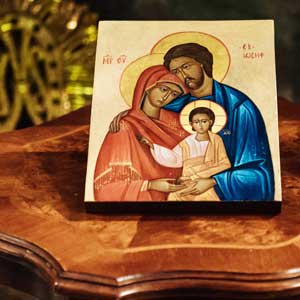
Icons and frescoes
Iconostasis (partition separating the sanctuary from the faithful)
The faithful themselves, who receive the incensation as a blessing
In this tradition, incense represents not only rising prayer to God but also the presence of the Holy Spirit.
In the Anglican and Protestant traditions:
In Anglicanism, incense is used in parishes of the Anglo-Catholic tradition, following a usage similar to Catholicism.
In Protestant Reformed churches, however, incense is rarely used. It is sometimes used in meditative contexts but without a formal liturgical role.
A strong and timeless symbolism
Incense, carried by the coal and diffused by the censer, is much more than a simple sensory element. It is an offering to God, a symbol of the prayers of the faithful, and a means of raising the soul to the divine.
Beyond its liturgical role, its use recalls powerful biblical texts:
The Apocalypse of Saint John (Rev 8, 3-4) describes incense as being associated with the prayers of the saints as they ascend to God.
Psalm 141, 2 evokes prayer compared to the smoke of incense rising before the Lord.
Thus, incense, charcoal and the censer remain essential elements of Christian spirituality, linking the faithful to a thousand-year-old tradition.