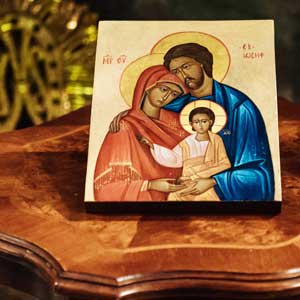
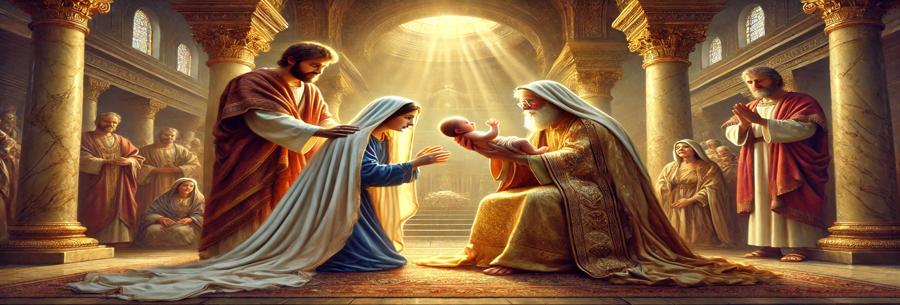
The Presentation of Jesus in the Temple is a key event in the childhood of Christ, recounted in the Gospel according to Saint Luke (2, 22-40). It is both a symbolic and prophetic moment that is part of Jewish tradition while announcing Jesus' messianic role. This scene highlights the Holy Family's obedience to the laws of Moses, Old Simeon's recognition of Christ and the prophecy of Anna, the prophetess. This episode is celebrated by the Church on 2 February as Candlemas.
Religious and historical background
The prescriptions of the Law of Moses
In Jewish tradition, the Law of Moses required every first-born male to be consecrated to the Lord forty days after birth (Ex 13, 2). This consecration was accompanied by a rite of purification for the mother, according to Leviticus (Lev 12, 1-8). The usual offering consisted of a one-year-old lamb for the burnt offering and a turtledove or dove for the sacrifice. However, for modest families, the law authorised the offering of two turtledoves or two doves, which was the case for Mary and Joseph, thus testifying to their humble condition.
The Temple of Jerusalem
The Temple of Jerusalem was the spiritual centre of the Jewish people, the place where they worshipped God. Presenting Jesus there meant officially consecrating him to God, in an act of obedience and faith. In this way, Mary and Joseph faithfully respected divine law, even though Jesus, as the Son of God, did not need this ritual purification. Nevertheless, this act marks the transition between the Old and New Covenants.
The Gospel account according to Saint Luke
The Gospel of Luke (2:22-40) describes the scene of the Presentation in great detail. After completing the days prescribed for purification, Mary and Joseph go up to Jerusalem with the Child Jesus in order to present him to the Lord.
The meeting with Simeon
Simeon is a just and pious man, who was waiting for "the consolation of Israel". The Holy Spirit had revealed to him that he would not die before seeing the Messiah. Inspired, he went to the Temple just as Mary and Joseph entered with the Child. When he saw Jesus, he took him in his arms and proclaimed the Nunc dimittis, a magnificent prayer:
"Now, O sovereign Master, you may let your servant go in peace, according to your word,
For my eyes have seen your salvation,
You have prepared in the sight of all peoples,
A light to enlighten the nations,
And the glory of Israel, your people." (Lk 2, 29-32)
This song expresses the joy and fulfilment of God's promises. Simeon recognises in Jesus the Saviour of the world and the Light of the nations.
Simeon's prophecy
After this praise, Simeon addresses Mary with words fraught with meaning:
"Behold, this child will cause the fall and rise of many in Israel.
He will be a sign of contradiction - and you, your soul will be pierced with a sword -
so that the innermost thoughts of many hearts may be revealed." (Lk 2, 34-35)
With these words, he announces to the Virgin Mary that her Son will be a source of division: he will be welcomed by some but rejected by others. He also foreshadows Mary's suffering at the Passion of her Son, when she will see him die on the Cross.
The testimony of the prophetess Anna
The prophetess Anna, aged 84, a widow and living in the Temple in prayer and fasting, then appears. She praises God and announces to all those who had been hoping for Israel's deliverance that the Messiah has arrived.
Spiritual significance of the Presentation of Jesus
An act of obedience and humility
Mary and Joseph, by obeying the Law, show their respect for the divine will. This episode also shows that Jesus, although the Son of God, enters fully into the human condition by respecting Jewish law.
Jesus, the Light of the nations
Simeon's proclamation emphasises Christ's universal mission. He did not come only for Israel, but to bring salvation to all peoples. It is for this reason that the feast of the Presentation is also called the "feast of the Light", hence the use of candles at Candlemas.
The announcement of the Passion
Simeon's prophecy is an announcement of the Cross. Jesus will be rejected by many, and Mary will suffer with him. It is an invitation to follow Christ even in trials.
The Presentation in Christian tradition
The feast of Candlemas
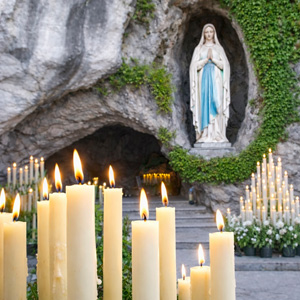
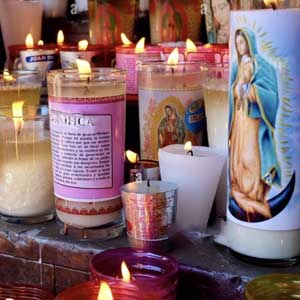
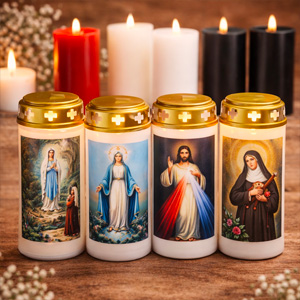
The Presentation of Jesus is celebrated on 2 February under the name Candlemas (festa candelarum, "feast of candles"). This tradition has its origins in the symbol of Jesus as the Light of the world, linked to Simeon's Nunc dimittis. The candles blessed on this day recall this divine light.
A Marian and Christological feast
This feast honours both the Blessed Virgin, who offers her Son to God, and Christ himself, presented as Saviour. It also marks the end of the Christmas liturgical cycle.
Conclusion
The Presentation of Jesus in the Temple is an event of immense spiritual richness. It manifests the fulfilment of divine promises, the humility of the Holy Family and the universal mission of Christ. Simeon and Anna show us the attitude of the believer: patiently awaiting salvation, recognising the Messiah and praising God. Through this story, we are invited to welcome Jesus as the Light of the world and to follow his path, even in trials.