The sacrament of baptism is the first of the seven sacraments of the Catholic Church and is the gateway to the Christian life. Instituted by Jesus Christ, baptism purifies from original sin, initiates the faithful into the community of the Church, and confers upon them the grace of becoming children of God. This fundamental sacrament, rich in symbolism and spirituality, is a moment of joy and commitment for the baptised and for the whole Church community.
1. The biblical origins of baptism
a) Prefiguration in the Old Testament
Baptism has its roots in the Old Testament, where water is often used as a symbol of purification and new life:
The Flood (Genesis 7): Water destroys evil and prepares a renewal for creation.
The crossing of the Red Sea (Exodus 14): Water frees the Hebrews from slavery in Egypt, prefiguring freedom from sin.
The water of the Jordan: Prophets, like Elisha, use water to purify and heal (2 Kings 5:14).
b) The institution by Jesus Christ
Jesus himself sanctified baptism by receiving this sacrament from the hands of John the Baptist in the Jordan:
"This is my beloved Son, in whom I am well pleased." (Matthew 3:17)
By this action, Jesus reveals the importance of baptism as an act of humility and a means of drawing closer to God.
Before his Ascension, Jesus entrusts his disciples with the mission of baptising all nations:
"Go therefore and make disciples of all nations, baptising them in the name of the Father, and of the Son, and of the Holy Spirit." (Matthew 28:19)
2. The spiritual significance of baptism
a) A cleansing from sin
Baptism blots out the original sin inherited from Adam and Eve, as well as all personal sins for the adults who receive it.
b) A new birth
By baptism, the believer is born to a new life in Christ. He becomes a "new creature", regenerated by water and the Holy Spirit (John 3:5).
c) Entry into the Christian community
Baptism integrates the believer into the Church, the Body of Christ. He or she becomes a member of a spiritual family united in faith and charity.
d) The beginning of sacramental life
Baptism opens the door to the other sacraments, which accompany the baptized throughout their spiritual journey.
3. The symbols of baptism
a) Water
Water is the central element of baptism. It symbolises:
The washing away of sins.
New life in Christ.
Participation in the death and resurrection of Jesus.
b) Anointing with the holy chrism
The consecrated oil used for anointing marks the baptised as belonging to God. It symbolises the power of the Holy Spirit and the prophetic, priestly and royal role of the Christian.
c) The white garment
The white garment put on by the baptised person represents the purity, dignity and light of Christ. It recalls the call to live a life of holiness.
d) The light of the Paschal candle
The candle lit at the Paschal candle symbolises the light of Christ, which illuminates the life of the baptised person and guides them on their spiritual journey.
4. The stages of the baptismal rite
a) The welcome
The priest or deacon greets the baptised person (or their parents and godparents in the case of a child) as they enter the church. This step expresses the desire to enter the Christian community.
b) The Word of God
Biblical passages are read to recall the meaning and spiritual fruits of baptism.
c) The exorcism and pre-baptismal anointing
The priest says a prayer of exorcism to free the baptised person from the influence of evil, and then applies a first anointing of holy oil.
d) The profession of faith
The baptised or their representatives (parents and godparents) renounce evil and profess their faith in God, Father, Son and Holy Spirit.
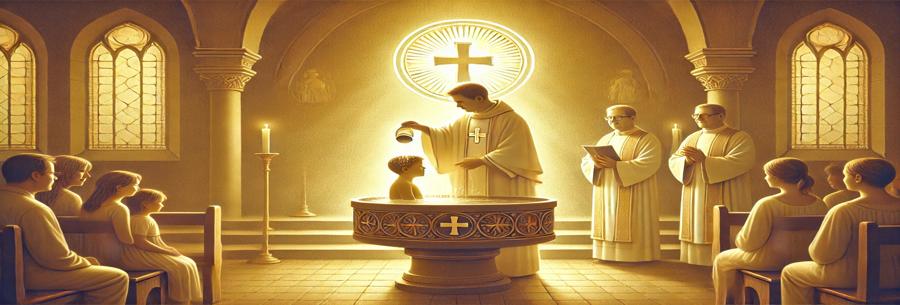
e) Immersion or sprinkling
Water is poured over the baptized person's head or the baptized person is immersed in water, while the priest says the words:
"I baptize you in the name of the Father, and of the Son, and of the Holy Spirit. "
f) The anointing and symbols
The baptized receives the anointing with holy chrism, is clothed in the white garment and receives the lighted candle.
5. The effects of baptism
a) Sanctifying grace
Baptism confers divine grace, which heals the soul of sin and enables it to live in communion with God.
b) Belonging to the Church
The baptised person becomes a member of the great family of believers, participating in the universal mission of the Church.
c) Eternal life
Baptism gives the hope of eternal life with God, according to Jesus' promise:
"Whoever believes and is baptized will be saved." (Mark 16:16)
6. Infant and adult baptism
a) Infant baptism
The Church baptizes infants to offer them God's grace from the beginning of their lives. Parents and godparents undertake to educate them in the Christian faith.
b) Adult baptism
Adults who request baptism follow a path of preparation, called catechumenate, to deepen their faith before receiving this sacrament.
7. The role of the godparent
Godparents accompany the baptised person in his or her spiritual life. They undertake to support their faith and be witnesses to the Christian life.
8. Conclusion : An entry into the divine life
Baptism is much more than a simple rite; it is a genuine spiritual transformation. It marks the beginning of a new life in Christ, membership of the Christian community, and a promise of eternal salvation. By living out their baptism on a daily basis, believers are called to reflect the light of Christ to the world, bearing witness to God's love and mercy for humanity.