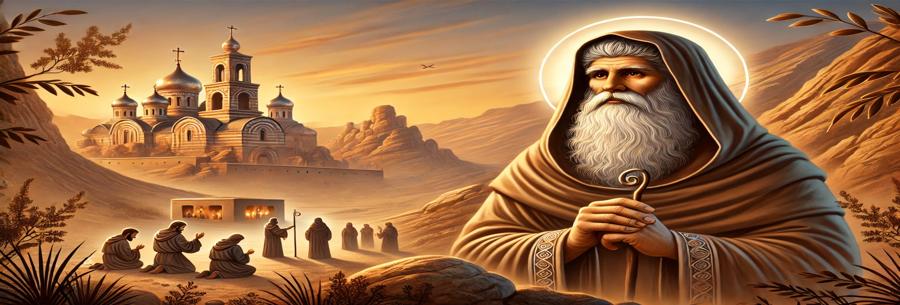
Saint Sabas, born in the 5th century, is one of the most outstanding figures of Eastern Christian monasticism. His exemplary life, characterised by a profound spirit of prayer, rigorous ascetic discipline and total devotion to God, has left an indelible mark on the history of the Church. Recognised as the father of Palestinian monasticism, he was also the founder of the famous Great Lavra of Saint Sabas, a monastery that is still active today. His life is a model of faith, courage and service.
The Early Years: An Early Vocation
Saint Sabas was born in 439 into a Christian family in Cappadocia, in the Eastern Roman Empire. From an early age, he showed a natural inclination towards the spiritual life. At the age of eight, he entered a local monastery to escape family disputes over an inheritance. There, he developed a deep love for prayer, silence and meditation.
His stay at the Flavianopolis monastery provided him with a solid education, both spiritual and intellectual. Very early on, he showed signs of holiness, impressing his teachers with his wisdom and spiritual maturity despite his young age. At the age of twenty, he left his monastery to pursue a more austere life in the Holy Land.
Life in the Desert: The Call of Asceticism
Arrived in Palestine, Sabas settled in the Judean desert, where he joined hermits living in extreme conditions. Under the guidance of Saint Euthymius the Great, a famous ascetic monk, he deepened his commitment to the monastic life. However, his desire for greater solitude and intimate union with God drove him to seek complete isolation.
It was in a cave in the Kidron valley that he settled for good. This cave, away from all civilisation, becomes a place of prayer and meditation. There, Sabas led a life of rigorous fasting and unceasing prayer, devoting himself entirely to God. His reputation for holiness began to attract disciples eager to follow his example.
The Foundation of the Great Lavra
In 483, faced with a growing influx of disciples, Sabas decided to found a monastery to organise the life of this community. Thus was born the Great Lavra of Saint Sabas, one of the first cenobitic monasteries in the Judean desert. This monastery, built around the cave of Sabas, quickly became a centre of spiritual life, learning and Christian influence.
The Great Lavra followed a rigorous monastic rule, emphasising collective prayer, manual work and fasting. Under Sabas's leadership, it became a model of monastic life, attracting monks from all over the region and laying the foundations of Palestinian monasticism.
The Role of Saint Sabas in the Church
Beyond his role as founder, Saint Sabas played an important role in Church affairs. As a respected monk and spiritual adviser, he was often called upon to resolve theological and political conflicts. He firmly opposed the Monophysite heresy that threatened the unity of the Church in his day, fervently defending the orthodox faith defined at the Council of Chalcedon.
In 511, he was sent to Constantinople to plead with Emperor Anastasius in favour of orthodoxy. Although this was a difficult mission, it testifies to the influence and respect Sabas enjoyed within the Church. Despite his involvement in ecclesiastical affairs, he remained faithful to his monastic commitment, always returning to the solitude of the desert after completing his missions.
A Life of Miracles and Holiness
During his lifetime, Saint Sabas was considered a man of miracles. Numerous accounts testify to his ability to heal the sick, calm storms and even provide water in the desert for his monks and pilgrims. These miracles, attributed to his unshakeable faith and communion with God, reinforced his reputation for holiness.
Despite his great popularity, Sabas remained humble and continued to lead a simple life, devoting his entire being to God. He is a living example of the monastic ideal, combining prayer, work and service to others.
The End of his Life and Legacy
Saint Sabas died peacefully on 5 December 532, aged 93. His death marked the end of an extraordinary life devoted to God and the Church. After his death, he was quickly venerated as a saint, and his cult spread throughout the Christian world.
His monastery, the Great Lavra, continues to be a place of prayer and pilgrimage, perpetuating the legacy of its founder. Even today, Saint Sabas is a model for monks and faithful alike, inspiring through his faith, perseverance and love of God.
Conclusion
The life of Saint Sabas is a living testimony to the power of faith and prayer. By choosing the difficult path of asceticism and total dedication, he not only transformed his own life, but also laid the foundations of a monastic tradition that continues to shine through the centuries. Saint Sabas remains an emblematic figure of Christian spirituality, reminding us that true happiness lies in communion with God.