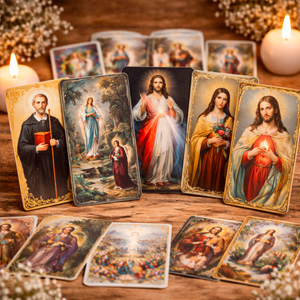

Saint John Joseph of the Cross (San Giovanni Giuseppe della Croce) is an emblematic figure of Franciscan spirituality. Born in 17th-century Italy, he distinguished himself by his profound humility, his life of asceticism and his zeal for the reform of his order. Canonised in 1839, he remains an example of self-denial and charity for the faithful.
His youth and entry into religious life
Birth and childhood
Jean Joseph de la Croix was born under the name Carlo Gaetano Calosirto on 15 August 1654 on the island of Ischia, off the coast of Naples, Italy. He grew up in a deeply Christian family, which instilled in him the values of piety and humility. From an early age, he showed signs of a religious vocation and a natural inclination towards prayer and renunciation of worldly pleasures.
From an early age, he was attracted to the monastic life and felt an inner call to devote himself entirely to God. Inspired by the example of St Peter of Alcantara, he turned to the order of reformed Franciscans, also known as Alcantarins, who advocated an austere life and strict observance of the rule of St Francis of Assisi.
His entry into the Franciscan Order
At the age of 16, Carlo Gaetano entered the monastery in Naples and took the name John Joseph of the Cross, in homage to St John of the Cross, a great figure of Christian mysticism. He took his vows in 1671 and embraced a life of rigorous asceticism, marked by prayer, penance and obedience.
From his first years as a monk, he impressed his superiors with his fervour and desire for spiritual perfection. He spent long hours in prayer and imposed severe mortifications on himself, sleeping little and living in extreme simplicity.
His mission of reform and his responsibilities in the order
Convent reform and exemplarity
At the age of 24, John Joseph was sent to help found a new convent at Piedimonte d'Alife, near Naples. There, he put into practice the ideals of the Franciscan reform:
Absolute poverty: he refused all material comforts and lived in austere conditions.
Strict obedience to the rule of St Francis: he encouraged his brothers to follow a simple life devoted to God.
Service to the poorest: he devoted time to the sick and needy.
His humility and commitment make him a model for his Franciscan brothers, who see him as a spiritual guide.
Appointed superior and spiritual director
Because of his great qualities, John Joseph is elected superior of the convent and entrusted with the spiritual direction of several monasteries. He governed with gentleness and wisdom, always concerned for the spiritual well-being of the religious under his care.
Despite his high responsibilities, he refused all forms of privilege and continued to lead a life of simplicity and penance. He performed the most humble tasks in the convent himself, such as sweeping the floors or washing the dishes, in order to remain faithful to the spirit of Saint Francis of Assisi.
His mystical life and miracles
A man of prayer and ecstasy
Jean Joseph of the Cross is known for his profound mystical life. He spent long hours in prayer, often in ecstasy, receiving spiritual revelations and consolations. It is reported that he could levitate during prayer, a sign of his intense union with God.
He also received the gift of prophecy and could read hearts. Many of the faithful and religious came to him for advice and words of comfort.
His miracles
Many miracles are attributed to him during his lifetime, including:
Miraculous healings: he is said to have cured the sick simply by his prayer and intercession.
Multiplication of food: on several occasions, the convent's food mysteriously multiplied under his blessing.
Bilocation: some witnesses claim to have seen him in two places at the same time, a phenomenon also observed in other mystical saints such as Saint Padre Pio.
These extraordinary signs reinforce the veneration in which he is held, and many people come to seek his help and prayers.
His death and canonisation
An end of life marked by suffering
Towards the end of his life, John Joseph of the Cross underwent great physical suffering, which he accepted with patience and abandonment to God. Despite his weakness, he continued to preach and counsel the faithful until his final days.
He died on 5 March 1734 in Naples, aged 79, surrounded by his Franciscan brothers. His reputation for holiness was such that many people came to pay their respects to his remains.
His canonisation
After his death, his cult spread rapidly in Italy and beyond. Numerous miracles were reported after his death, reinforcing the conviction that he interceded with God for the faithful.
In recognition of his exemplary life, he was beatified in 1789 by Pope Pius VI, then canonised in 1839 by Pope Gregory XVI. He is celebrated on 5 March, the day of his death.
His spiritual legacy
St John Joseph of the Cross remains an inspirational figure for Christians. His message rests on three pillars:
Absolute humility: He always refused honours and lived in simplicity.
Constant prayer: His union with God was the source of his strength and his miracles.
Charity towards the poor and the sick: He embodied the spirit of Saint Francis by serving the most destitute.
Still today, his example inspires religious and lay people to lead a life more centred on God, in prayer and service to others.
Conclusion
Saint John Joseph of the Cross embodied the Franciscan ideal of humility, poverty and charity throughout his life. His profound spirituality and the miracles attributed to him have made him a saint venerated far beyond Italy. His message remains relevant today: put God at the centre of your life and dedicate yourself to others with love and humility.
May his example continue to inspire those who seek to deepen their faith and live the Gospel in their daily lives.