Ash Wednesday marks the beginning of Lent, a forty-day period of spiritual preparation before the celebration of the Christian Easter. Observed mainly in the Catholic Church and some Protestant denominations, this day is of particular importance to the faithful, who are invited to conversion, prayer, fasting and penance.
Origin and biblical significance
The origin of Ash Wednesday goes back to the earliest traditions of the Church. The imposition of ashes has its roots in the Old Testament, where they were a symbol of repentance, mourning and humility. Several biblical passages mention the use of ashes to signify an attitude of penitence:
Jonas 3, 6: When the prophet Jonah preached in Nineveh, the inhabitants, overcome with remorse, covered themselves with sackcloth and sprinkled themselves with ashes as a sign of repentance.
Job 42, 6: Job acknowledged his unworthiness before God and "repented in dust and ashes".
Daniel 9, 3: The prophet Daniel fasts and puts on sackcloth as a sign of prayer and supplication.
In the New Testament, although the use of ashes is not explicitly mentioned, Jesus invites conversion of heart rather than outward gestures. In particular, he teaches:
"Be converted and believe in the Gospel" (Mark 1:15).
Thus, the Church has taken up this tradition of ashes to remind the faithful of the need to turn to God with humility.
Liturgical and spiritual significance
Ashes Wednesday marks the entry into Lent, a period of forty days that recalls:
The 40 days of fasting of Jesus in the desert before the beginning of his ministry (Matthew 4, 1-11).
The 40 years of wandering of the people of Israel in the desert before entering the Promised Land.
The 40 days of the Flood in the Old Testament.
Lent is therefore a period of prayer, fasting and almsgiving, designed to prepare Christians to celebrate Christ's Resurrection at Easter.
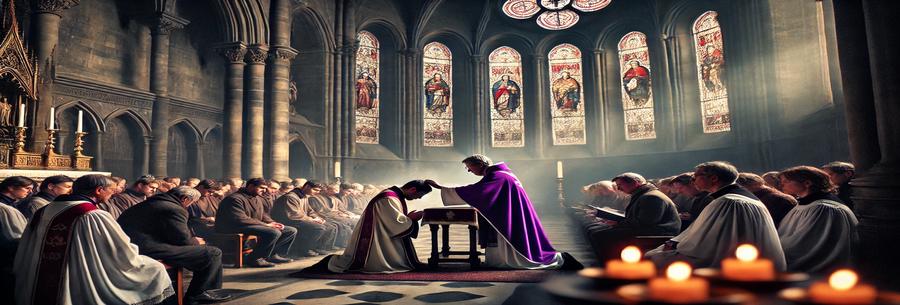
One of the highlights of Ash Wednesday is the imposition of ashes on the foreheads of the faithful, accompanied by one of the following formulas pronounced by the priest:
"Remember that you are dust and to dust you shall return" (Genesis 3:19) → reminder of the human condition and the need to turn to God.
"Convert and believe in the Gospel" (Mark 1, 15) → call to conversion and faith.
The ashes used traditionally come from the previous year's blessed twigs (from Palm Sunday). These twigs are burnt and then mixed with holy water to form the ashes.
Practices associated with Ash Wednesday
1. Imposition of the ashes
This rite takes place during a Mass or Liturgy of the Word. All Christians, including those unable to take communion, may receive the ashes as a sign of conversion. This gesture symbolises the commitment to walk the Lenten path with a sincere heart.
2. Fasting and abstinence
Ash Wednesday is a day of fasting and abstinence:
Fasting consists of eating only one main meal and two light snacks during the day (no snacking). It applies to the faithful between the ages of 18 and 59.
Abstinence involves not eating meat and applies from the age of 14.
These practices are not simply ritual obligations, but a way of refocusing on what is essential, fighting selfishness and opening one's heart to others.
3. Entering Lent
Ash Wednesday ushers in a forty-day period during which Christians are called to:
Pray more, to strengthen their relationship with God.
Fast and deprive themselves, to detach themselves from material excesses and focus on what is essential.
Give alms, helping those in need through donations or time offered.
Lent closes with Holy Week, which culminates in the Passion, death and Resurrection of Christ celebrated at Easter.
Ash Wednesday today
In the modern world, Ash Wednesday retains all its importance, but forms of penance have evolved. The Church encourages the faithful to adapt their Lenten journey according to their lifestyle, choosing for example to:
Reduce their consumption of social networks or entertainment to devote more time to prayer and reflection.
Practise a "digital fast" by limiting the use of screens in favour of family and spiritual exchanges.
Commit to solidarity actions, such as supporting the most disadvantaged.
The central message of Ash Wednesday remains the same: a call to inner conversion and a life closer to the Gospel. It is a powerful moment for Christians who wish to renew their commitment to the faith.
Conclusion
Ashes Wednesday is much more than a simple liturgical rite: it represents a call to conversion and humility, marking the entry into a time of purification and spiritual preparation before the great feast of Easter. Through the imposition of ashes, fasting and prayer, Christians are reminded of their human frailty while renewing their commitment to follow Christ.
By embracing this period with sincerity, each member of the faithful is invited to redirect his or her heart towards God, to show charity and to grow in love and faith.