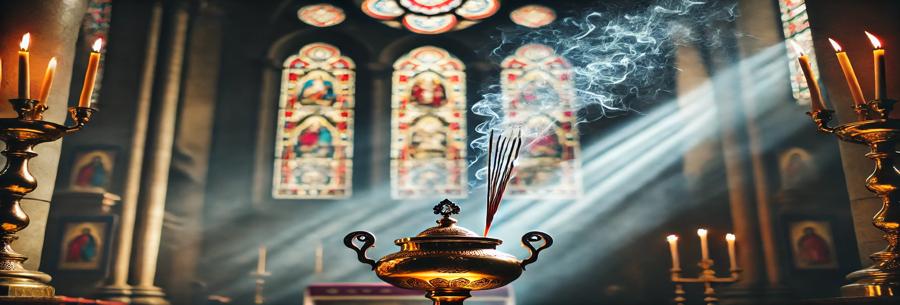
The symbolism of incense smoke rising towards God
Incense, used for millennia in religious rites, occupies a central place in Christian liturgy. Its smoke, which rises gently towards heaven, has a strong and profound symbolism, evoking prayer, the divine presence and the purification of the soul.
In this article, we will explore the different dimensions of the symbolism of incense smoke in the Christian tradition, its biblical roots and its spiritual significance.
An ancestral tradition with biblical origins
The use of incense in Christian spirituality has its roots in Jewish and biblical traditions. As far back as the Old Testament, incense is presented as an essential element of worship to God.
In Exodus (Ex 30:34-38), God commands Moses to prepare sacred incense to be burnt before the Ark of the Covenant, specifying that this smoke represents the prayer of the people ascending to the Lord.
In Psalm 141:2, the psalmist writes: "Let my prayer before you be lifted up like incense, and the lifting up of my hands like the evening offering."
In the Apocalypse of Saint John (Rev 8:3-4), incense is said to be mixed with the prayers of the saints and presented before God by an angel.
These passages show that from the very beginning, incense and its smoke have been perceived as offerings pleasing to God and vectors of communication between man and the divine.
Incense smoke as a symbol of prayer rising to god
One of the most powerful symbols of incense smoke is the image of prayer rising to heaven.
A bridge between the visible and the invisible
The smoke, light and impalpable, rises fluidly and gracefully, creating a link between the earthly world and the heavenly realm. It illustrates the elevation of the soul to God and reminds the faithful that their prayers, though sometimes silent, always rise to Him.
An act of adoration and offering
In the liturgy, incense smoke accompanies key moments in the religious service, particularly during the incensing of the altar, the Gospel, the faithful and sacred objects. This gesture manifests a spiritual offering, a tribute paid to the divine presence.
An image of the Holy Spirit
Like the wind that blows unseen, the smoke of incense recalls the Holy Spirit, invisible but active in the lives of believers. It evokes his mysterious and sanctifying presence, filling the church and hearts.
Smoke as a symbol of purification and sanctification
In many spiritual traditions, incense is used to purify a place or a person. The smoke has a sanctifying function, warding off harmful influences and preparing a sacred space for prayer.
Purification of objects and places
In the Catholic and Orthodox Churches, priests use incense to bless the altar, icons, and even coffins at funerals. Incense marks these objects with a special consecration, making them fit for divine service.
A sign of detachment from the material world
The smoke of incense, which gently dissipates into the air, reminds believers of the fleeting nature of earthly life. It invites us to detach ourselves from material concerns in order to turn towards what is essential: our relationship with God.
Incense and spiritual warfare
In certain prayers and blessing rites, incense is used to drive away evil spirits. This tradition dates back to ancient times, when the smoke was seen as a means of purifying the air and warding off any evil influences.
Incense smoke as an anticipation of heaven
In Christian liturgy, incense is not just an earthly symbol: it is also a prefiguration of heavenly worship.
The image of the heavenly temple
In Revelation, incense is described as being burnt before the throne of God, mingled with the prayers of the saints. This heavenly incensing is an image of the worship rendered by the angels and the elect in divine glory.
An atmosphere of solemnity and sacredness
On the great liturgical feasts, the spreading of incense smoke fills the church with a special atmosphere, reinforcing the feeling of transcendence. It evokes the mystery and majesty of God, enveloping the assembly in a sacred veil.
A reminder of the divine presence
Incense creates an atmosphere where the faithful can feel God's presence more intensely. As in the Old Testament, where the cloud accompanied the people of Israel, the smoke of incense becomes a visible sign of the Lord's nearness.
A powerful and timeless symbol
The smoke of incense, rising gently towards the heavens, is much more than just an aesthetic element of Christian worship. It is a visible expression of prayer, an offering of adoration, a means of purification and an anticipation of heavenly worship.
Through it, the faithful are invited to raise their hearts to God, to detach themselves from earthly concerns and enter into a deeper relationship with the divine. Its use in the liturgy is a reminder that, however invisible, everyone's prayers ascend to the Lord, carried by the breath of the Spirit.
Thus, each wisp of smoke that rises in the churches is a silent but powerful reminder of God's presence among mankind, an invitation to contemplation and communion with Him.