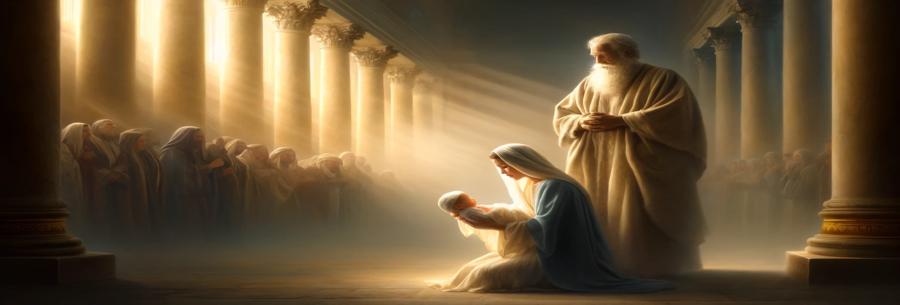
The Presentation of Jesus in the Temple is an event of great importance in the life of Christ, recounted in the Gospel according to Saint Luke (Lk 2, 22-40). It marks both the fulfilment of the Jewish Law and the revelation of Jesus' messianic role. But why did this episode take place? What is its spiritual and theological significance? In this detailed text, we will explore the reasons why Jesus was presented at the Temple, analysing the religious, prophetic and symbolic aspects of this event.
An obligation of the Law of Moses
The prescriptions of Jewish Law
In Jewish tradition, two important laws concern male firstborns and the purification of mothers after childbirth:
The consecration of firstborns
According to Exodus 13:2: "Every firstborn shall be consecrated to the Lord."
This recalled Israel's deliverance from Egypt, when God spared the firstborn of the Hebrews.
The ritual of purifying the mother
After giving birth, a woman was considered unclean for 40 days if she had given birth to a boy (Lev 12:1-8).
She then had to offer a sacrifice in the Temple: a lamb and a dove, or, if she was poor, two turtledoves.
Mary and Joseph obey the Law
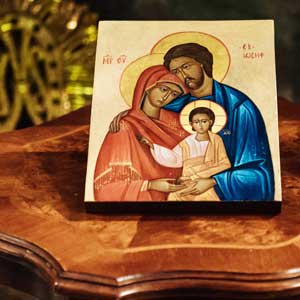
Mary and Joseph, despite knowing that Jesus is the Son of God, respect the Law and perform these rites.
They present Jesus to the Temple so that he can be officially consecrated to the Lord.
Mary, although free from sin and therefore from any impurity, nevertheless follows the custom of the purification ritual.
This gesture shows the humility and obedience of the Holy Family in the face of the divine will.
A prophetic encounter: Simeon and Anna
Simeon recognises Jesus as the Messiah
At the Temple, an elderly man, Simeon, receives Jesus in his arms and speaks inspired words:
"Now, O sovereign Master, you may let your servant go in peace, according to your word,
For my eyes have seen your salvation,
Which you have prepared in the sight of all peoples,
A light to enlighten the nations,
And the glory of Israel, your people." (Lk 2:29-32)
Simeon proclaims that Jesus is the expected Saviour. This passage emphasises that Jesus did not come only for Israel, but for all nations.
The announcement of the Passion
Simeon then says to Mary:
"Behold, this child will cause the fall and rise of many in Israel.
He will be a sign of contradiction - and you, your soul will be pierced with a sword -
so that the innermost thoughts of many hearts may be revealed." (Lk 2:34-35)
He announces that Jesus will be a sign of division, accepted by some, rejected by others.
He also prophesies Mary's sorrow as she witnesses the Passion of her Son.
Anne, the prophetess, bears witness to salvation
An elderly woman, Anne, a widow living in the Temple, praises God and speaks of Jesus to those awaiting Israel's deliverance. She confirms Christ's messianic mission.
A theological and spiritual revelation
Jesus, the true Firstborn consecrated to God
In Jewish Law, the firstborn were consecrated to God but had to be redeemed. Now, Jesus will not be "redeemed" by an offering, for he belongs fully to God and is Himself the Saviour of the world.
Jesus, Light of the nations
One of the great revelations of this event is that Jesus is the Light that enlightens all peoples, not just Israel.
This is why the feast of the Presentation is also called Candlemas, the feast of candles symbolising the light of Christ.
The announcement of Christ's sacrifice
Simeon announces that Jesus will be a sign of contradiction, meaning that his message will be divisive. This announcement is an initial allusion to his Passion and Cross.
A festival celebrated in Christian tradition
Chandeleur: festival of Light
On 2 February, the Church celebrates the Presentation of Jesus under the name of Chandeleur (festa candelarum, "festival of candles").
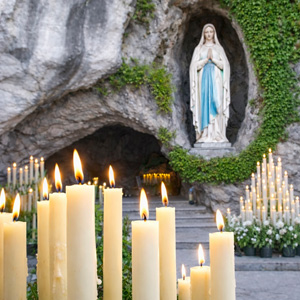
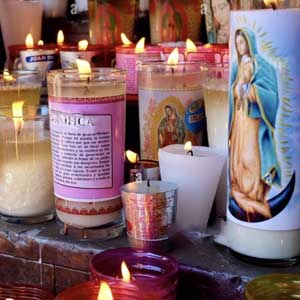
Candles are blessed as a reminder that Jesus is the Light of the world.
This feast also marks the end of the Christmas liturgical cycle.
A link with Mary and the Cross
This feast is both a Marian feast, as it highlights the role of Mary in offering her Son to God,
and a Christological feast, as it already heralds the Passion of Christ.
Why is this event important for us today?
A model of obedience and humility
Mary and Joseph show us that being faithful to God involves obeying with trust, even when we don't understand everything.
Recognising Jesus as the Light of our lives
Simeon and Anne invite us to welcome Jesus as the Saviour and to let him illuminate our hearts.
Accepting the Cross to reach the light
Simeon's prophecy reminds us that following Jesus sometimes involves trials, but these lead us to the true light.
Conclusion
Jesus was presented in the Temple in accordance with Jewish Law, but this event has a much greater significance. It marks his recognition as the Messiah, the Light of the nations and the Saviour of the world.
Through the words of Simeon and Anna, we understand that Jesus comes to fulfil God's promises, but also that he will be rejected by some and a cause of suffering for Mary.
This episode invites us to welcome Christ into our lives, to walk in his light and to persevere in faith, even at the heart of trials.