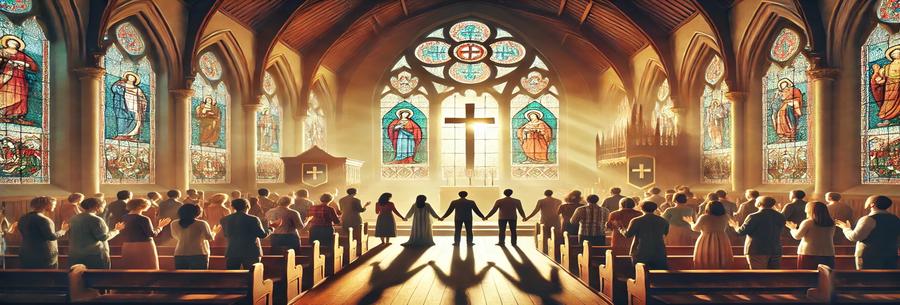
Christian unity is a central aspiration of Christianity, rooted in the prayer of Jesus Christ recorded in the Gospel according to John: "That they may all be one, just as you, Father, are in me and I am in you. May they also be one in us, so that the world may believe that you sent me" (John 17:21). This prayer expresses Christ's deep desire for his disciples: perfect communion in love, faith and truth, in order to bear credible witness to the Gospel to the world.
However, this unity does not mean uniformity. It does not seek to erase the differences between the Churches, but rather to bring Christians together around their common faith in Jesus Christ, while respecting diverse traditions, cultures and liturgical practices. This quest for unity, often referred to as ecumenism, is a spiritual, theological and practical journey that aims to bring divided churches closer together so that they can live out their common mission in the world.
Unity in diversity: understanding the different dimensions
1. Spiritual unity
Christian unity begins with a spiritual communion that transcends visible divisions. All Christians share a common faith in Jesus Christ, the Son of God, and confess one baptism. This spiritual unity is expressed in prayer, in reading the Word of God and in living according to the values of the Gospel.
Prayer plays a crucial role in this dimension. When Christians from different denominations gather to pray together, they recognise that they belong to the same spiritual family and that they believe in the same Lord. This is why events such as the Week of Prayer for Christian Unity are so important in the journey towards deeper unity.
2. Doctrinal unity
Doctrinal unity is a complex and often difficult dimension to achieve. Theological differences between the Churches (Catholic, Orthodox, Protestant, Anglican, etc.) have led to historical schisms. These differences concern essential points such as the authority of the Church, the role of the Pope, the nature of the sacraments, the place of Mary, and justification by faith.
However, significant progress has been made thanks to ecumenical dialogue. Joint declarations, such as that on justification by faith signed in 1999 between the Catholic Church and the Lutheran World Federation, show that it is possible to find common ground, even on complex issues.
3. Liturgical unity
Liturgical diversity is a richness of Christianity, but it can also reflect divisions. Each tradition has developed its own liturgical practices, often linked to its culture and history. Unity does not seek to standardise these practices, but to recognise their complementarity. Participation in ecumenical celebrations enables a better understanding and appreciation of the varied expressions of faith.
4. Practical unity
Christian unity is not limited to prayer or theological discussions; it also manifests itself in concrete actions. Faced with global challenges such as poverty, conflict, migration and the protection of creation, the Churches are called to work together. Practical unity bears witness to the ability of Christians to overcome their divisions in order to act in solidarity and love.
Why is Christian unity important?
1. Faithfulness to the Gospel
Jesus himself prayed for the unity of his disciples. Working for Christian unity is therefore a direct response to his call. A divided Church can weaken its witness, whereas a united Church more credibly embodies God's love for humanity.
2. Witness to the world
Christian unity is a powerful witness to peace and reconciliation in a world marked by division and conflict. It shows that differences, whether cultural, theological or historical, can be overcome through love, dialogue and faith in God.
3. A common mission
All churches share a common mission: to proclaim the Good News, defend the oppressed, care for the sick, welcome strangers and protect creation. Cooperation between Christian denominations makes it possible to respond more effectively to these global challenges.
Challenges and obstacles to Christian unity
Despite the progress made, many obstacles remain on the road to unity:
The wounds of the past: Schisms, persecutions and historical misunderstandings have left deep marks on relations between Churches.
Doctrinal differences: Some theological disagreements seem difficult, if not impossible, to overcome.
Prejudices and misunderstandings: Lack of mutual knowledge can fuel stereotypes and divisions.
Fear of losing identity: Some churches fear that too much openness will dilute their specificities.
A path of hope
Christian unity is a long and demanding road, but it is also one that brings hope. Numerous symbolic gestures and concrete initiatives bear witness to a genuine desire for rapprochement. For example:
The joint prayer between Catholics and Protestants during the Week of Prayer for Christian Unity.
The reciprocal visits by popes and Orthodox patriarchs, or meetings with Protestant leaders.
The collaboration between Churches in charity work or campaigns for social justice.
These gestures show that, despite differences, it is possible to live a real unity, based on love and faith.
Conclusion: A unity in Christ
Christian unity does not mean erasing differences, but living together in communion and mutual respect. It is a call to recognise that, despite our divisions, we are all brothers and sisters in Christ, members of the same body, animated by the same Spirit.
By praying for unity and working concretely for reconciliation, we respond to Jesus' call and bear witness to God's infinite love for the world. It's a journey of personal and communal conversion, requiring humility, patience and perseverance. But it is also a promise of hope: one day, we will be fully united in Christ, for his glory and for the salvation of all.