
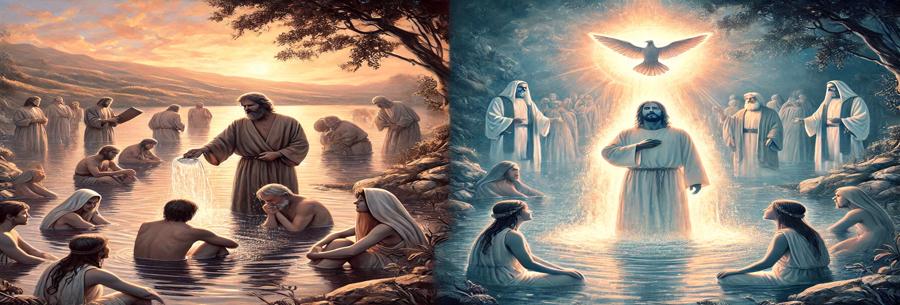
Baptism is a central practice in the Christian tradition, but its origin and meanings differ according to the contexts and biblical figures involved. Two forms of baptism are particularly significant in the Scriptures: that of John the Baptist, which prepared men and women for the coming of the Messiah, and that instituted by Jesus Christ, which marks a new era of grace and salvation. These two baptisms, although they share similarities, have fundamental differences in terms of meaning, purpose and spiritual significance.
The baptism of John the Baptist: a baptism of repentance
Historical context and the role of John the Baptist
John the Baptist, a charismatic prophet, was sent to prepare the people for the coming of the Messiah. In the Judean desert, he preached a powerful message of repentance and called on people to change their lives and turn to God. The baptism he administered in the waters of the Jordan had a clear function: to spiritually prepare hearts to welcome the one who would come after him, Christ.
Spiritual Significance
John the Baptist's baptism was symbolic. It signified an act of repentance, i.e. a change of attitude and a willingness to renounce sin in order to follow God's ways. However, this baptism did not really erase sins. It was not a promise of eternal salvation, but a preparation for a greater act, the salvation brought by Jesus.
John himself explains this in the Gospels: "I baptise you with water to bring you to repentance; but he who is coming after me is mightier than I, [...] he will baptise you with the Holy Spirit and with fire" (Matthew 3:11). This emphasises that his baptism was temporary and pointed towards a deeper and more lasting divine work.
Rite and symbol
John the Baptist's baptism was by immersion in water. The water symbolised outward purification, a visible sign of the inner desire to turn away from sin and live according to God's commandments. However, this rite was only a precursor, a preparatory stage in God's plan.
The baptism instituted by Jesus Christ: a baptism of salvation and transformation
A baptism that goes beyond repentance
In contrast to John's baptism, Jesus' baptism is not limited to repentance. Jesus inaugurates a baptism that involves a profound inner transformation through the action of the Holy Spirit. This baptism, administered in the name of the Father, the Son and the Holy Spirit, is not just a symbolic rite, but a sacrament that confers divine grace.
In the Gospel according to John (3:5), Jesus teaches Nicodemus: "Truly, truly, I say to you, unless a man is born of water and the Spirit, he cannot enter the kingdom of God." This passage highlights that Christian baptism is not just an outward cleansing, but a spiritual new birth that opens the gates to the Kingdom of God.
An act of reconciliation and salvation
Jesus' baptism is directly linked to his sacrifice on the cross and his resurrection. By receiving this baptism, the believer is united to Christ's death and resurrection. As the apostle Paul explains, "We have been buried with him through baptism into death, so that, just as Christ was raised from the dead by the glory of the Father, we too may walk in newness of life" (Romans 6:4).
Thus, this baptism is an act of reconciliation with God. It does not merely prepare believers for salvation: it actually offers them the divine grace that makes them righteous before God.
The presence of the Holy Spirit
One of the great differences between the baptism of Jesus and that of John is the coming of the Holy Spirit. In Christian baptism, the Holy Spirit descends on the baptized, sanctifies them, and strengthens them to live a Christian life. This mirrors what happened at the baptism of Jesus himself, where the Holy Spirit descended in the form of a dove.
The link between the two baptisms
Although distinct, these two baptisms are not opposed, but complementary. The baptism of John the Baptist serves as a preparation for that of Jesus. It calls for the awareness and repentance necessary to receive Christ. Jesus' baptism, on the other hand, completes this work by conferring real grace, forgiveness of sins and new life in God.
John himself recognises the superiority of Jesus' baptism when he says: "I baptise you with water, but he will baptise you with the Holy Spirit" (Mark 1:8). Thus, the baptism of Jesus fulfils and transcends that of John, inaugurating a new era in God's plan of salvation.
Conclusion
The baptism of John the Baptist and that of Jesus represent two essential milestones in the history of the Christian faith. The first, rooted in the prophetic tradition, calls for an external purification and prepares hearts for the coming of the Messiah. The second, instituted by Jesus, goes much further, offering an inner transformation through the grace of God and the action of the Holy Spirit. Together, these two baptisms underline the importance of repentance and faith, and they show how God acts to bring humanity closer to himself, in a plan of redemption that culminates in Christ's sacrifice and resurrection.