Every year on 27 December, the Catholic Church celebrates the feast of Saint John the Apostle and Evangelist, a central figure in Christianity. This day honours one of Jesus' closest disciples, known for his faithfulness, his role as witness to the major events in Christ's life, and his writings imbued with love and spirituality. The Feast of Saint John the Apostle is an opportunity to meditate on his example and celebrate his spiritual legacy.
A unique apostle: "the disciple whom Jesus loved"
Saint John occupies a special place among the apostles. A young man with a pure and faithful heart, he was the only disciple to remain at the foot of the Cross with the Virgin Mary, thus receiving the special mission of caring for her as his own mother. This unique relationship with Jesus earns him the title of "beloved disciple".
The feast of Saint John is an opportunity to recall:
His intimacy with Jesus: John rests on Jesus' breast at the Last Supper, a symbol of his love and understanding of the divine mysteries.
His unshakeable fidelity: Unlike other apostles, John does not flee during Christ's Passion, but remains faithful to the very end.
His role as witness: John was present at the Resurrection and was one of the first to believe in the risen Christ.
The writings of Saint John: a spiritual heritage
The feast of Saint John also highlights the major contributions of this apostle to the Christian faith through his writings. These texts, with their remarkable theological depth, continue to inspire believers down the centuries.
The Gospel according to John
The Gospel of John stands out for its unique approach. More contemplative and spiritual than the synoptic Gospels, it emphasises:
The divinity of Jesus: "In the beginning was the Word, and the Word was with God, and the Word was God" (John 1:1).
The signs and miracles of Jesus, as revelations of his divine nature.
The discourses of love and truth, inviting believers to enter into communion with Christ.
The Epistles of John
John's letters reflect his pastoral role, exhorting Christian communities to:
Live in brotherly love: "He who does not love has not known God, for God is love" (1 John 4:8).
Reject false teaching and remain faithful to the truth of the Gospel.
Walk in the light, the symbol of life in Christ.
The Apocalypse
John is also the author of the Book of Revelation, a prophetic text written on the island of Patmos. This book is a mystical vision of God's final victory over evil, offering a message of hope to persecuted Christians.
Spiritual significance of the feast
The feast of Saint John the Apostle, celebrated shortly after Christmas, is part of the liturgical season of joy and light. It is an invitation to:
Contemplate divine love: John, apostle of love, reminds us that the heart of the Christian message is unconditional love for God and for others.
Stay faithful to the truth: John exhorts believers to walk in the light and reject darkness.
Seeking closeness to Jesus: Like John, Christians are called to cultivate an intimate and personal relationship with Christ.
The feast is also an opportunity to pray for Christian unity, drawing inspiration from John's teaching on brotherly love.
Traditions linked to the feast of St John
Although the feast of St John the Apostle is less well-known than that of St John the Baptist (celebrated in June), it is marked by liturgical celebrations and local traditions.
Solemn masses: Masses are celebrated in honour of Saint John, featuring readings from his writings and homilies focusing on love and fidelity.
Community celebrations: In some regions, believers gather for meals or times of prayer in community, paying homage to Saint John.
Spiritual readings:The day is conducive to meditating on the texts written by John, such as his Gospel or his epistles, to deepen his understanding of the divine mysteries.
The symbolism of light and the eagle
The feast of Saint John is also associated with strong symbols that recall his unique role:
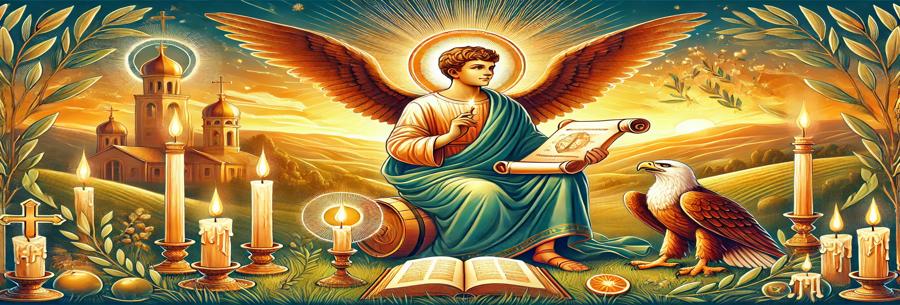
The eagle: The emblem of Saint John, it symbolises the height and depth of his theological thought. As the eagle soars towards heaven, John's Gospel invites us to contemplate heavenly truths.
The light: John's writings highlight Jesus as the "Light of the world". This light is a guide to living in truth and love.
Conclusion
The feast of St John the Apostle is much more than a simple liturgical commemoration: it is an invitation to deepen our faith, to love with a sincere heart, and to walk in the light of Christ. Through his example of fidelity, his inspiring writings and his message of love, Saint John continues to guide believers towards an authentic and meaningful Christian life. On this special day, the faithful gather to honour his legacy and pray to live according to his teachings, in truth and love.