St John the Evangelist is one of the most outstanding figures of Christianity and a pillar of the Christian faith. He is recognised as one of the twelve apostles of Jesus Christ and as a privileged witness to the most important events in the life of his master. His life, writings and role in the early Church make him a key figure in understanding the foundations of the Christian message.
A life marked by closeness to Jesus
St John was the son of Zebedee, a fisherman, and Salome, often regarded as a disciple of Jesus. He was the brother of James the Greater, another apostle, and together they were nicknamed by Jesus "the sons of thunder" (Boanergès), because of their fiery temperament. Before following Jesus, John was a fisherman on Lake Tiberias, where he worked alongside his father and brother.
John is often described as "the disciple whom Jesus loved", an expression that reflects the special intimacy he had with Christ. This closeness can be seen at key moments in Jesus' life:
At the Last Supper, John sits close to Jesus and rests on his breast, a posture that symbolises affection and trust.
At the foot of the Cross, he is the only one of the apostles present with Mary, Jesus' mother, to whom he is entrusted by Christ: "Behold your mother" (John 19:27). This gesture by Jesus is a sign of the love and responsibility bestowed on John.
After the Resurrection, he is one of the first apostles to discover the empty tomb and to believe in the Resurrection.
Inspired author of the Scriptures
St John is traditionally regarded as the author of several fundamental texts of the New Testament:
The Gospel according to John
This Gospel stands out from the other three (Matthew, Mark, Luke) for its unique style and theological depth. John does not simply report facts; he interprets them to reveal the divinity of Jesus. The miracles, called "signs", and the speeches of Jesus, centred on themes such as light, truth and love, take centre stage. This text is also marked by dialogues of great richness, such as the one between Jesus and Nicodemus or with the Samaritan woman at the well.
The Three Epistles of John
These letters are addressed to the first Christian communities and insist on essential themes: brotherly love, truth, and vigilance against false teachings. The first epistle, in particular, proclaims that "God is love" (1 John 4:8), a universal message that remains at the heart of Christianity.
The Apocalypse
This prophetic book, also attributed to John, is an apocalyptic vision he is said to have received while exiled on the island of Patmos, during the reign of the emperor Domitian. The Apocalypse is both a mystical text and an exhortation to hope, describing God's final victory over evil and the triumph of Christ.
His role in the early Church
After Jesus' resurrection, John became a major player in the nascent Church. According to tradition, he lived in Ephesus, where he watched over the Christian community and continued to teach. Unlike most of the other apostles, John was not martyred, although tradition has it that he was persecuted and exiled. He is said to have died at an advanced age, making him the last of the apostles to leave this world.
Symbol and representation
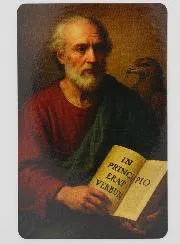
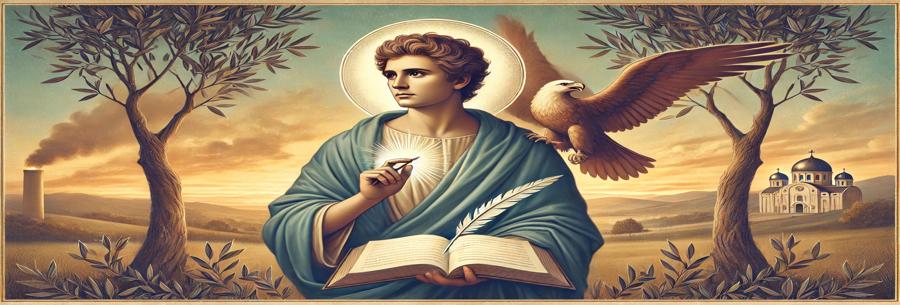
St John the Evangelist is often depicted in Christian art as a beardless young man, reflecting his youth at the time he followed Jesus. His symbol, the eagle, illustrates the spiritual elevation and theological depth of his writings. The eagle, able to fly high in the sky, is associated with the contemplation of divine truths and the elevation of the soul.
The spiritual heritage of Saint John
John is venerated as the model of the faithful and loving disciple. He embodies purity of heart, unshakeable faith and mystical contemplation. His insistence on love - for God and for others - remains a central foundation of the Christian faith.
Every year, the Catholic Church celebrates the feast of Saint John the Evangelist on 27 December, in the joy of Christmas light. Through his writings and example, Saint John continues to inspire Christians to seek the truth, live in love and walk in the footsteps of Christ.