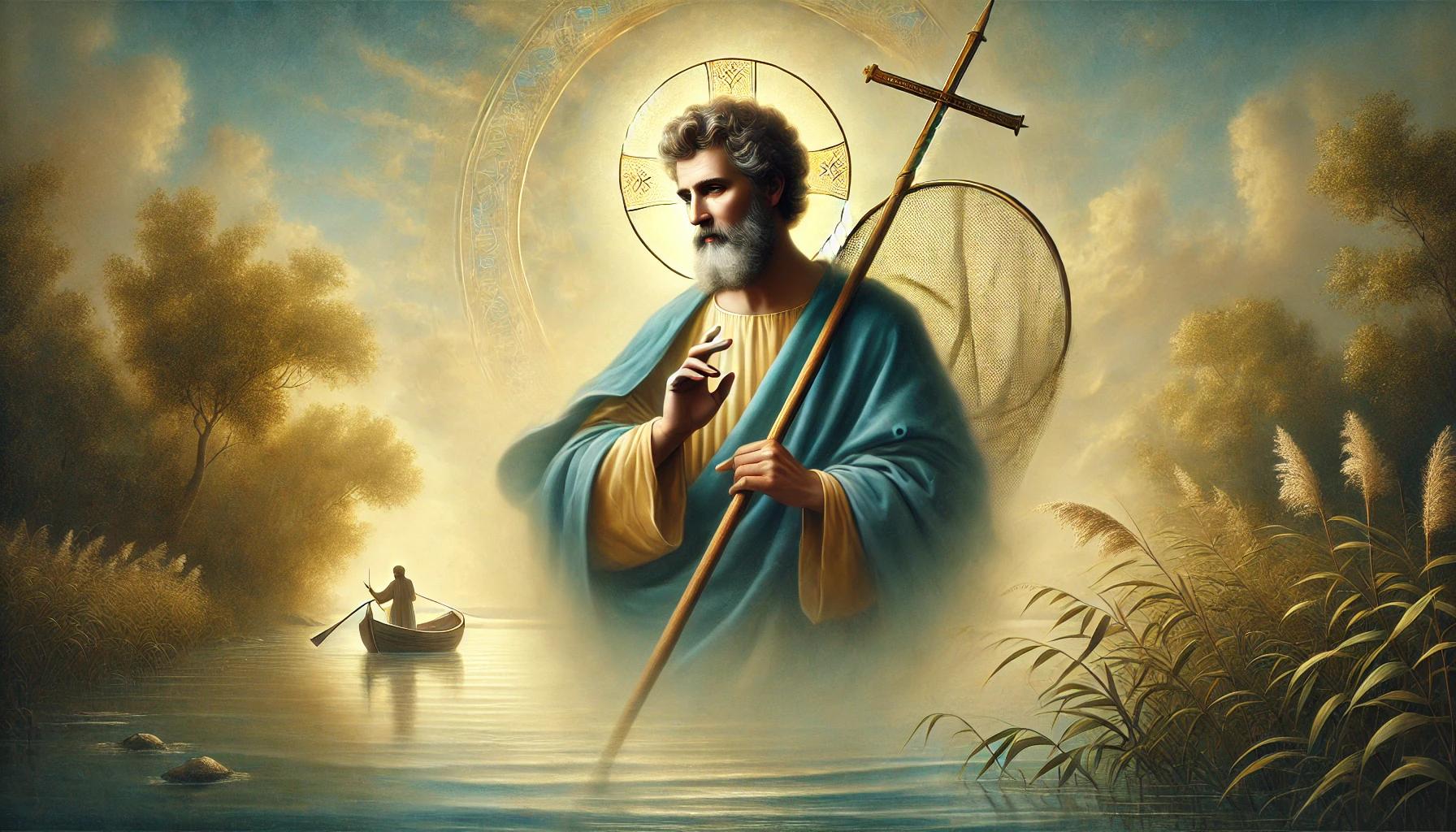
St Andrew, known as the first apostle called by Jesus, occupies a special place in the New Testament and in Christian tradition. The brother of Saint Peter, he is an example of immediate faith and dedication to Christ's mission. Patron saint of many nations and communities, he is venerated throughout the world, particularly on his feast day, 30 November. This text explores his life, his role in Christian history, and his spiritual legacy.
The life of Saint Andrew
Origins and calling
Saint Andrew was born in Bethsaida, a fishing village on the shores of Lake Tiberias. The son of Jonah, he was the brother of Simon Peter. Like many of his contemporaries, he worked as a fisherman.
Before following Jesus, Andrew was a disciple of John the Baptist. According to the Gospel of John (1:35-40), Andrew heard John the Baptist refer to Jesus as the Lamb of God. Without hesitation, he followed Jesus and spent the day with him. Subsequently, he became the first apostle called, earning him the title "First Called" (Protokletos) in Eastern tradition.
Mission and ministry
After meeting Jesus, Andrew immediately bore witness to his faith by bringing his brother Simon (later known as Peter) to meet Christ. He played a key role in the formation of the group of apostles.
The Gospels mention Andrew on several occasions, notably at the multiplication of the loaves (John 6:8-9), where he reported the presence of a young boy with five loaves and two fish. In this way, he demonstrated his role as an intermediary, bringing others to Jesus.
After Pentecost, tradition records that Andrew set out on a mission to evangelise. He preached in various regions, including Greece, Asia Minor, and as far away as Scythia (now Ukraine and Russia), earning him the title of patron saint of these regions.
The martyrdom of Saint Andrew
According to tradition, Andrew was crucified in Patras, Greece, on an X-shaped cross, today known as the "Cross of Saint Andrew". Refusing to be crucified in the same way as Jesus out of humility, he chose this particular shape. For two days, he preached to those around him before giving up the ghost.
The X-shaped cross has become a symbol associated with St Andrew, particularly in heraldry and flags, such as that of Scotland.
The role of St Andrew in Christian tradition
1. A model of immediate faith
St Andrew is an example of immediate faith and obedience. When he heard Jesus' call, he responded without hesitation, leaving behind his life as a fisherman to become an apostle.
2. The go-between to Christ
Throughout his life, Andrew played the role of go-between, bringing others to Jesus. This is particularly visible when he introduced his brother Peter to Christ. This aspect of his ministry is a reminder of the importance of personal witness and evangelisation.
3. Patron saint of nations
Saint Andrew is the patron saint of many nations, including:
Scotland: His X-shaped cross is depicted on the Scottish flag, known as the Saltire.
Russia: Considered the evangeliser of the eastern lands.
Greece: Place of his martyrdom.
His influence also extends to several professions, including fishermen and craftsmen.
Traditions associated with Saint Andrew
1. The Feast of Saint Andrew (30 November)
The Feast of Saint Andrew often marks the beginning of the Advent period in the Western Church. It is celebrated with special masses and prayers in his honour.
In the Orthodox Church, he is particularly venerated for his role in the evangelisation of Eastern lands and as the presumed founder of the Patriarchate of Constantinople.
2. Scottish traditions
In Scotland, St Andrew is celebrated as the national patron saint. His feast day is the occasion for cultural festivities, traditional dances and prayers. The Saltire, the Scottish flag, reflects his martyrdom.
3. Eastern traditions
In Slavic countries, St Andrew is venerated as a key evangeliser. In Russia, his feast day is marked by processions and prayers for unity and faith.
The spiritual legacy of Saint Andrew
1. Evangelisation and witness
St Andrew reminds all Christians of their call to be witnesses to Christ. His missionary zeal inspires us to share the faith with courage and conviction.
2. Humble faith
André never sought glory or a position of power, but always pointed others to Jesus. His humility is a powerful example for those seeking to serve God.
3. Christian unity
As the first apostle called, St Andrew is a symbol of unity between the Eastern and Western traditions of Christianity. His common veneration in these traditions makes him a bridge between the Churches.
Conclusion
St Andrew, the first apostle called by Jesus, embodies obedience, faith, and missionary zeal. His life and martyrdom are a reminder of the importance of responding to God's call with an open and generous heart. Patron saint of many nations and a spiritual guide, he inspires believers to become witnesses for Christ in their own lives. His feast day, 30 November, is a special time to reflect on his legacy and to seek his intercession in our lives.