The Sacrament of the Anointing of the Sick, often referred to as the Sacrament of the Sick, is one of the seven sacraments of the Catholic Church. It is especially intended for people suffering from serious illnesses, the elderly or the faithful preparing for major surgery. Through this sacrament, the Church offers the sick God's grace to support them in their ordeal, give them inner peace, and, if it is in accordance with divine will, heal them physically or spiritually.
1. The biblical origins of the anointing of the sick
a) Prefigurations in the Old Testament
In the Old Testament, oil is often used as a sign of blessing, healing and sanctification:
Psalm 23:5: "You pour fragrant oil on my head; my cup overflows. "
Isaiah 61:1: The prophet announces a Messiah who will come to bring healing and consolation.
b) The ministry of Jesus
Jesus manifests God's special care for the sick through his many healings. He touches, heals and comforts:
"Come to me, all you who labour under a burden, and I will give you rest." (Matthew 11:28)
The Gospels record episodes in which Jesus heals by simple touch or by the power of his word, thus showing that illness is an opportunity for an encounter with God.
c) Institution by Jesus and apostolic practice
Jesus entrusts his apostles with the mission of healing the sick:
"They shall lay hands on the sick, and they shall be healed." (Mark 16:18)
The apostles follow this command, as James 5:14-15 testifies:
"Is any of you sick? Let him call for the elders of the church, and let them pray for him, anointing him with oil in the name of the Lord."
2. The spiritual significance of the anointing of the sick
a) An encounter with the suffering Christ
The sacrament unites the sick person to the sufferings of Jesus Christ, offering an opportunity for personal sanctification and participation in the redemptive work.
b) A source of comfort and peace
The anointing of the sick brings an inner peace that helps one to face illness or death with confidence in God.
c) A possibility of physical healing
The sacrament can, in some cases, bring physical healing if it is in accordance with God's will.
d) A preparation for eternal life
For those at the end of life, the anointing of the sick prepares the soul to meet God, offering forgiveness of sins and spiritual strength.
3. The symbols of the anointing of the sick
a) The blessed oil
The oil used in this sacrament, called the oil of the sick, is blessed by the bishop during the Chrism Mass. It symbolises strength, healing and divine blessing.
b) The laying on of hands
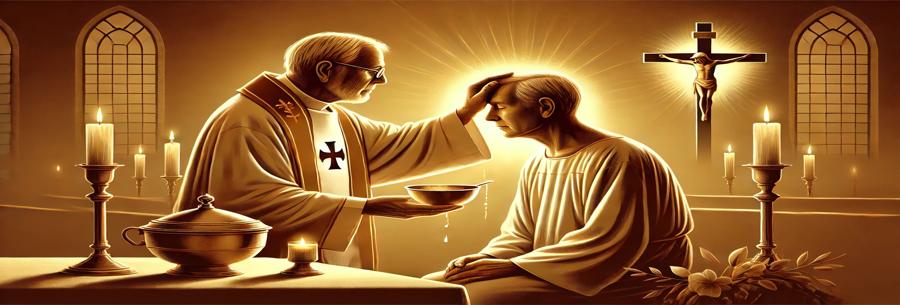
The priest lays his hands on the sick person, a sign of the transmission of grace and the prayer of the Church.
c) The prayer of faith
The prayer spoken by the priest expresses trust in God to restore physical and spiritual health.
4. The rite of the anointing of the sick
a) Spiritual preparation
Before receiving the sacrament, the sick person may, if possible, go to confession to be in a state of grace.
b) The process
The initial prayer: The priest begins with a prayer to invoke God's presence.
The reading of the Word of God: A biblical passage is proclaimed to comfort the sick person and nourish his faith.
The laying on of hands : The priest places his hands on the sick person, invoking the Holy Spirit.
The anointing with oil : The priest traces a cross with oil on the forehead and, if possible, on the hands of the sick person, saying:
"Through this holy anointing, may the Lord in his great goodness comfort you with the grace of the Holy Spirit. May he save you and raise you up."
c) The Eucharist for the dying
For the faithful at the end of life, the reception of the Eucharist as viaticum is often associated with the anointing of the sick, strengthening them for their passage to eternal life.
5. The spiritual fruits of the anointing of the sick
a) Inner peace
The sacrament soothes the soul and drives away anxiety, bringing profound serenity.
b) Forgiveness of sins
The anointing of the sick erases sins if the sick person has not been able to confess before receiving the sacrament.
c) Spiritual strength
The sacrament gives the sick person the strength to endure hardship and to live their illness in communion with Christ.
d) Possible healing
If it is God's will, the sacrament can contribute to physical healing, thus testifying to the power of faith.
6. Who can receive the sacrament?
a) The seriously ill
This sacrament is for those whose health is seriously affected by illness or weakness.
b) The elderly
The faithful who are ageing and in declining health can receive the sacrament.
c) People before major surgery
Those who are to undergo major surgery may request anointing to prepare spiritually.
7. Reconciliation and the community
a) A support from the Church
The anointing of the sick reminds us that the Christian community supports and accompanies its members through illness.
b) A union with the Passion of Christ
The sick person is united with the suffering Jesus, transforming his suffering into a spiritual offering.
8. Conclusion : A sacrament of life and hope
The sacrament of the anointing of the sick is a precious gift of the Church for the faithful in situations of illness or weakness. Through this sacrament, God shows his love and mercy, offering healing, comfort and hope. Far from being a sacrament reserved solely for the end of life, the anointing of the sick is a path of grace that accompanies the faithful through their trials and prepares them to meet the Lord, in this life or in eternity.