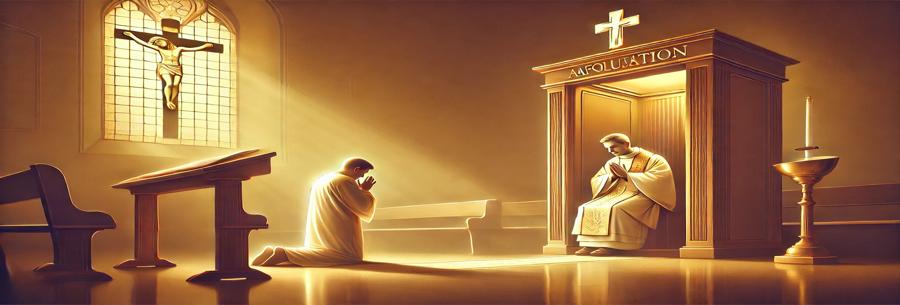
The sacrament of reconciliation, also known as confession or penance, is one of the seven sacraments of the Catholic Church. Through this sacrament, the faithful receive forgiveness for their sins and renew their relationship with God and the Church. Reconciliation is a profound experience of divine mercy, a call to conversion, and a source of inner peace and spiritual renewal.
1. The biblical origins of reconciliation
a) Forgiveness in the Old Testament
The idea of asking God for forgiveness is present throughout the Old Testament:
David and Psalm 51: After his sin, King David expresses deep repentance: "O God, create in me a clean heart."
The role of the priests: The priests of the Old Testament were often mediators between God and his people for the purification of sins (Leviticus 16).
b) The institution by Jesus Christ
Jesus, in his earthly ministry, reveals the depth of God's forgiveness:
He forgives sins, as to the sinful woman (Luke 7:48) or the paralytic (Mark 2:5).
He entrusts his apostles with the power to forgive:
"Receive the Holy Spirit. Whose sins you forgive, they are forgiven them." (Jean 20:22-23)
2. The spiritual significance of the sacrament of reconciliation
a) Restoration of relationship with God
Sin breaks communion with God. Through confession, this relationship is restored, and the faithful person regains sanctifying grace.
b) An inner conversion
The sacrament invites an examination of conscience and a profound change of heart, a metanoia, i.e. a turning back to God.
c) A reconciliation with the Church
Sin affects not only the relationship with God, but also with the Christian community. Forgiveness restores unity with the Church.
d) A victory over evil
By confessing their sins, the faithful renounce evil and receive the strength to live according to the Gospel.
3. The stages of the sacrament of reconciliation
a) Examination of conscience
Before confession, the penitent reflects on the times when he or she has strayed from God, his will and his commandments.
b) Contrition
The penitent feels sincere regret for his sins, motivated by love of God rather than fear of punishment.
c) Confession of sins
The penitent confesses his sins to a priest, who acts in the person of Christ. This requires humility and honesty.
d) Absolution
The priest pronounces the words of absolution:
"May God show you his mercy. I forgive you your sins in the name of the Father, the Son and the Holy Spirit."
e) Satisfaction (or penance)
The priest gives a penance, often a prayer or a restorative action, to help the penitent to reconnect with God and live a life of holiness.
4. The fruits of the sacrament of reconciliation
a) Forgiveness of sins
The sacrament erases all sins confessed and restores the soul to the state of grace.
b) Inner peace
By receiving forgiveness, the penitent experiences profound peace and freedom from spiritual burdens.
c) Strength to avoid sin
The sacrament gives the grace to resist temptations and grow in virtue.
d) A renewed life
Reconciliation offers a fresh start, an opportunity to live more fully in Christ.
5. The symbols of reconciliation
a) The priest
The representative of Christ and the Church, the priest acts as mediator to dispense divine forgiveness.
b) The words of absolution
These words express the power of God's mercy and seal the forgiveness granted.
c) The sign of the cross
Made at the beginning and end of the sacrament, it recalls Christ's victory over sin and death.
6. The frequency of the sacrament of reconciliation
The Church encourages the faithful to go to confession regularly:
Annual minimum: It is recommended to receive this sacrament at least once a year, especially during Lent.
In the case of mortal sin: Confession is necessary before receiving the Eucharist.
As a spiritual exercise: Many Catholics go to confession monthly to maintain an active spiritual life.
7. Reconciliation and divine mercy
a) A sacrament of God's love
The sacrament of reconciliation reveals God's infinite love, always ready to welcome and forgive.
b) An invitation to ongoing conversion
This sacrament is not just a one-off healing, but a call to ongoing transformation of heart.
c) A model of forgiveness
By receiving forgiveness, the faithful are called to forgive in turn, following Jesus' example.
8. Benefits for the Christian community
a) A unified Church
Each confession strengthens the unity of the community, as it repairs the divisions caused by sin.
b) A light for the world
The reconciled faithful bear witness to God's love and mercy in their daily lives.
9. Conclusion: An encounter with God's mercy
The sacrament of reconciliation is an extraordinary experience of God's love. It enables believers to free themselves from the weight of sin, to draw closer to Christ, and to live in peace with themselves and others. This sacrament, a precious gift of divine mercy, is an inexhaustible source of grace, joy and renewal for all those who participate in it with faith and sincerity. Through reconciliation, the Church manifests her role as refuge and spiritual guide, calling each member of the faithful to a life of love, forgiveness, and holiness.