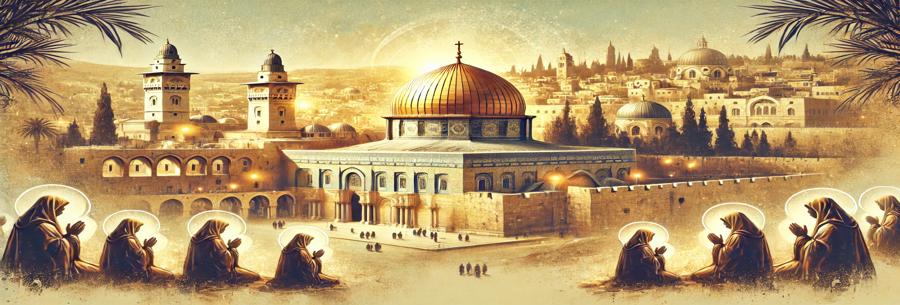
Among the many places of pilgrimage in the Catholic world, Jerusalem, in the Holy Land, occupies a unique place. At the heart of this thousand-year-old city lies the Holy Sepulchre, considered to be the holiest site in Christianity. It is directly linked to the central events of the Christian faith: the crucifixion, burial and resurrection of Jesus Christ. Every year, millions of pilgrims flock from every continent to walk in the footsteps of Christ and enjoy an unforgettable spiritual experience.
1. The Holy Sepulchre: Place of Jesus' Death and Resurrection
a) A biblical site
The Holy Sepulchre is located at the place traditionally identified as Calvary (or Golgotha), where Jesus was crucified, and the tomb where he was laid to rest after his death. It is also here that the Gospels relate his Resurrection, a fundamental event in the Christian faith.
b) A basilica rich in symbols
The Basilica of the Holy Sepulchre, built in the fourth century by the Emperor Constantine and his mother Helena, is a major monument for Catholics and Christians the world over. It houses:
The Calvary: Where the altar marking the site of the crucifixion is located.
The Anastasis: A rotunda containing the empty tomb of Jesus, a symbol of the Resurrection.
The Stone of the Anointing: Where the body of Jesus is said to have been prepared for burial.
2. A pilgrimage destination for centuries
a) Importance to early Christians
From the earliest days of Christianity, believers travelled to Jerusalem to visit the places where Jesus had lived, taught and fulfilled his saving mission.
b) Medieval pilgrimages
In the Middle Ages, pilgrimage to Jerusalem was a major spiritual objective, often difficult and perilous. The Crusaders even set out to protect these holy places.
c) A universal attraction
Today, Jerusalem remains a must-see place for Catholics, bringing together pilgrims from all origins, languages and cultures. Liturgical celebrations, such as the Good Friday procession, attract impressive crowds.
3. A unique spiritual experience
a) Walking in the footsteps of Christ
The pilgrimage to Jerusalem allows you to experience a deep connection with Jesus by following the stages of his Passion:
The Via Dolorosa: the Way of Calvary, marked by the 14 stations of the Stations of the Cross.
The Garden of Gethsemane: Where Jesus prayed before his arrest.
The Upper Room: Place of the Last Supper.
b) Closeness to the Paschal Mystery
To be at the Holy Sepulchre is to immerse oneself in the mystery of Christ's Passion, Death and Resurrection. Many pilgrims describe a feeling of peace, renewed faith and closeness to God.
4. A basilica shared by several traditions
a) A symbol of unity and diversity
The Holy Sepulchre is shared by several Christian confessions: Catholics, Orthodox and Armenian Apostolic. This reflects both the unity around the faith in the Resurrection and the historical differences between the Churches.
b) Rituals and celebrations
Each Christian community celebrates services at the Holy Sepulchre according to its liturgical traditions, offering a unique spiritual richness.
5. Why is the Holy Sepulchre the most sacred?
a) The centre of the Christian faith
The Holy Sepulchre is the place where the promise of the Resurrection, the heart of the Christian message, is fulfilled. For Catholics, it represents hope and victory over death.
b) A universal destination
Unlike other sacred places linked to apparitions or saints, the Holy Sepulchre is directly associated with Jesus Christ himself, making it a must-see for every Christian.
c) A place of grace and transformation
Many pilgrims testify to graces received during their visit, whether spiritual healings, conversions or inner peace.
6. Pilgrimage to the Holy Sepulchre today
a) A spiritual journey
Visiting Jerusalem and the Holy Sepulchre is not just a physical adventure; it is a spiritual journey that requires preparation and reflection.
b) A prayer for unity
In an often divided world, the Holy Sepulchre is a reminder of the unity Jesus calls for his disciples: "That they may be one, as you, Father, are in me and I am in you." (John 17:21)
c) A light for the world
The Holy Sepulchre remains a beacon of faith and hope, attracting not only believers, but also seekers of truth and curious tourists.
7. Conclusion : A bridge between heaven and earth
The Holy Sepulchre in Jerusalem is much more than just a geographical location. It is the spiritual centre of the Catholic faith, a place where the mysteries of salvation come to life and the hearts of believers are transformed. This sacred place, a silent witness to the most important events in Christian history, continues to be a source of faith, peace and light for the whole world. For every Catholic, a pilgrimage to Jerusalem is an unforgettable experience, an intimate encounter with the Risen Christ.